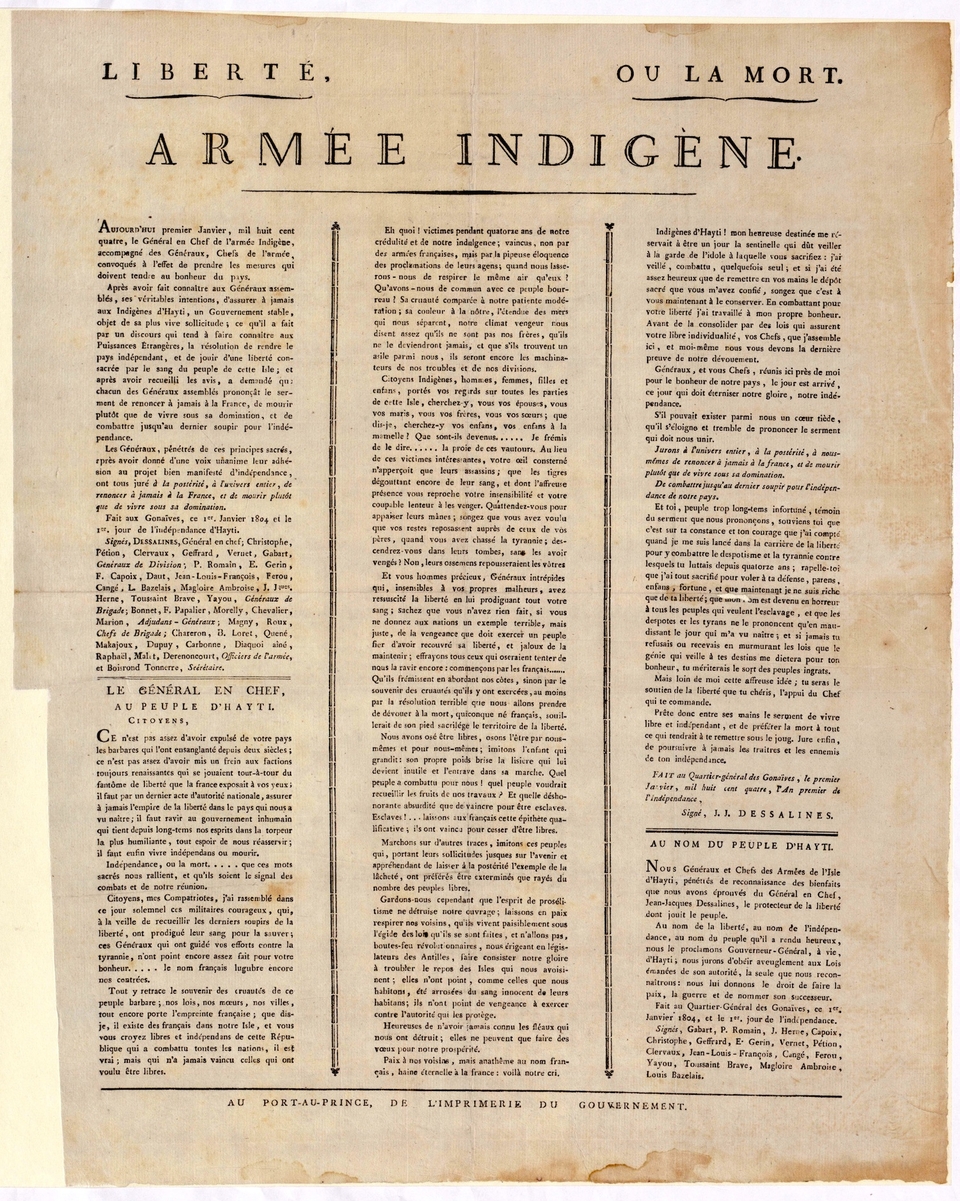
 Unknown author — Public Domain, Wikimedia Commons 1804
 Haiti declared independence from France following the Haitian Revolution, becoming the world's first black-led republic and the first independent nation in Latin America.
Sources: Encyclopedia Virginia ; Library of Congress, Latin American, Caribbean and European Division ; Office of the Historian, U.S. Department of State
Independence  Photo by Elliott & Fry — Public Domain, Wikimedia Commons 1900
 Nigeria came under direct British colonial control as the Royal Niger Company surrendered its charter and its territories were reorganised into separate Northern and Southern protectorates. Frederick Lugard, the northern protectorate's first high commissioner, took over the administration from the company and hoisted the Union flag at Lokoja that morning.
Sources: Britannica ; His Majesty's Stationery Office (Colonial Reports, Annual No. 346), digitised by University of Illinois Library ; African Study Monographs (Kyoto University), vol. 11 no. 3, 1990
Politics  Public Domain, Wikimedia Commons
1956 Sudan gained independence from Anglo-Egyptian condominium rule, becoming a sovereign republic with Ismail al-Azhari as its first prime minister.
Sources: Britannica ; Office of the Historian, U.S. Department of State ; U.S. Library of Congress, Federal Research Division (Country Studies series)
Independence  White House Photographic Collection — Public Domain, Wikimedia Commons 1960
 Cameroon gained independence from France, raising its new tricolor flag at Yaoundé; Ahmadou Ahidjo went on to become the country's first president.
Sources: Britannica ; Office of the Historian, U.S. Department of State ; United Nations, Repertory of Practice of United Nations Organs ; The Washington Post
Independence  Unknown photographer — Public Domain, Wikimedia Commons 1964
 The Federation of Rhodesia and Nyasaland ceased to exist, dissolved by an Order in Council with effect from immediately before January 1, 1964, splitting into Southern Rhodesia and the territories that would soon become independent Zambia and Malawi.
Sources: UK Statutory Instruments ; Encyclopaedia Britannica ; Hansard, UK Parliament (House of Lords)
Politics 2011 A bomb exploded outside a Coptic Christian church in Alexandria, Egypt, as worshippers left a New Year service, killing 21 people, the toll given by the United Nations and by wire reports that day; some accounts put it at 23.
Sources: France 24 ; Al Jazeera ; Office of the Spokesperson for UN Secretary-General Ban Ki-moon (United Nations)
Tragedy 2013 A crush among crowds leaving a government New Year fireworks display at the Félix Houphouët-Boigny Stadium in Abidjan, Ivory Coast, killed 64 people by the count Ivorian officials gave the following week and injured more than 200. Rescue officials had first put the dead at 61, most of them children between 8 and 15.
Sources: Al Jazeera ; Associated Press (via Fox News) ; NBC News / Reuters
Tragedy  Unknown author — Public Domain, Wikimedia Commons 2009
 Helen Suzman, South African anti-apartheid activist and long-serving opposition member of parliament, died at age 91.
Sources: South African History Online ; Nelson Mandela Foundation
Death  Nesnad — Public Domain, Wikimedia Commons 1967
 The first-ever Kwanzaa, the African American cultural celebration created by Maulana Karenga, concluded on its seventh and final day, marking the principle of Imani (faith).
Sources: Smithsonian National Museum of African American History and Culture ; HISTORY (A&E Television Networks)
Culture