
Aksum, the Red Sea Kingdom of the Ethiopian Highlands
By Princewill Ubani · Published · Updated
Research ID: PA-POL-aksum
The highland kingdom that ruled northern Ethiopia and Eritrea for six centuries, minted gold coins, fought wars in Yemen and made Christianity its court religion in the fourth century.
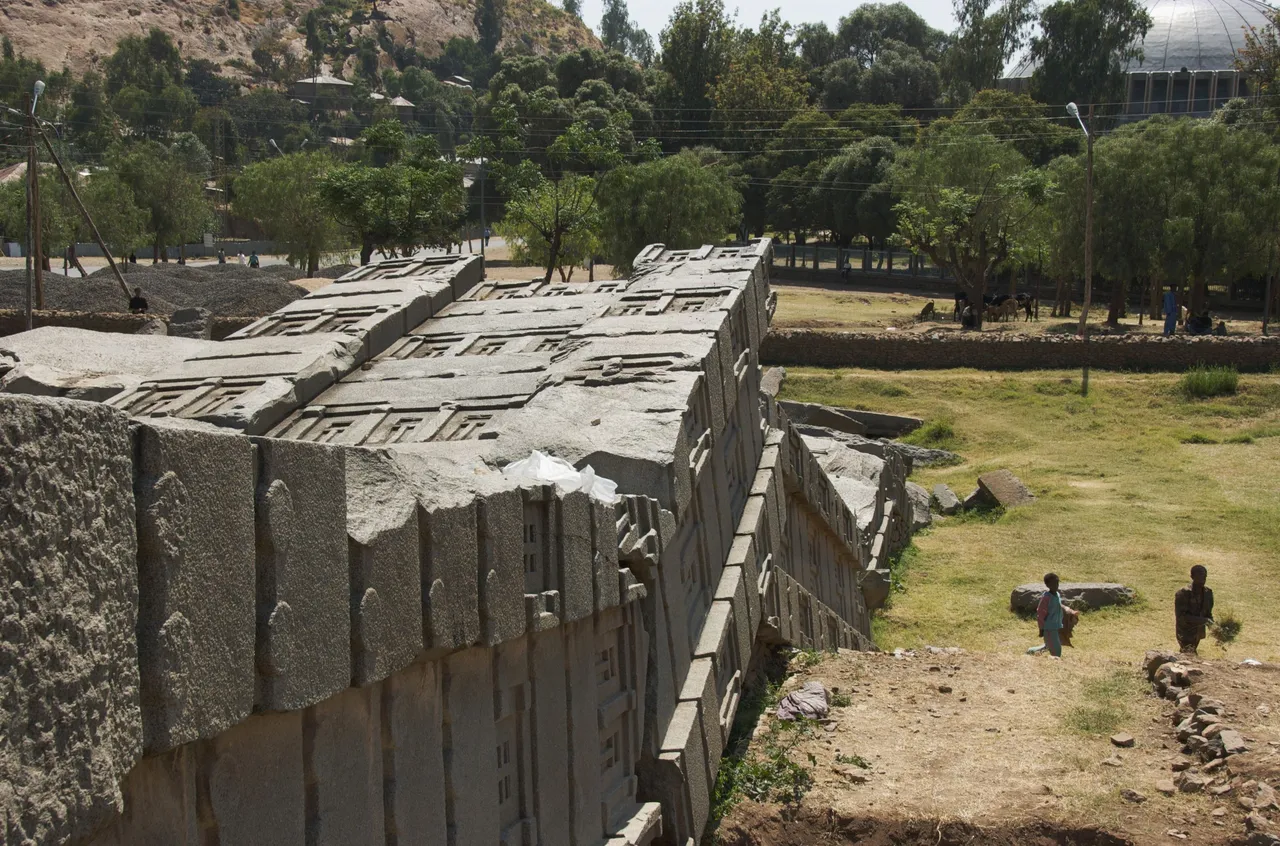
Some time around the middle of the fourth century AD, workers at Aksum in the highlands of northern Ethiopia tried to raise a carved stone shaft beside a royal tomb. The stone was 33 meters long and weighed about 520 tonnes, and its faces were carved to look like a building 13 stories high. In the reading of archaeologist David Phillipson, it fell and broke as it went up, and he calls it probably the largest single block of stone that people anywhere have tried to set on end, though not the longest.1 Bertrand Poissonnier, who excavated beside it in 1999, argues instead that the stone was properly erected and stood upright until it was deliberately pulled down, perhaps for political or religious reasons.2
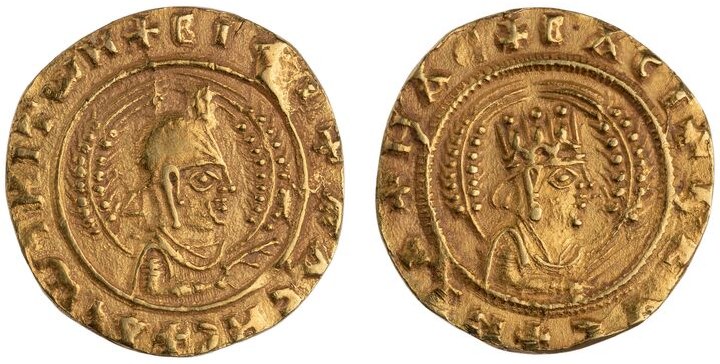
No king of Aksum tried again. Around the same time, the kingdom’s coins dropped the crescent and disc of the old gods for a cross, and King Ezana began to credit his victories to the Christian God. Phillipson has suggested that the failed stone may have been read as an omen against the old religion.3
Aksum ruled the highlands of Tigray and Eritrea, and the Red Sea port of Adulis, for most of the first seven centuries AD. Its kings minted coins in gold, silver and bronze, sent armies into Yemen, wrote in Ge’ez and Greek, and made Christianity the religion of their court. The Persian prophet Mani, who died in 276 or 277, was reported by his followers to have named it one of the four great kingdoms of the world, beside Persia, Rome and a fourth that may have been China.4
Before Aksum
Aksum grew from older roots. From about the fifth century BC, by the evidence of their letter forms, rulers in the northern highlands left inscriptions in a script and style shared with the kingdom of Saba in southern Arabia. Some took the title mukarrib, a South Arabian word for a ruler with priestly duties, and called themselves rulers of D’MT and Saba. Four rulers of D’MT are known by name.5 The great temple at Yeha, built in this period, still stands, and archaeologists have attributed some 90 sites to this pre-Aksumite period.6
Scholars once read this material as the work of Arabian colonists ruling over local people. Munro-Hay concluded that by the time the inscriptions were carved, most of it represented the civilization of the Ethiopians themselves, with South Arabian contacts adding writing, dressed-stone building and perhaps iron working.7 Phillipson likewise stresses that the basic economy and technology of Aksum grew out of local developments of the first millennium BC.8
The D’MT kingdom left no clear heir. For several centuries before Aksum’s rise the record is thin, with no large towns, sanctuaries or inscriptions, a gap Munro-Hay calls an Ethiopian “Dark Age.”9 The nearest forerunner of the capital was a hilltop community on Beta Giyorgis, just above the later town.10
A town below the hill
Phillipson dates the start of Aksumite civilization to a move downhill, when a new settlement grew in the valley between Beta Giyorgis and Mai Qoho, probably in the first half of the first century AD. Rodolfo Fattovich and Kathryn Bard, who excavated on Beta Giyorgis, put the beginning much earlier, around 400 to 350 BC; Phillipson rejects that view.11 The oldest dated features at Aksum itself are stone platforms in the burial ground, set up in the first century AD by radiocarbon dating.12
The site had much to offer. It sat at about 2,100 meters, with rains from late June to early September and some of the best plow land in the region.13 Routes ran west down the Mareb and Tekeze valleys toward the Nile, and Munro-Hay reckoned the town’s first importance came from these interior routes. Phillipson adds ivory: elephants still roamed central Tigray or south-central Eritrea in the sixth century, and by the third century the export of their tusks contributed greatly to Aksum’s wealth.14
Aksum was never a walled city. Phillipson describes it as a loose spread of buildings and burial grounds with no clear edge, and no Aksumite town has yielded a defensive wall.15
The Periplus of the Erythraean Sea, a Greek guide to the ports of the Red Sea and Indian Ocean compiled by an unknown author in Roman Egypt in the mid-first century AD, describes the region. It names the “metropolis” of the Aksumites, the port of Adulis and a ruler called Zoscales, whom it describes as miserly but acquainted with Greek literature.16 Scholars disagree about who he was. Munro-Hay treats him as Aksum’s earliest known king; Phillipson argues that the text never says he ruled at Aksum and that he probably ruled the coast around Adulis.17
Adulis was Aksum’s door to the sea, eight days’ journey from the capital according to the Periplus and 12 according to the sixth-century historian Procopius.18 The Periplus lists what ships landed there: cloth, glass, brass and copper vessels, iron, wine and olive oil, with cloaks and gold and silver ware “for the king.”19 Ivory, tortoiseshell and rhinoceros horn were among the exports.20
Kings of kings
The earliest king of Aksum who can be securely dated is named on a copper-alloy object found in a cache at Addi Galamo in eastern Tigray. Its inscription reads “GDR, king of Aksum,” and the letter forms place it around AD 200.21
By then Aksum was fighting across the Red Sea. Inscriptions from southern Arabia, written by Aksum’s allies and enemies there, record Aksumite kings they called Gadarat, ‘Adhebah, Datawnas and Zaqarnas. Between about 200 and 270, Hatke writes, Aksum allied with and fought against both Saba and Himyar, kept a governor at Najran, stationed garrisons on the coastal plain and once held the country around the Himyarite capital, Zafar, for seven months.22 A Himyarite victory ended this first venture. By the 270s Himyar had annexed Saba, and no further Aksumite campaigns in Arabia are recorded until the sixth century.23
At home, Aksum absorbed its neighbors. Inscriptions at Anza and Safra in the east name small kingdoms of their own in the first three centuries AD, and the Anza stela records a gift of 520 containers of beer and 20,620 loaves.24 Conquered peoples often kept their rulers, who paid tribute to Aksum; some whole populations were moved. The Aksumite king took the title “king of kings,” which Ethiopian rulers used until the death of Emperor Haile Selassie.25
The boldest claims come from a lost inscription on a marble throne at Adulis, copied by the Greek merchant Cosmas around 518 to 520. Its unnamed king says he subdued peoples from the snowy Simien mountains to the waterless plains of the east, and across the sea, and calls himself “the first and only of the kings my predecessors” to do so.26 Hatke places it among the third-century Arabian wars. Phillipson, following the French historian Francois-Xavier Fauvelle-Aymar, doubts it was Aksumite at all and suggests an earlier coastal kingdom.27
Gold, silver and bronze
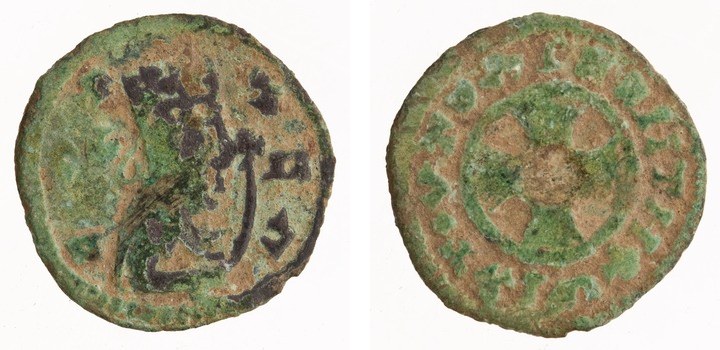
Around 270 to 290, King Endubis struck Aksum’s first coins, in gold, silver and bronze, modeled on Roman weights and inscribed in Greek.28 Munro-Hay writes that no other state south of the Sahara issued coins until the sultanate of Kilwa, perhaps in the 10th century.29 Phillipson ties the coinage to a surge of wealth in the second half of the third century, the same period in which Mani named Aksum among the world’s great kingdoms.30 The ivory boom helps explain it. Emperor Diocletian’s price edict of about 301 records a fall in the price of ivory, which Phillipson reads as a sign that supply from Africa, much of it from Aksum, had grown.31
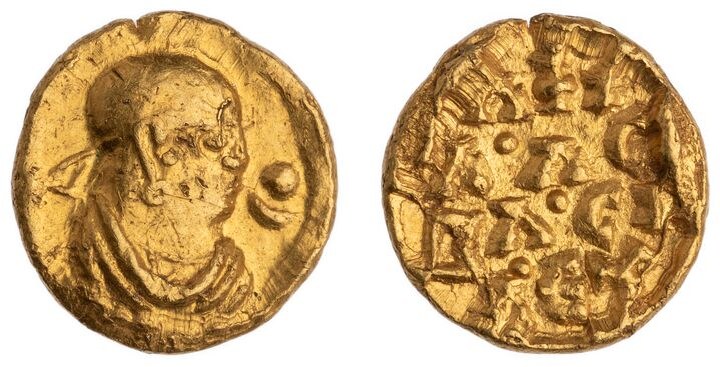
The coins are the backbone of Aksumite history. For about three centuries they name the kings in turn, and most kings of Aksum are known from nothing else.32 The gold, inscribed “king of the Aksumites,” was meant for foreign trade, and much of it has turned up in southern Arabia. Silver and bronze stayed at home, some inlaid with gold, a technique Munro-Hay calls remarkable.33
The stelae
The grandest tombs of the third and fourth centuries, almost certainly those of kings, lie under a terrace in what is now the Stelae Park at Aksum. Each was marked by a monolith quarried to the west of the town and dragged in.34 Six were carved as tower houses of many stories, with false doors, windows and beam ends in stone, and metal plaques at their tops.35
Three were giants. Stela 3, about 160 tonnes and 10 stories, still stands. Stela 2, about 170 tonnes and 24.6 meters long, was deliberately undermined, Phillipson writes, perhaps toward the end of the first millennium. Poissonnier, who excavated its foundation in 1999, found a trench dug beneath it by robbers looking for treasure and, at the edge of their digging, a coin of King Gersem issued around 600. He reads the fall as an accident of the robbers’ work, in the seventh century.36 In 1937, during the Italian occupation of Ethiopia, its pieces were shipped to Rome on Mussolini’s personal order and set up there. A 1947 treaty required Italy to return looted Ethiopian antiquities, but the stela came home only in 2005.37 Stela 1 is the one that fell. Beside it lay a tomb known as the Mausoleum, with 10 side chambers, dated to about the middle of the fourth century. He thinks it held the last king buried in the old way, most likely Ezana or his immediate predecessor.38
After Stela 1 fell, the kings stopped raising stelae. By the sixth century, elite tombs were topped by chapels of Christian form.39 At Berik Audi, outside the town, the archaeologists Marlies Wendowski and Helmut Ziegert found a small chapel built over the grave of a pagan king and later enlarged into a church with a baptistery.40
Ezana
Ezana left more inscriptions than any other king of Aksum. His father, in the accounts of Phillipson and Hatke, was Ousanas, known on the throne as Ella Amida, who reigned roughly from 310 to 330, and Ezana came to power young, around 330, with his mother acting as regent.41 The historian Aaron Michael Butts has since argued from the inscriptions that Ousanas was the son of an Ella Amida, and so “likely Ezana’s older brother.”42 Of the nine inscribed royal stones known at Aksum, seven are attributed to him, some only tentatively. Two are trilingual, carrying the same text in Greek and in two scripts of Ge’ez, and stood by the roads into the capital. The British traveler Henry Salt recorded the first in 1805; farmers found the second in 1981.43
The early inscriptions call Ezana “son of the unconquered Mahrem,” the war god the Greek versions render as Ares. His titles claim much more: king of Aksum, of Himyar, Raydan, Saba and Salhen across the sea, of Tsiyamo, the Beja and Kasu, “king of kings.”44 The Arabian titles were not real. Munro-Hay concludes that Ezana did not control any Arabian kingdom, and Phillipson endorses the view of historian G. W. B. Huntingford that the titles were kept as a reminder of former greatness.45
The trilingual stones record a revolt of the Beja, a people of the lands east of the Nile, north of Aksum. Saiazana and Adefan, whom the texts call Ezana’s brothers and Phillipson thinks were more likely his commanders, brought back six chiefs and their people, 4,400 in all. They were fed 22,000 loaves a day for four months and settled at a place called Matlia, and one version of the text gives the six chiefs 25,140 cattle between them. Ezana gave Mahrem one statue of gold, one of silver and three of bronze.46 No one knows where Matlia was.47
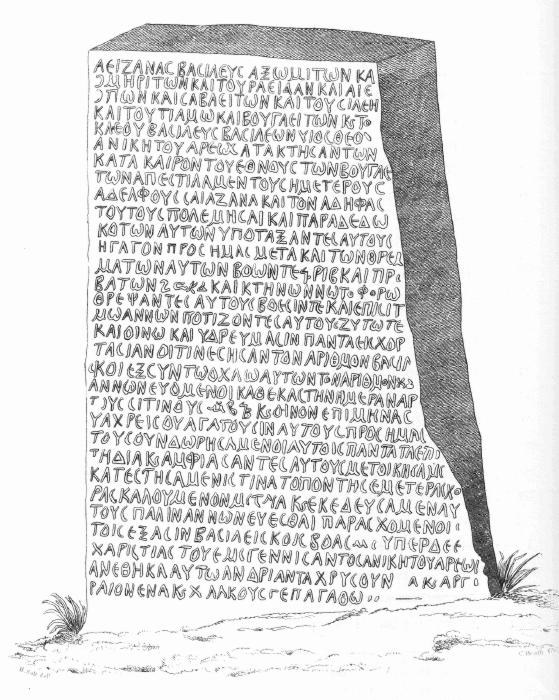
A later inscription tells of a war against the Noba, a Nubian-speaking people who had gained power in the middle Nile valley by the fourth century. Several peoples on Aksum’s western edge had asked for help against them, and the Noba had mistreated Ezana’s envoys and boasted, “They will not dare to cross the Takaze.” Ezana fought them at the river, chased them for 23 days, and reached the Kasu, the people of the old kingdom of Kush, where the Takaze meets a river the inscription calls the Seda.48 He counted 758 dead and 629 prisoners, and took 10,560 cattle and 51,050 sheep.49
The campaign is sometimes said to have destroyed Meroe, Kush’s capital. Hatke argues that it was aimed at the Noba and that Ezana’s texts claim no final blow against Kush.50 The site’s Kush page sets out the same debate from the Nile side.
The king’s new faith
The story of how Christianity reached the court comes from Rufinus, a Latin church historian writing near the end of the fourth century, who said he had it from one of the men involved. A philosopher of Tyre named Meropius, sailing home from “India,” put in at a port where, because a treaty with Rome was reported broken, the local people killed everyone on board except two boys, Frumentius and Aedesius. The boys were taken to the king, who made Aedesius his cupbearer and Frumentius his treasurer and secretary. When the king died, his widow asked them to help govern until her young son came of age. Frumentius sought out Christian merchants and helped them build places of prayer. Later he went to Alexandria to ask for a bishop, and the patriarch Athanasius consecrated Frumentius himself.51
Rufinus names no king and no kingdom, and he never says the king converted. Later evidence makes Aksum near certain, and the Ethiopian church reveres Frumentius as Abba Salama, its founder.52 The king who died is usually taken to be Ousanas, and the boy king Ezana.53
Ezana’s own records show a gradual change. The coins drop the crescent and disc for a cross. The inscriptions move from Mahrem to a “Lord of Heaven,” a phrase also used by non-Christian believers in one god in southern Arabia at the time, and then, in one Greek text, to the Father, Son and Holy Spirit, with Ezana calling himself “servant of Christ.”54 The Greek versions are more openly Christian than the Ge’ez ones, and Phillipson suggests that Ezana publicized his faith more to foreign readers than to his own subjects.55
An outside source shows that Rome believed Frumentius was bishop at Aksum by the 350s. In 356 or 357 the Roman emperor Constantius II, who favored the Arian side in the church’s quarrels, wrote to Ezana and a second ruler called Sazana, asking them to send Frumentius to Alexandria to be examined by the Arian bishop George of Cappadocia. Athanasius preserved the letter. There is no sign it had any effect.56
The date of Ezana’s conversion is disputed. Munro-Hay argued for about 333 from the weight of Ezana’s first Christian gold coins; Hatke accepts the Ethiopian church’s traditional date, equal to 340 or 341, as a floor; Phillipson puts it between 337 and 350.57 Butts questions the sequence these dates are fitted to. “The proposed three-step linear conversion of Ezana has several problems,” he writes: the Greek text of one supposedly pagan inscription already names a Lord of Heaven and Earth, and Ezana put crosses only on his gold, the coinage meant for foreign readers, never on his silver or copper.58 Hatke dates the start of the Nubian campaign, whose inscription is explicitly Christian, most likely to March 360.59
Christianity spread slowly beyond the court. For a century or more it stayed largely confined to areas under direct royal control, Phillipson argues, and crosses became common on ordinary household pottery only in the late fifth and early sixth centuries.60 Ethiopian tradition credits missionaries known as the Nine Saints, from the eastern Roman empire, with carrying the faith into the countryside in the late fifth century; the historian Pierluigi Piovanelli counts the leading role long given to Syrian refugees in that century among old scholarly opinions that are “still uncritically repeated.” The monastery of Debre Damo, which traces its founding to one of them, probably dates to the sixth century.61 The Bible was put into Ge’ez in this period, and the Garima Gospels, illuminated books kept at a monastery near Adwa, have been dated by radiocarbon to at least the sixth or seventh century.62
Kaleb and the war in Yemen
The next king to leave a large mark was Kaleb, also called Ella Atsbeha, who reigned from about 510 into the 540s. His inscription at Aksum names his father, Tazena, and thanks God for setting him on “the throne of my fathers.”63
In southern Arabia a ruler named Yusuf As’ar Yath’ar, remembered by Arab writers as Dhu Nuwas, followed a form of monotheism that Christian writers called Jewish. In the early 520s he attacked Zafar, killed many of the Aksumites there and burned the church, then besieged the Christian town of Najran and burned many of its people in their church.64 The Byzantine emperor Justin, through the patriarch of Alexandria, urged Kaleb to act. A fleet gathered at the port of Adulis, some of its ships built there and others sent from ports further north, and Kaleb’s army landed in Arabia and defeated Yusuf, who was killed.65 The dates are unsettled. Cosmas dated the first preparations to the start of Emperor Justin’s reign in 518, and scholars place the main invasion anywhere from about 520 to about 530.66
Kaleb left a Christian Himyarite, Sumyafa’ Ashwa’, as his client king. Later Sumyafa’ Ashwa’ was deposed, with the backing of Aksumite troops who had stayed in Yemen, and a man named Abraha took his place. Procopius wrote that Kaleb sent 3,000 men under a relative to punish Abraha, but they killed their leader and joined him; a second army was beaten.67 Abraha ruled Yemen for two decades or more, repaired the great dam at Marib and built a church at Sanaa, and after Kaleb’s time he paid tribute to Aksum’s new king.68 Munro-Hay called the Yemen war “Aksum’s swan-song as a great power.”69
Justinian, emperor from 527, sent envoys to Kaleb around 530 to seek help against Persia. The report of one of them, Julian, preserved in the chronicle of John Malalas, is the only surviving description of an Aksumite king’s appearance: dressed in gold-threaded linen, standing on a carriage drawn or carried by four elephants, holding a small gilded shield and two gilded spears, surrounded by his council and flute players.70
Ethiopian tradition says Kaleb gave up his throne, sent his crown to the Church of the Holy Sepulchre in Jerusalem and retired to a monastery. Phillipson places the abdication probably in the 540s.71 By the 570s Persia held much of southern Arabia.72
The move east
By the middle of the sixth century, decline showed around Aksum. In Phillipson’s reading the population of the capital area fell sharply, with great houses taken over by squatters and the coinage losing quality; the gold was debased faster in the third quarter of the century.73 Growth in the fourth and fifth centuries had used up the timber on the hills, and Munro-Hay describes eroded, overworked fields around the town.74 Munro-Hay thought Aksum may have suffered from the plague that reached Egypt in 541; Phillipson finds no evidence of it there.75
Trade failed too. With Himyar in Persian hands from the 570s, and later under Arab rule, Aksum lost free passage for its exports to the north. Ivory may have been getting harder to find: around 530 a Byzantine envoy saw a herd he put at 5,000 elephants near a place called Aue and noted that local people were forbidden to harm them.76 The last kings to strike coins, Armah and Gersem, issued poorer pieces; Armah struck no gold at all.77
The kingdom was still Christian when the first Muslims arrived. In 615, according to Muslim historians, a group of Muhammad’s followers left Mecca for Ethiopia, and a larger group of 101 followed. The Ethiopian king, whom Arab writers call Ashama ibn Abjar, refused the Quraysh’s demand to hand them over. He died in 630.78 These accounts were written down two or three centuries later, and no trace of the episode has been found in the archaeological record or in Ethiopian Christian tradition.79
In the first half of the seventh century the kings left Aksum. Arab geographers of the ninth and tenth centuries name the king’s town as Ku’bar, a place not yet identified, and describe a large and powerful Christian state. The kingdom’s center of gravity shifted to eastern Tigray, where churches were carved from the rock in the following centuries.80 Phillipson describes the abandonment of Aksum as “not an end, but a transition.”81
The old capital survived as a holy city. In the eighth or ninth century a ruler named Dana’el had an inscription cut on a throne base there which, on one reading, claims he subdued a “king of Aksum.”82 Tradition blames a queen, Gudit, for sacking the city and toppling stelae in the 10th century. Phillipson finds the evidence at Stela 2 not incompatible with that tradition; Poissonnier’s coin puts its fall about three centuries earlier.83 The Zagwe dynasty took power around 1137 by Munro-Hay’s reckoning, a date he calls long disputed; Taddesse Tamrat put it about 1150 and David Phillipson in the 11th century or earlier. The Solomonic kings who followed in 1270 claimed descent from Aksum’s kings, and several were crowned at Aksum.84
How we know
Aksum wrote about itself. Its kings left inscriptions on stone in Greek and Ge’ez, now collected in the Recueil des inscriptions de l’Ethiopie; a German expedition led by Enno Littmann recorded those known in 1906.85 The coins give a sequence of kings for about three centuries.32
Outsiders add the rest: the Periplus, the Greek geographer Ptolemy, Mani’s followers, Rufinus, Constantius II’s letter, Cosmas, Procopius and the Byzantine envoys, South Arabian inscriptions, Syriac texts on the Himyar war, and Arab historians.86 When Salt cleared the base of the first trilingual stone in 1805, Phillipson writes, he carried out the first known archaeological excavation in Ethiopia or Eritrea. The German expedition, and Italian and Swedish digs at Adulis, followed in 1906. Later work includes the British Institute in Eastern Africa’s excavations at Aksum under Neville Chittick in 1972 to 1974, and campaigns since at the stelae, at Beta Giyorgis and at sites across Tigray and Eritrea.87
Ethiopian tradition is harder to use. King-lists survive only in late copies that disagree with one another, and very few of the names on the coins appear in them.88 The Kebra Negast, which tells how the Queen of Sheba bore Solomon a son, Menelik, who brought the Ark of the Covenant to Ethiopia, took its present form in the early 14th century, though Phillipson finds older material in it.89 Tradition also credits the conversion to two kings, Abraha and Atsbaha, a pairing Phillipson and others trace to a confusion with Kaleb, called Ella Atsbeha, and the Abraha who ruled Yemen after Kaleb’s war.90
Much is still unsettled, from who Zoscales was to when Kaleb sailed. Even the kingdom’s size in people is a guess. The Soviet historian Yuri Kobishchanov put it at half a million at most; Munro-Hay judged that no valid figure can be made, though he thought that one probably too low.91
Notes
-
Phillipson 2012, pp. 48, 143. ↩
-
Poissonnier 2012, pp. 81-83. ↩
-
Phillipson 2012, p. 91 n. 2; for the coins and inscriptions, see the section on the king’s new faith below. ↩
-
Munro-Hay 1991, pp. 6, 17. ↩
-
Munro-Hay 1991, pp. 4, 62-64. ↩
-
Munro-Hay 1991, pp. 62, 199-200. ↩
-
Munro-Hay 1991, pp. 62, 66. ↩
-
Phillipson 2012, p. 48. ↩
-
Munro-Hay 1991, pp. 4, 40. ↩
-
Phillipson 2012, pp. 47, 69. ↩
-
Phillipson 2012, pp. 47, 69. ↩
-
Phillipson 2012, p. 70; Munro-Hay 1991, pp. 69, 266. ↩
-
Munro-Hay 1991, pp. 31, 35. ↩
-
Munro-Hay 1991, p. 33; Phillipson 2012, pp. 71, 196. ↩
-
Phillipson 2012, p. 49; Munro-Hay 1991, pp. 5, 45. ↩
-
Munro-Hay 1991, p. 17; Phillipson 2012, p. 65. ↩
-
Munro-Hay 1991, p. 69; Phillipson 2012, p. 73. ↩
-
Munro-Hay 1991, p. 30. ↩
-
Phillipson 2012, p. 197. ↩
-
Munro-Hay 1991, p. 6; Phillipson 2012, p. 196. ↩
-
Phillipson 2012, pp. 79-80. ↩
-
Hatke 2013, p. 43; Munro-Hay 1991, pp. 71-74. ↩
-
Munro-Hay 1991, p. 77; Hatke 2013, p. 43. ↩
-
Phillipson 2012, pp. 73-74; Munro-Hay 1991, p. 75. ↩
-
Munro-Hay 1991, pp. 4, 36; Phillipson 2012, p. 78. ↩
-
Phillipson 2012, p. 63; Munro-Hay 1991, pp. 5, 222-223. ↩
-
Hatke 2013, pp. 42-43; Phillipson 2012, pp. 63-64, 75. ↩
-
Phillipson 2012, p. 82; Munro-Hay 1991, pp. 75-76, 184. ↩
-
Munro-Hay 1991, p. 180. ↩
-
Phillipson 2012, p. 50. ↩
-
Phillipson 2012, p. 196. ↩
-
Munro-Hay 1991, pp. 3, 183-184. ↩
-
Phillipson 2012, p. 48; Munro-Hay 1991, p. 138. ↩
-
Phillipson 2012, pp. 48, 142. ↩
-
Phillipson 2012, p. 142; Poissonnier 2012, pp. 78, 83. ↩
-
Phillipson 2012, pp. 142-143. ↩
-
Phillipson 2012, p. 143. ↩
-
Phillipson 2012, pp. 48-49. ↩
-
Wendowski and Ziegert 2003, pp. 221-222. ↩
-
Hatke 2013, pp. 11, 90, 94; Phillipson 2012, p. 80. ↩
-
Butts 2025, pp. 20-21. ↩
-
Phillipson 2012, pp. 58-59, 62; Munro-Hay 1991, p. 77. ↩
-
Munro-Hay 1991, pp. 224-225; Phillipson 2012, p. 84. ↩
-
Munro-Hay 1991, p. 79; Phillipson 2012, p. 84, citing Huntingford 1989, p. 51. ↩
-
Munro-Hay 1991, pp. 224-225; Phillipson 2012, pp. 75, 83. ↩
-
Phillipson 2012, p. 76. ↩
-
Munro-Hay 1991, pp. 227-228; Phillipson 2012, p. 76; Hatke 2013, p. 97. ↩
-
Munro-Hay 1991, p. 228. ↩
-
Hatke 2013, pp. 92, 97. ↩
-
Munro-Hay 1991, pp. 17, 202-204; Phillipson 2012, p. 92. ↩
-
Phillipson 2012, pp. 92-93; Munro-Hay 1991, p. 207; Butts 2025, p. 22. ↩
-
Munro-Hay 1991, pp. 77, 204; Hatke 2013, p. 90. ↩
-
Phillipson 2012, pp. 95-97; Munro-Hay 1991, pp. 202, 229. ↩
-
Phillipson 2012, p. 97. ↩
-
Phillipson 2012, pp. 94-95; Munro-Hay 1991, pp. 17, 78. ↩
-
Munro-Hay 1991, pp. 78, 202; Hatke 2013, pp. 93-94; Phillipson 2012, pp. 97-99. ↩
-
Butts 2025, pp. 17-18, 25-26. ↩
-
Hatke 2013, pp. 94-97. ↩
-
Phillipson 2012, p. 99. ↩
-
Phillipson 2012, pp. 104-105, 222-223; Munro-Hay 1991, p. 207; Piovanelli 2018, pp. 7-8. ↩
-
Phillipson 2012, p. 102; Munro-Hay 1991, p. 208. ↩
-
Phillipson 2012, p. 82; Munro-Hay 1991, p. 230. ↩
-
Phillipson 2012, p. 204. ↩
-
Phillipson 2012, pp. 200, 204. ↩
-
Phillipson 2012, pp. 204-205; Munro-Hay 1991, pp. 85, 87; Hatke 2013, p. 43; Nebes 2010, pp. 42-43, 46-47; Beaucamp, Briquel-Chatonnet and Robin 1999-2000, pp. 76-77. ↩
-
Munro-Hay 1991, pp. 7, 87; Phillipson 2012, p. 205. ↩
-
Phillipson 2012, pp. 205-206. ↩
-
Munro-Hay 1991, p. 88. ↩
-
Phillipson 2012, pp. 85-87. ↩
-
Munro-Hay 1991, pp. 88-89; Phillipson 2012, p. 202. ↩
-
Phillipson 2012, p. 206. ↩
-
Phillipson 2012, p. 209. ↩
-
Munro-Hay 1991, p. 258; Phillipson 2012, p. 209. ↩
-
Munro-Hay 1991, p. 92; Phillipson 2012, pp. 206-207. ↩
-
Phillipson 2012, p. 210. ↩
-
Munro-Hay 1991, pp. 90-91. ↩
-
Munro-Hay 1991, pp. 18, 56. ↩
-
Phillipson 2012, p. 211. ↩
-
Munro-Hay 1991, pp. 96-97; Phillipson 2012, pp. 210-212, 223. ↩
-
Phillipson 2012, p. 211. ↩
-
Phillipson 2012, pp. 62-63, 212. ↩
-
Munro-Hay 1991, pp. 14-15; Phillipson 2012, pp. 142 n. 7, 212; Poissonnier 2012, p. 78. ↩
-
Munro-Hay 1991, pp. 19, 21, 23, 61, 94, 102; Taddesse Tamrat 1972, pp. 54-55; Phillipson 2012, p. 228. ↩
-
Phillipson 2012, pp. 57-58; Munro-Hay 1991, pp. 27-29. ↩
-
Munro-Hay 1991, pp. 16-18. ↩
-
Phillipson 2012, pp. 59, 69-70, 142; Munro-Hay 1991, pp. 25-29, 265. ↩
-
Phillipson 2012, p. 81; Munro-Hay 1991, p. 16. ↩
-
Phillipson 2012, pp. 66-67. ↩
-
Phillipson 2012, p. 103; Munro-Hay 1991, p. 205. ↩
-
Munro-Hay 1991, pp. 166-167. ↩
Where the estimates differ
| Estimate | Who holds it | Source |
|---|---|---|
| About 333 | Stuart Munro-Hay, from the weight standard of Ezana's first Christian gold coins | Munro-Hay 1991, pp. 76, 78, 202 |
| About 340 to 341, and no earlier | George Hatke, accepting the Ethiopian church's date of 333 in its own calendar | Hatke 2013, pp. 93-94 |
| Between 337 and 350 | David Phillipson | Phillipson 2012, pp. 97-99 |
| 347 to 349 | Wolfgang Hahn, in his later work, as reported by Phillipson | Phillipson 2012, p. 98 n. 38 |
| After 361, perhaps closer to 370 | Laszlo Torok, reading Constantius II's letter as addressed to pagan kings | Munro-Hay 1991, pp. 205-206; Hatke 2013, p. 91 |
| Not datable from the coins and inscriptions as they have been read | Aaron Michael Butts, who rejects the three-step sequence the other dates are fitted to | Butts 2025, pp. 17-26 |
| Estimate | Who holds it | Source |
|---|---|---|
| Around 520, with a viceroy until about 525 | Stuart Munro-Hay | Munro-Hay 1991, pp. 85, 87 |
| A first invasion in 518 | George Hatke | Hatke 2013, p. 43 |
| Preparations from 518; the main invasion after the Najran killings of about 522-523; withdrawal about 529-530 | David Phillipson, following de Blois, Beaucamp and Gajda | Phillipson 2012, pp. 204-205 |
| A first intervention probably around 519; the main invasion in 525, after the Najran killings of October and November 523 | Norbert Nebes, who follows Beaucamp, Briquel-Chatonnet and Robin for 519 and 523 | Nebes 2010, pp. 42-43, 46-47 |
| A first intervention perhaps in late 518 or 519; the Najran killings in November 523; Yusuf's defeat and death about 529 or 530 | Joëlle Beaucamp, Françoise Briquel-Chatonnet and Christian Julien Robin | Beaucamp, Briquel-Chatonnet and Robin 1999-2000, pp. 76-77 |
| Estimate | Who holds it | Source |
|---|---|---|
| About 400 to 350 BC, at Beta Giyorgis | Rodolfo Fattovich and Kathryn Bard | Phillipson 2012, p. 69 |
| The first half of the first century AD, when settlement moved to the valley below | David Phillipson | Phillipson 2012, pp. 47, 69 |
| About the beginning of the Christian era | Stuart Munro-Hay | Munro-Hay 1991, p. 69 |
| Estimate | Who holds it | Source |
|---|---|---|
| A king of Aksum in the first century AD | Stuart Munro-Hay, with the older consensus | Munro-Hay 1991, p. 69 |
| A ruler of the coast around Adulis, not of Aksum | David Phillipson, following Fauvelle-Aymar and others | Phillipson 2012, p. 73 |
Rulers of Aksum
| Ruler | Reign | Note |
|---|---|---|
| GDR | c. 200 | Earliest securely dated king of Aksum, named on a bronze object from Addi Galamo. |
| Endubis | c. 270 to 290 | First king to strike coins. |
| Aphilas | Late third or early fourth century | Known from his coins. |
| Wazeba | Early fourth century | Struck coins with Ge'ez legends instead of Greek. |
| Ousanas (Ella Amida) | c. AD 310 to c. AD 330 | Ezana's father in most accounts; Aaron Michael Butts argues he was Ezana's older brother. Frumentius probably reached Aksum in his reign. |
| Ezana | c. 330 to the 360s | Adopted Christianity; left more inscriptions than any other king. |
| MHDYS | Fifth century | Coins carry a Ge'ez version of Constantine's motto, "By this sign you will conquer." |
| Kaleb (Ella Atsbeha) | c. 510 to the 540s | Invaded Himyar in Yemen; abdicated. |
| WZB (Wa'zeb) | After 540 | Kaleb's son, known from one inscription. |
| Armah | Early seventh century | Among the last kings to strike coins; issued no gold. |
| Ashama ibn Abjar | Died 630 | The king who sheltered Muhammad's followers, in Muslim sources. |
Timeline
- c. AD 50 Aksum emerges
- c. AD 50 Capital at Aksum
- c. AD 310 Ousanas (Ella Amida) begins to rule
- c. AD 630 Capital at Ku'bar (location unknown)
- c. AD 630 The capital moves east from Aksum; the kingdom carries on under Christian kings
Corrections
Our Aksum page gave one archaeologist's account of how the great stelae fell as settled fact.It said Stela 1 broke as it was being raised and that Stela 2 was deliberately undermined, and linked Stela 2's fall to the tradition of a 10th-century queen, Gudit. Those are David Phillipson's readings (Phillipson 2012, pp. 142-143). Bertrand Poissonnier, who excavated beside both stones in 1999, argues that Stela 1 stood until it was pulled down, and that Stela 2 fell in the seventh century when treasure hunters dug beneath it, a date he takes from a coin of King Gersem found at the edge of their trench (Poissonnier 2012, pp. 78, 81-83). The page now gives both views.Corrected in September 2026. See the log entry.
Our Aksum overview has moved into the new Aksum page, and it dated Ezana's conversion too early.The overview at /history/articles/aksumite-empire-four-great-powers/ now redirects to the new state page. It dated King Ezana's conversion to Christianity to about 325-328. None of the sources we used allows a date that early: Munro-Hay argued for about 333 from Ezana's coins, Hatke for no earlier than 340-341, and Phillipson for 337-350 (Munro-Hay 1991, p. 202; Hatke 2013, pp. 93-94; Phillipson 2012, pp. 97-99). The new page sets out these estimates side by side.Corrected in September 2026. See the log entry.
Sources
- Stuart Munro-Hay. “Aksum: An African Civilisation of Late Antiquity”, Edinburgh University Press, 1991.
- David W. Phillipson. “Foundations of an African Civilisation: Aksum and the Northern Horn, 1000 BC-AD 1300”, James Currey, 2012.
- George Hatke. “Aksum and Nubia: Warfare, Commerce, and Political Fictions in Ancient Northeast Africa”, New York University Press, 2013.
- Aaron Michael Butts. “Ezana of Aksum: The First Christian African King”, Aethiopica 28, pp. 7-38, 2025.
- Bertrand Poissonnier. “The Giant Stelae of Aksum in the Light of the 1999 Excavations”, Palethnologie 4, pp. 49-86, 2012.
- Marlies Wendowski and Helmut Ziegert. “Aksum at the Transition to Christianity”, Annales d'Éthiopie 19, pp. 215-230, 2003.
- Norbert Nebes. “The Martyrs of Najrān and the End of the Ḥimyar: On the Political History of South Arabia in the Early Sixth Century”, in Angelika Neuwirth, Nicolai Sinai and Michael Marx, eds., The Qur'ān in Context, Brill, 2010.
- Pierluigi Piovanelli. “Aksum and the Bible: Old Assumptions and New Perspectives”, Aethiopica 21, pp. 7-27, 2018.
- Stuart Munro-Hay. “The Ge'ez and Greek Palaeography of the Coinage of Aksum”, Azania 19, pp. 134-144, 1984.
- Joëlle Beaucamp, Françoise Briquel-Chatonnet and Christian Julien Robin. “La persécution des chrétiens de Nagrān et la chronologie ḥimyarite”, ARAM 11-12, pp. 15-83, 1999-2000.
Further Reading
The sources above support the specific claims on this page. The works below are the scholarship behind them. Citations are given in full so readers can find them through a library or database; some are paywalled.
Peer-reviewed articles
- Fattovich, Rodolfo (2010). "The Development of Ancient States in the Northern Horn of Africa, c. 3000 BC-AD 1000: An Archaeological Outline." Journal of World Prehistory 23(3): 145-175. DOI: 10.1007/s10963-010-9035-1.abstract free
- Phillipson, David W. (2009). "The First Millennium BC in the Highlands of Northern Ethiopia and South-Central Eritrea: A Reassessment of Cultural and Political Development." African Archaeological Review 26(4): 257-274. DOI: 10.1007/s10437-009-9064-2.abstract free
- Bard, Kathryn A. et al. (2014). "The chronology of Aksum (Tigrai, Ethiopia): a view from Bieta Giyorgis." Azania: Archaeological Research in Africa 49(3): 285-316. DOI: 10.1080/0067270x.2014.943484.abstract free
- Phillipson, David (2003). "Aksum." Azania: Archaeological Research in Africa 38(1): 1-68. DOI: 10.1080/00672700309480357.abstract free
- Sernicola, Luisa; Phillipson, Laurel (2011). "Aksum's regional trade: new evidence from archaeological survey." Azania: Archaeological Research in Africa 46(2): 190-204. DOI: 10.1080/0067270x.2011.580146.abstract free
- Phillipson, Laurel (2006). "Ancient Gold Working at Aksum." Azania: Archaeological Research in Africa 41(1): 27-40. DOI: 10.1080/00672700609480433.abstract free
- D'Andrea, A. Catherine et al. (2008). "The Pre-Aksumite and Aksumite Settlement of NE Tigrai, Ethiopia." Journal of Field Archaeology 33(2): 151-176. DOI: 10.1179/009346908791071268.abstract free
- Harrower, Michael J. et al. (2019). "Beta Samati: discovery and excavation of an Aksumite town." Antiquity 93(372): 1534-1552. DOI: 10.15184/aqy.2019.84.abstract free
- Kaplan, Steven (1982). "Ezana's Conversion Reconsidered." Journal of Religion in Africa 13(2): 101-109. DOI: 10.1163/157006682x00087.abstract free
- Castiglia, Gabriele (2025). "Architecture, Liturgy, Chronology: Aksumite Christianity as a Cosmopolitan Paradigm (?) - The Case Study of Adulis (Eritrea)." Journal of Late Antiquity 18(2): 368-400. DOI: 10.1353/jla.2025.a969357.abstract free
- Pankhurst, Richard (1999). "Ethiopia, the Aksum Obelisk, and the Return of Africa's Cultural Heritage." African Affairs 98(391): 229-239. DOI: 10.1093/oxfordjournals.afraf.a008009.abstract free
- Butts, Aaron Michael (2025). "Ezana of Aksum: The First Christian African King." Aethiopica 28: 7-38. DOI: 10.15460/gfj9t143.
- Poissonnier, Bertrand (2012). "The Giant Stelae of Aksum in the Light of the 1999 Excavations." Palethnologie 4: 49-86. DOI: 10.4000/palethnologie.5778.
- Wendowski, Marlies; Ziegert, Helmut (2003). "Aksum at the Transition to Christianity." Annales d'Éthiopie 19: 215-230. DOI: 10.3406/ethio.2003.1044.
- Nebes, Norbert (2010). "The Martyrs of Najrān and the End of the Ḥimyar: On the Political History of South Arabia in the Early Sixth Century." in Angelika Neuwirth, Nicolai Sinai and Michael Marx, eds., The Qur'ān in Context, Brill undefined: 27-59. DOI: 10.1163/ej.9789004176881.i-864.9.
- Piovanelli, Pierluigi (2018). "Aksum and the Bible: Old Assumptions and New Perspectives." Aethiopica 21: 7-27. DOI: 10.15460/aethiopica.21.0.1161.
- Munro-Hay, Stuart (1984). "The Ge'ez and Greek Palaeography of the Coinage of Aksum." Azania 19: 134-144. DOI: 10.1080/00672708409511335.
- Beaucamp, Joëlle; Briquel-Chatonnet, Françoise; Robin, Christian Julien (1999). "La persécution des chrétiens de Nagrān et la chronologie ḥimyarite." ARAM 11-12: 15-83.
Books
- Kobishchanov, Yuri M. (1979). Axum. Pennsylvania State University Press.
- Hahn, Wolfgang; West, Vincent (2016). Sylloge of Aksumite Coins in the Ashmolean Museum, Oxford. Ashmolean Museum.
More on Aksum
Aksum: c. AD 50 to c. AD 630.