
By Princewill Ubani · Published
Research ID: PA-ART-1240647677290909696
Abebe Bikila Wins the 1960 Rome Olympics Marathon Barefoot
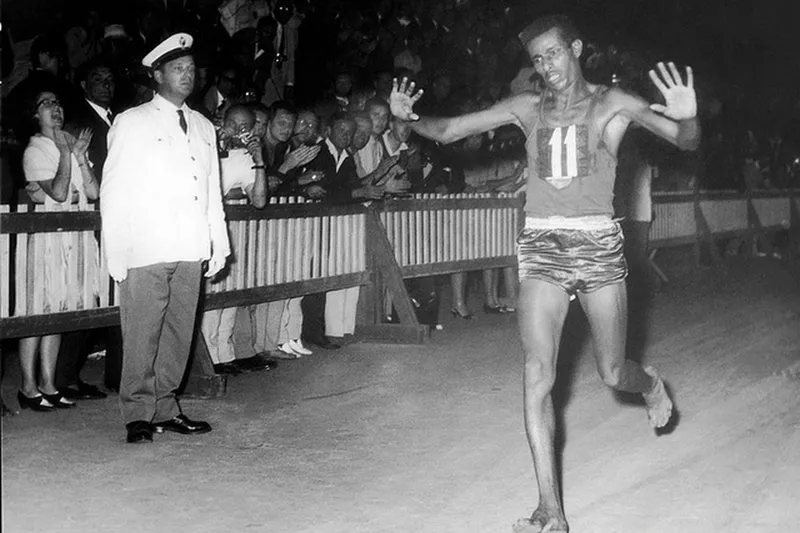
Abebe Bikila won the marathon at the 1960 Rome Olympics on September 10, running the entire 26.2 miles without shoes and crossing the finish line at the Arch of Constantine in a world and Olympic record time of 2 hours, 15 minutes and 16.2 seconds. He beat Morocco’s Rhadi Ben Abdesselem by roughly 25 seconds. Bikila had planned to race in shoes, but when his pair wore out in the final days before the event, a replacement pair he tried on gave him blisters, and he opted to run barefoot instead, a decision that became one of the defining images of the Games.
Bikila had come to competitive running by an unlikely path. Raised as a cattle herder in the countryside near Jatta, he joined Emperor Haile Selassie’s Imperial Bodyguard at 19 after visiting the palace in Addis Ababa, and discovered his talent for distance running through the guard’s exercise regimen. He moved from track events into marathon racing only in 1959, making Rome his first Olympic appearance and, by some accounts, only his second competitive marathon.
The Rome course carried an unmistakable historical weight for an Ethiopian runner. Part of the route passed the Obelisk of Axum, a 1,700-year-old monument that Italian forces had looted from Ethiopia and shipped to Rome in 1937, during the fascist occupation that followed Italy’s second invasion of the country. Bikila made his decisive break from the lead pack near the obelisk, going on to win in the capital of the country that had occupied Ethiopia a generation earlier.
His victory made him the first Black African to win an Olympic gold medal, a distinction that came just five days after Ghanaian boxer Clement “Ike” Quartey became the first Black African to win any Olympic medal, taking silver in the light-welterweight division at the same Games. Bikila went on to defend his marathon title four years later at the 1964 Tokyo Olympics, this time wearing shoes and setting another world record, becoming the first athlete to win two Olympic marathon gold medals. He died in 1973 after years of declining health following a car accident that left him paralyzed in 1969, but remains one of the most celebrated distance runners in Olympic history.
Sources
- “Remembering Bikila's 1960 Olympic marathon victory on its 60th anniversary”, World Athletics.
- “Abebe Bikila”, Britannica.
- “Boxer Quartey becomes first black African medalist”, Olympics.com.
Books & Further Reading
Paul Rambali, Barefoot Runner: The Life of Marathon Champion Abebe Bikila (Serpent's Tail, 2006, ISBN 9781852429041)