
By Princewill Ubani · Published
Research ID: PA-ART-abreha-atsbeha-church-adam-eve-mural
The Adam and Eve Mural of Abreha wa-Atsbeha, and What's Actually Known About Its Age
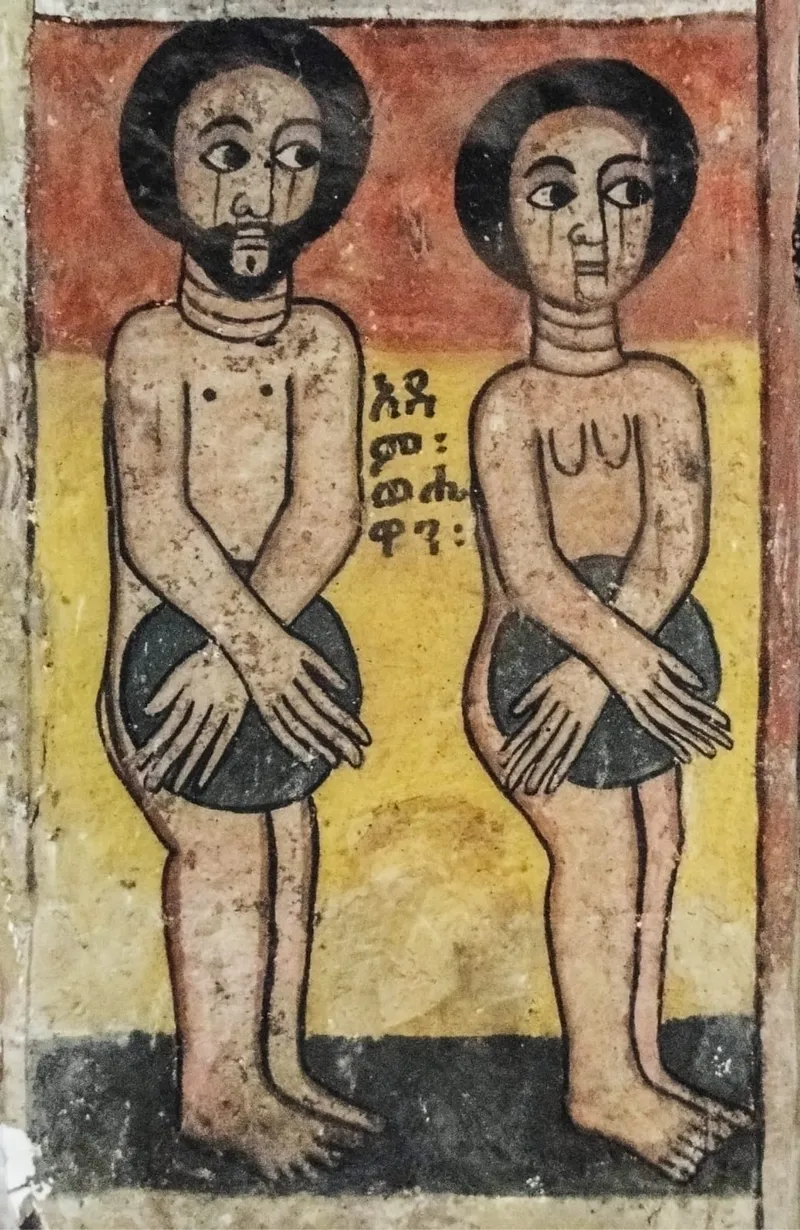
Deep in Ethiopia’s Tigray region, carved into a cliff face near the town of Wukro, the semi-monolithic church of Abreha wa-Atsbeha, also known as Debre Negast, “monastery of kings,” holds a striking interior mural: a depiction of Adam and Eve rendered in the flat, richly colored style characteristic of Ethiopian Orthodox religious art. Local tradition attributes the church itself to two 4th-century Axumite kings, Abreha and Atsbeha, generally identified with the historical rulers Ezana and Sayzana, who according to that account carved it directly into the mountain around 335 to 340 AD as part of the kingdom’s early conversion to Christianity.
The archaeological record complicates that founding legend considerably. Scholars who have studied the region’s rock-hewn churches, difficult to date precisely given restrictions on excavation at active religious sites, generally place their actual construction well after the 4th century, with estimates for the group as a whole spanning the 8th to the 15th century. For Abreha wa-Atsbeha’s interior decoration specifically, the murals most consistently cited date is the 12th century, a layer that art historians and travel researchers describe as the paintings’ earliest identifiable phase, with additional work added over subsequent centuries through the 17th and 18th. A claim sometimes repeated online, that the church or its Adam and Eve mural dates simply to “700 to 1000 AD,” lands within the broad range scholars allow for the structure’s excavation but does not match the more specific, more commonly cited 12th-century dating of the murals themselves, the two questions, when the rock was carved and when it was painted, are related but distinct, and popular retellings often collapse them into one.
The site’s significance isn’t in dispute: a rock-hewn church whose interior has carried images of the Christian creation story for centuries, standing among a cluster of similar churches across Tigray’s Gheralta region that together are among the oldest continuously used bodies of Christian architecture and art anywhere in Africa, regardless of exactly which century first put brush to its walls.
Sources
- “Mikael Muehlbauer, "An Italian Renaissance Face on a 'New Eritrea': The 1939 Restoration of the Church of Abreha wa-Atsbeha," Journal of the Society of Architectural Historians, Vol. 78, No. 3 (University of California Press)”.
- “The Rock-hewn Churches of Ethiopia”, SouthWorld.
- “Abreha wa Atsbeha church, Ethiopia”, Boris Kester (traveladventures.org).
Books & Further Reading
David W. Phillipson, Ancient Churches of Ethiopia: Fourth-Fourteenth Centuries (Yale University Press, 2009, ISBN 9780300141566)