
By Princewill Ubani · Published · Updated
Research ID: PA-ART-third-anglo-ashanti-war-burning-kumasi
The Third Anglo-Ashanti War and the Burning of Kumasi, 1873–1874
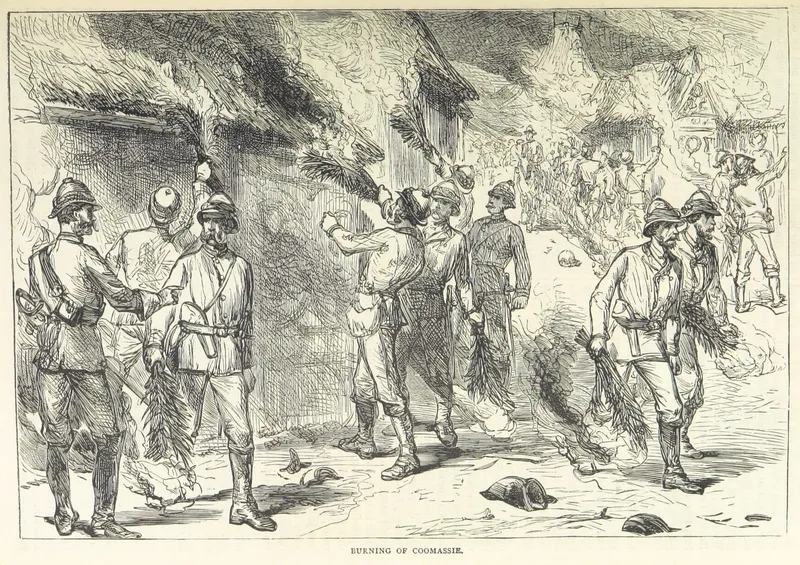
By the early 1870s, tension between Britain and the Asante kingdom over control of the Gold Coast had been building for decades. In 1872 Britain took possession of the coastal fort of Elmina, territory the Asante regarded as under their own jurisdiction, and in 1873 Asante forces moved to occupy the coastal provinces. Britain responded by sending an expeditionary force under Major-General Sir Garnet Wolseley, a campaign remembered among Asante and British troops alike as the “Sagrenti War,” an Asante rendering of Wolseley’s own name.
Wolseley’s force combined British regulars, including the Black Watch and the Rifle Brigade, with African and Indian troops, and carried advantages the Asante had not faced in earlier wars: quinine to reduce losses to malaria, more reliable modern rifles, and artillery. The decisive engagement came at the Battle of Amoafo on January 31, 1874. The Asante army, commanded by the Bantamahene Amankwatia, chose strong defensive ground in forest and swamp and fought with a discipline that impressed British officers: accounts describe close to one in ten British and allied soldiers hit by Asante gunfire during the fighting, and Amankwatia himself was killed directing the defense. But British firepower told: Asante losses are estimated in the range of 2,000 killed or wounded, against a few dozen British and allied dead, and the road to the Asante capital, Kumasi, lay open. A smaller follow-up engagement at Ordashu on February 4 cleared the last resistance on that road.
Kumasi’s rulers and residents abandoned the city before Wolseley’s column arrived later that same day, making a negotiated surrender in the field impossible. British troops occupied the largely empty capital, looted and destroyed the royal palace with explosives, and burned much of the city before withdrawing, a deliberate demonstration of force rather than an attempt at permanent occupation. Wolseley’s entire campaign, from landing to withdrawal, took roughly two months; he pulled his troops out before the onset of the rainy season, when disease historically inflicted the heaviest casualties on European forces in West Africa.
The war ended with the Treaty of Fomena, dated Feb. 13, 1874, and agreed by Asantehene Kofi Karikari. Its terms required Asante to pay a war indemnity of 50,000 ounces of gold, renounce claims to Elmina and other southern territory, and keep the road to the Pra open for free trade. On human sacrifice the Asantehene promised only to “use his best endeavours to check” it. Asante paid 1,000 ounces at once and never paid the rest. The treaty did not end Asante independence outright, but it broke the empire’s military parity with Britain and set the terms for the later conflicts that followed within a generation, ending in British annexation by an Order in Council of Sept. 26, 1901.
Corrections
Our article on the Third Anglo-Ashanti War said the Treaty of Fomena formally ended human sacrifice.The treaty, dated Feb. 13, 1874, has the Asantehene promise only to "use his best endeavours to check" the practice (Brackenbury 1874, vol. 2, pp. 268-270). The article also dated the annexation of Asante to 1902 instead of Sept. 26, 1901.Corrected in October 2026. See the log entry.
The Third Anglo-Ashanti War: the date of Ordashu.The engagement at Ordashu was placed two days after Amoaful. Amoaful was fought on January 31, 1874 and Ordashu on February 4, the same day British troops entered Kumasi.Corrected in September 2026. See the log entry.
Sources
- “Asante empire”, Britannica.
- “The 'Sagrenti War' and the 'Sacking of Kumasi'”, Edward A. Ulzen Memorial Foundation.
- “'Sir Garnet Wolseley entering Coomassie, 1874' collection record”, National Army Museum (London).
- “Anglo-Ashanti Wars: Origins, Causes & Aftermath, on the Battle of Amoafo and the burning of Kumasi”, World History Edu.
- “Isaac Junior Kwarteng, "Weaponizing Nature: Environment, Military Tactics, and the Anglo-Asante War of 1873-4," The Webster Review of International History 4:1 (2024), open-access academic article”.
Books & Further Reading
Stephen Manning, Britain at War with the Asante Nation 1823-1900: 'The White Man's Grave' (ISBN 9781526786029)