
By Princewill Ubani · Published · Updated
Research ID: PA-ART-battle-nsamankow-how-asante-killed-british
The Battle of Nsamankow: How the Asante Killed a British Governor
On This Day: January 21
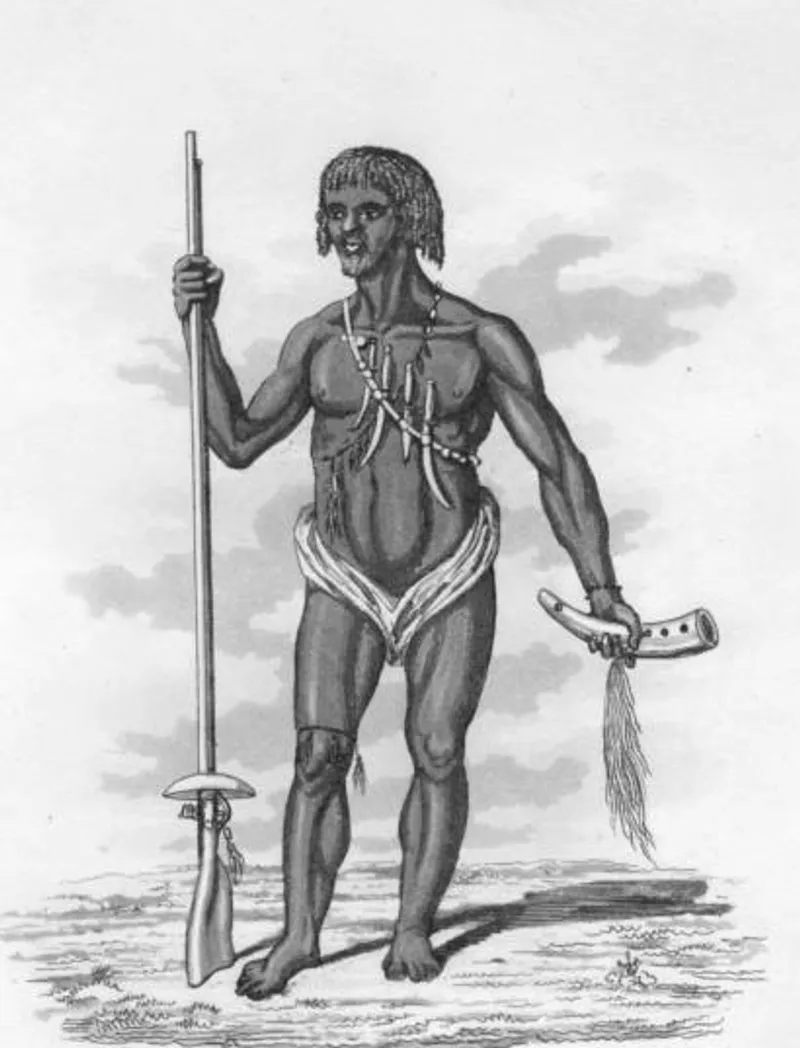
At the Battle of Nsamankow, fought on Jan. 21, 1824, an Asante army wiped out a British column and killed the governor of Britain’s West African settlements, a blow to imperial prestige that shaped British strategy on the Gold Coast for decades afterward.
The war grew out of a territorial dispute between the Asante kingdom and the Fante, a coastal people allied with Britain. When Sir Charles MacCarthy, the governor, rejected Asante claims in the disputed region, war followed. MacCarthy divided his forces into several columns meant to converge on the Asante army, but coordination between them broke down almost immediately. His own column, a few hundred regulars of the Royal African Colonial Corps and Cape Coast militia with irregular allies, pushed ahead alone through days of heavy rain and camped near a tributary of the Pra River. Carl Reindorf, the Gold Coast historian, put those irregulars at about 3,000.
Warned that a large Asante force was near, MacCarthy dismissed the danger. His brigade-major, Major Ricketts, recorded him saying the night before the battle that he “was determined to see how the Ashantees liked our balls.” At about 2 p.m. the next day an Asante army appeared that Ricketts was told numbered “considerably more than ten thousand men”; Reindorf later put it at nearly 20,000. In an odd overture, MacCarthy ordered his band to strike up “God Save the King,” and the Asante played back. The exchange settled nothing, and fighting broke out as Asante forces worked to cross the river.
The battle turned on a supply failure. Each man had 20 rounds, and by about 4 p.m. they were spent. The reserve ammunition never reached the line: its carriers refused to go on and most ran away, Ricketts wrote. With his allies fleeing and his men unable to return fire, MacCarthy was shot in the arm and then the chest, and was laid under a tree. Ensign Wetherell died beside him. MacCarthy’s secretary, J.T. Williams, was taken prisoner and, by his own account, was later locked up at night in a room with the preserved heads of MacCarthy, Wetherell and the engineer Buckle, kept by the Asante as trophies. Ricketts listed nine officers and officials killed and counted about 177 men killed, taken prisoner or lost in the woods.
Nsamankow did not end the war. Britain and Asante fought again several times over the next 76 years, until Asante was annexed in 1901. The kingdom’s full history is on our Asante page.
Correction
Our article on the Battle of Nsamankow said Governor MacCarthy probably killed himself and that his ammunition crates held macaroni.No source we read supports either story. The only eyewitness account of MacCarthy's last minutes, given by his secretary J. T. Williams and printed by MacCarthy's brigade-major, Major Ricketts, has him shot in the arm and chest and overrun, and Ricketts blames the ammunition shortage on carriers who refused to go on and ran away (Ricketts 1831, pp. 56-58, 82-83). The article gave the Asante army as 10,000; Ricketts was told it was considerably more than 10,000 and Reindorf put it near 20,000 (Ricketts 1831, p. 55; Reindorf 1895, p. 192). It also called the battle one of Britain's most lopsided defeats in West Africa, which we could not support, and dated the annexation of Asante to 1902 instead of 1901.Corrected in October 2026. See the log entry.
Sources
- “Battle of Nsamankow (Mathew Lyons)”, History Today.
- “Battle of Nsamankow”, World History Edu.
- “Ashanti war horn ('A trophy worth losing your head for'), on MacCarthy's death and the skull cup”, National Army Museum (London).
- “The Anglo-Ashanti Wars (1823-1900), on the wider conflict Nsamankow opened”, BlackPast.org.
- “How this Ashanti king led an army to defeat the British and behead a governor on this day in 1824”, Face2Face Africa.
- “Major Ricketts, Narrative of the Ashantee War (London: Simpkin and Marshall, 1831), the brigade-major's eyewitness account”, Internet Archive.
Books & Further Reading
Stephen Manning, Britain at War with the Asante Nation 1823-1900: 'The White Man's Grave' (ISBN 9781526786029)