
By Princewill Ubani · Published
Research ID: PA-ART-1150733584149504001
The Killing of a Dutch Governor and the Fall of Badu Bonsu II, 1837-38
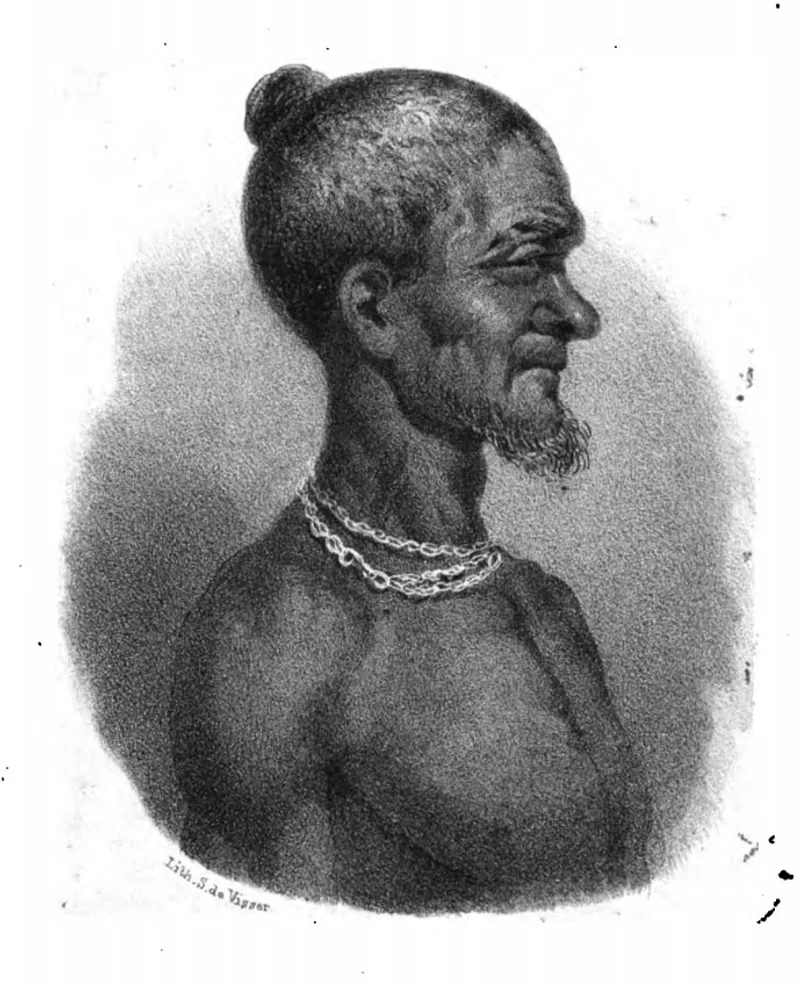
In October 1837, the Ahanta king Badu Bonsu II killed the Dutch official running the Gold Coast, an act that triggered a Dutch military expedition and ended, nine months later, with his execution and the removal of his head to a Dutch museum jar, where it stayed for the next 170 years.
The trouble began over a subchief. Badu Bonsu had sentenced Eteroe, a subordinate ruler at Sekondi, to death for secretly selling gunpowder to a rival kingdom in defiance of the king’s ban on arms sales to outsiders. Eteroe fled to Dutch protection at Elmina, where the matter reached Hendrik Tonneboeijer, the acting Dutch governor of the Gold Coast. When Badu Bonsu refused Tonneboeijer’s summons, fearing he would be shipped off as a slave, the governor sent two officials, Elmina commandant George Maasen and Fort Batenstein officer Adrian Cremer, to bring the king in by force. On October 23, 1837, at Butre, an attempt to arrest Badu Bonsu turned violent; the king’s men killed both officials and took their heads back to his palace at Busua.
Tonneboeijer marched into Ahanta territory himself to make the arrest. Badu Bonsu’s fighters met him near Takoradi on October 28, 1837, and killed the governor within minutes, along with a number of his men; some accounts say Tonneboeijer fled toward a nearby fort before being caught and killed at its gate.
News reached The Hague by late February 1838. King William I’s government dispatched General Jan Verveer, who landed at Elmina that May with roughly 200 troops and spent weeks recruiting several thousand additional fighters from Fante, Wassa, Sekondi and other coastal groups before marching on Ahanta at the end of June. According to Dutch historian Ineke van Kessel, the campaign ended without a major battle: Badu Bonsu’s own people, under pressure, handed him over to the Dutch in exchange for ten ounces of gold. After what colonial authorities called a trial, Badu Bonsu II was sentenced to death on July 25, 1838, and hanged two days later at Butre, on the same spot where Maasen and Cremer had been killed the previous October. A Dutch medical officer removed his head at Elmina Castle and preserved it in formaldehyde before it was shipped to the Netherlands; several other Ahanta leaders were hanged at Elmina that August, and more than a dozen surviving rebels were exiled to Dutch colonies in the Caribbean and East Indies.
Badu Bonsu’s head sat largely forgotten in a jar at Leiden’s anatomy collection until Dutch novelist Arthur Japin came across it in 2005 while researching a different book on Ahanta history. Its rediscovery, and a formal request from then-Ghanaian President John Kufuor, led the Dutch government to return the head to Ghana in a ceremony in The Hague in 2009, nearly 200 years after it had been removed. Ahanta’s kingship itself did not survive the war intact: Busua and Takoradi were largely destroyed, and the throne stood empty for roughly a decade before a new line of Ahanta kings was installed.
Sources
Books & Further Reading
Senam Okudzeto, "Emotive Histories: The Politics of Remembering Slavery in Contemporary Ghana," Atlantic Studies, vol. 9, no. 3 (2012), DOI 10.1080/14788810.2012.698098
Also posted once more between 2020 and 2019.