
By Princewill Ubani · Published · Updated
Research ID: PA-ART-anglo-ashanti-wars-century-resistance-gold
The Anglo-Ashanti Wars: A Century of Resistance in the Gold Coast
Between 1824 and 1900 the Asante (Ashanti) kingdom and Britain fought a series of wars on the Gold Coast, in what is now southern Ghana. How many depends on what is counted. The historian Ivor Wilks does not count the British occupation of Kumasi in 1896 as a war, because the Asante did not fight it. The kingdom’s full history, with its sources, is on our Asante page.
The first war grew out of Asante’s claims over the Fante, a coastal people allied with Britain. On Jan. 21, 1824, at the Battle of Nsamankow, an Asante army destroyed the column of Sir Charles MacCarthy, governor of Britain’s West African settlements, and MacCarthy was killed. His own column was a few hundred regulars and militia; the Gold Coast historian Carl Reindorf adds about 3,000 irregulars. On April 25, 1824, the Asante beat the British allies again near Efutu, and the troops fell back to Cape Coast. The fighting ended on Aug. 7, 1826, when an Asante army was routed at Katamanso on the Accra plains. Under a treaty of April 1831 the Asantehene sent a son and a nephew to Cape Coast as hostages and 600 ounces of gold as security.
A second war, from 1863 to 1864, began when an Asante force crossed the Pra in pursuit of a fugitive. The British force sent against it lost its men mostly to disease and was withdrawn in 1864, and no treaty was made.
In the third war, 1873-1874, British forces under Sir Garnet Wolseley, equipped with quinine to blunt malaria and modern weaponry including Snider-Enfield rifles, Gatling guns, and Armstrong breech-loading cannons, defeated the Asante at the Battle of Amoafo in January 1874, then occupied and burned the capital, Kumasi. The Treaty of Fomena, dated Feb. 13, 1874, set an indemnity of 50,000 ounces of gold and made Asante give up its claims over Elmina and several southern states.
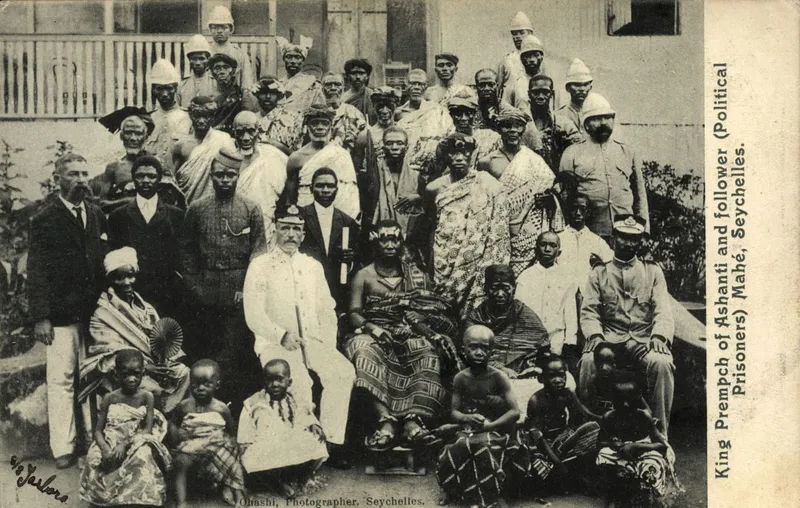
In January 1896 a British expedition entered Kumasi unopposed. On Jan. 20 Governor William Maxwell arrested Asantehene Agyeman Prempeh I, his mother and leading chiefs. They were held at Elmina, shipped to Sierra Leone at the start of 1897 and moved to the Seychelles in 1900.
The last war, the War of the Golden Stool, began in 1900 after Governor Frederic Hodgson told the Asante chiefs at Kumasi that the kingship was ended and demanded the Golden Stool, the kingdom’s most sacred object. Yaa Asantewaa, the queen mother of Edweso (Ejisu), led the fighting, which ended late that year; she surrendered in March 1901. An Order in Council of Sept. 26, 1901, annexed Asante to the British Crown. It was later governed with the Gold Coast, which became independent as Ghana in 1957.
British troops marched on Kumasi three times, in 1874, 1896 and 1900, before the kingdom was annexed.
Corrections
Our article on the Anglo-Ashanti Wars put MacCarthy's force at 2,500 and said the British were pushed back toward Sierra Leone.MacCarthy's own column was a few hundred regulars and militia, with about 3,000 irregulars by Reindorf's count (Wilks 1975, p. 174; Reindorf 1895, pp. 191-192), and after the defeat near Efutu in April 1824 the troops fell back to Cape Coast (Ricketts 1831, pp. 151-152). The article said the 1831 treaty fixed the Pra River as the boundary; the treaty text does not say so (Reindorf 1895, pp. 258-260). It said the Treaty of Fomena was made in July 1874; it is dated Feb. 13, 1874 (Brackenbury 1874, vol. 2, pp. 268-270). It said the 1896 expedition was driven by fear of France or Germany, which we could not support, and that Asante was annexed in 1900, when the Order in Council is dated Sept. 26, 1901. It also said the governor demanded to sit on the Golden Stool; the article now gives the record of his words and his wife's denial. The article now notes that historians count the wars differently and includes the 1826 battle of Katamanso.Corrected in October 2026. See the log entry.
The Asante Empire fought five wars against Britain, not four.One article's summary line said "four wars" while its own fact card and body both said "five," and a second article on the same site made the identical four-versus-five error against its own numbered list. Wikipedia's account of the Anglo-Ashanti Wars confirms five conflicts, 1823 to 1900. Both articles now say five throughout.Corrected in September 2026. See the log entry.
The Battle of Nsamankow: dated one day later in a passing mention than in our own dedicated article.A brief mention of the battle gave the date as January 22, 1824. This site's own dedicated article on the battle, sourced separately and in more depth, gives January 21, matching Wikipedia's account. The passing mention now matches it.Corrected in September 2026. See the log entry.
Sources
- “The Anglo-Ashanti Wars (1823-1900)”, BlackPast.
- “Asante empire”, Britannica.
- “Anglo-Ashanti Wars: Origins, Causes & Aftermath”, World History Edu.
- “Anglo-Asante Wars”, New World Encyclopedia.
- “Ashanti war horn, on the trophy taken during the First Anglo-Ashanti War”, National Army Museum (London).
Books & Further Reading
Stephen Manning, Britain at War with the Asante Nation 1823-1900: 'The White Man's Grave' (ISBN 9781526786029)