
Asante, the Forest Kingdom of Gold, c. 1700-1901
By Princewill Ubani · Published
Research ID: PA-POL-asante
The Akan kingdom built around Kumasi and the Golden Stool, from Osei Tutu's victory over Denkyira in 1701 to British annexation in 1901, and the kingship that was restored in 1935 and continues today.
In May 1701 the Dutch at Elmina heard of heavy fighting between Denkyira, then the strongest power in the forest behind the Gold Coast, and a people they wrote down as “the Assjantee.” By November the news was of a complete victory. The Denkyira, one Dutch writer reported, were “forced to fly before those, whom they not long before thought no better than their Slaves.”1 The winners were a coalition of small Akan states led by Osei Tutu, the ruler of Kumasi, and their victory at Feyiase that year is where the history of Asante as a kingdom usually begins.2
Asante lasted as an independent state for two centuries. At its height in the early 19th century the Asantehene, the king who sat on the Golden Stool at Kumasi, held a core of Akan states within about 30 miles of his capital, provinces that reached the sea, and tributaries in the northern savanna. The historian Ivor Wilks put the whole area of Asante ascendancy at some 125,000 to 150,000 square miles, on what he called a conservative estimate.3 Gold paid for it: gold dust was the currency in Kumasi, and the state drew its revenue from mining rents, tribute, trade and death duties.4
British forces burned Kumasi in 1874, arrested the Asantehene Agyeman Prempeh in 1896 and fought the last war of resistance in 1900. An Order in Council of Sept. 26, 1901, annexed the kingdom. The office of Asantehene did not end. Britain restored it in 1935, and it exists today.5
The forest before Asante
How old the farming communities of the Akan forest are is one of the open questions behind Asante. Ivor Wilks argued that farming replaced foraging in the forest between the Ofin and Pra rivers only in the 15th and 16th centuries, and that the change could happen so late because clearing forest needed labor the Akan did not have. They got it, in his reading, by exchanging gold for captives, first from the savanna and then from Portuguese ships. “I advance, contrary to his evolutionary view, a ‘big bang’ theory of Akan history,” he wrote, answering the colonial anthropologist R. S. Rattray.6
Archaeology has pushed the dates back. Gérard Chouin and Christopher DeCorse dated earthworks at Akrokrowa in southern Ghana to the eighth or ninth century and re-dated the earthwork series Wilks had relied on. “In the forest area that Wilks envisioned as being sparsely populated by bands of hunter-gatherers,” they wrote, “a network of fully formed agrarian settlements now comes to light.”7 Peter Shinnie’s excavations at Asantemanso, the place where Asante tradition says the first people came out of the earth, found a settlement of considerable size dating back to at least the ninth century.8 Chouin and DeCorse also suggest the earthwork sites were abandoned in the 14th century, possibly because of plague, and label that a hypothesis to be tested.9
John Parker, in the most recent survey, keeps both views in play: the archaeology points to settled farmers in the forest before Atlantic trade began, but early Akan states still grew up on gold and on captive labor.10 Kumasi itself, in Wilks’s account, was founded when Oti Akenten, an ancestor of the royal line, bought land at Kwaman from its owner, a woman named Adwowa Nkrawiri, for 30 peredwans of gold, or 67.5 ounces.11
Denkyira and the Kwaman coalition
In the second half of the 17th century the forest between the Ofin and Pra was dominated by Denkyira. From its capital, Abankeseso, about 40 miles southwest of Kumasi, Denkyira was the main inland supplier of gold and captives to the Dutch at Elmina and the English at Cape Coast, and the largest buyer of their guns.12 The small states around Kumasi paid it tribute. Their royal Osei Tutu spent years at Abankeseso as a hostage in the 1660s and 1670s, then took refuge in Akwamu, the other militarized Akan kingdom of the day, before returning to rule in Kumasi.13 Asante tradition says he brought back gun-bearers from Akwamu, between 30 and 300 depending on who tells it.14
Wilks dates Osei Tutu’s rule in Kumasi to probably the early 1680s; Asante tradition gives 1699 for the founding of the kingdom; Prempeh I’s king list says about 1700. These are not necessarily in conflict. Wilks distinguishes Osei Tutu’s rule over the Kumasi state from his later headship of the whole union.15 The war with Denkyira’s king Ntim Gyakari ended at Feyiase, about eight miles southeast of Kumasi, where Ntim Gyakari was killed.16 The Asante sacked Abankeseso, and Dutch observers saw Osei Tutu’s share of the booty, worth “some several thousand marks of gold,” in his camp.17
The rise was under way before Feyiase. Willem Bosman, a Dutch factor at Elmina who wrote in about 1700, said Denkyira had taught all its neighbors to fear it “except Asiante and Akim, who are yet stronger than they.”18 Joseph Dupuis, a British consul who collected Muslim records in Kumasi in 1820, dated the start of the Denkyira war to 1719, but the Dutch letters of 1701 and every modern historian place it nearly two decades earlier.19
The name of the new union is explained by a pun in Twi. Tradition has the Denkyira king mocking the coalition with words meaning “it is only because of war that these people have come together,” so that the Asantefo were “the because-of-war people.” Parker calls the etymology uncertain.20
The Golden Stool and the Apafram
The best-known account of how the union was sealed is the story of the Golden Stool, the sika dwa kofi. In it the priest Okomfo Anokye brings a stool down from the sky in a black cloud, and it settles on Osei Tutu’s knees; Anokye tells the people it holds the sunsum, the soul, of the nation. That version was recorded by Rattray in 1921, during the crisis over the stool’s desecration, and Rattray believed he was the first to write it down.21 Another of his informants, Kwadwo Apao, Anokye’s successor as Agonahene, said the stool was carved on earth like any other.22 It was cased in gold and hung with bells, and Anokye, Rattray was told, said they “represented the seven Kings who would all be powerful; after whose time the power of Ashanti would wane.”23
The written Asante history of 1907 tells it differently. “There is, however, nothing of this in HAK,” Wilks wrote of the History of Ashanti Kings, which the exiled Asantehene Agyeman Prempeh I compiled in the Seychelles. It puts at the center of the union not the stool but a charm, a suman called Apafram, which Osei Tutu obtained after the war and for which he appointed a yearly festival.24 Wilks concludes that the founding of the Apafram cult, and its place in the annual Odwira festival, marks the creation of the Asanteman, the Asante nation.25 Parker makes the same point: the ritual focus of the Odwira was the Apafram, not the stool.26
Okomfo Anokye himself is hard to pin down. The one near-contemporary European description of a powerful inland priest, in Bosman’s letters of about 1698, does not name him; T. C. McCaskie identified that priest with Anokye. The name first appears in Asante writing in the 1907 history.27 McCaskie also argues that the miracles told of him are the usual way such histories explain success and assert the new order’s legitimacy.28
Greater Asante
Osei Tutu was killed in 1717 fighting the Akyem at a crossing of the Pra.29 Under his successor Opoku Ware, who reigned from about 1720 to 1750, Asante became an empire. Parker gives the sequence: Takyiman to the northwest overrun in 1722-23, Gonja in the savanna made tributary in 1732-33, Gyaman in 1740, Akyem defeated in 1742 before the army moved on Accra and the eastern coast, and Dagomba made tributary in a later campaign.30 Dutch reports confirm the defeat of Akyem in the spring of 1742.31 By the middle of the century, in Wilks’s words quoted by Parker, Kumasi “found itself the metropolis of a large and sprawling empire.”32
The empire had layers. At its center were the amantoo, the original allied states, and above all five within about 30 miles of Kumasi: Dwaben, Kokofu, Bekwai, Nsuta and Mampon. Historians call this core metropolitan Asante.33 The sources do not agree on which states made up the original union: Bowdich, Carl Reindorf and Rattray each recorded a different list, and Parker gives another.34 Each core state kept its own ruler, army, treasury, courts and Odwira festival, but appeals went to the Asantehene’s court and every ruler had to attend the great Odwira in Kumasi first.35 Wilks reckoned metropolitan Asante at about 10,000 square miles.36
Beyond the core, the anthropologist Kwame Arhin, who coined the term Greater Asante, sorted the conquered lands into provinces, protectorates and tributaries. Provinces were the Akan states, such as Akyem, Assin, Denkyira, Wassa and Takyiman, whose contingents had to fight in Asante’s wars and which could not make war of their own; Opoku Ware forbade the Akyem to do so without his leave. Tributaries such as Dagomba and Gonja paid in captives, cattle and cloth and were otherwise left alone.37 Bowdich recorded the yearly payment from the northern region, Dagomba included, as 500 slaves, 200 cows, 400 sheep, 400 cotton cloths and 200 cloths of cotton and silk.38 Asante’s hold weakened with distance, and Dupuis, a witness in 1820, said the north-eastern frontier towns “seem to belong rather to the class of tributaries, than subjects,” though they were made to fight in the empire’s wars.39
From about 1812 the Asantehene posted resident officials to the provinces and to coastal towns such as Accra and Elmina to settle disputes under his oath.40 Conquered peoples were also moved: parts of Takyiman’s population were resettled in central Asante, and Osei Kwadwo moved two Wassa groups to the Atebubu district and Kwahu.41 Dupuis described the whole as a fabric “whose foundation is subject to periodical decay, and therefore requires unremitting attention.”42
Kumasi
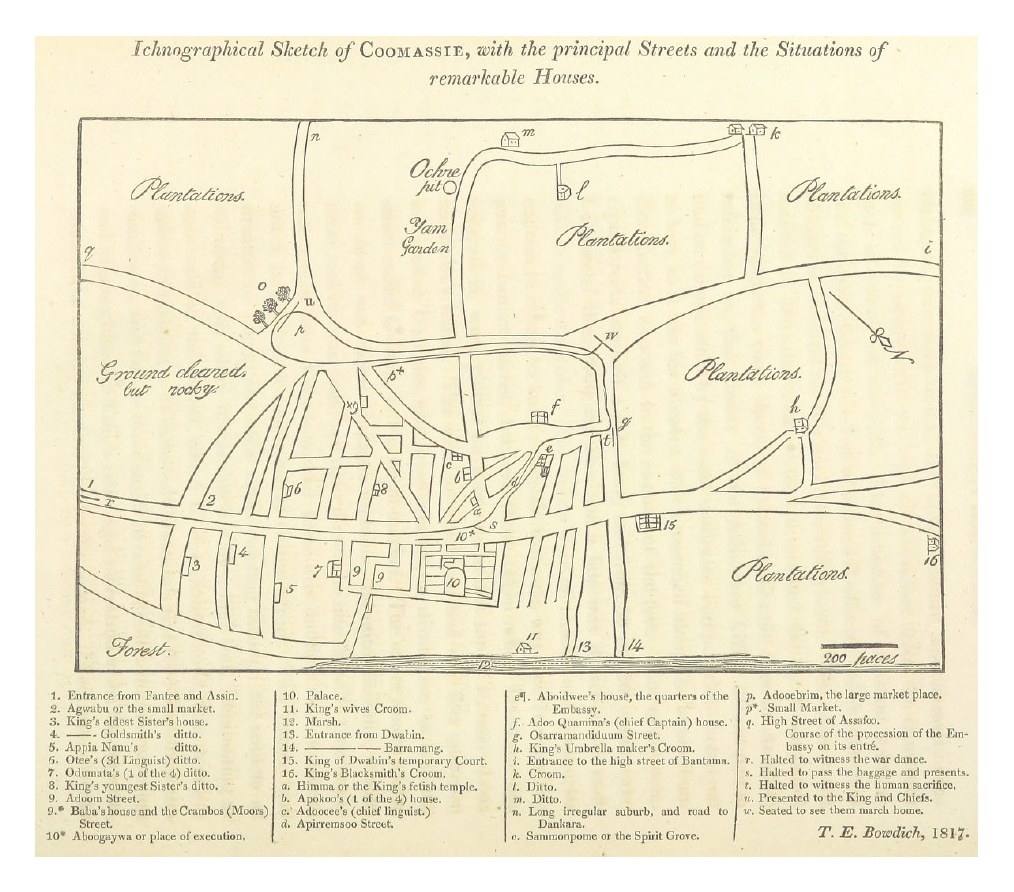
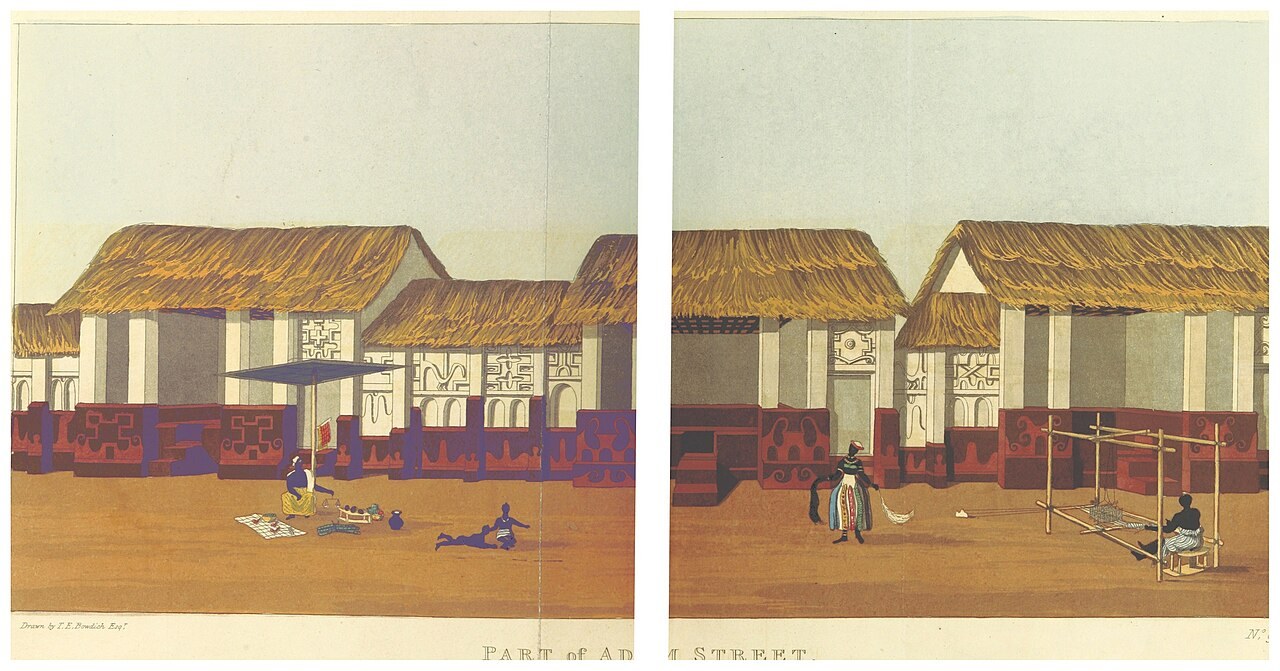
Kumasi was the seat of the court, the council and the treasury, and visitors were mostly kept there, so it is the best-described place in the kingdom.43 Thomas Bowdich, who arrived with a British mission in May 1817, drew a plan of it, counted 27 streets, four of them half a mile long and 50 to 100 yards wide, and put the town at nearly four miles round, not counting its suburbs.44 Parker counts 77 named wards, and the principal streets each had a captain in charge.45
How many people lived there depends on whom one asks and when. Bowdich put the ordinary resident population at 12,000 to 15,000, and noted that his hosts insisted it was more than 100,000 when the people were collected for great occasions. Later visitors gave 30,000 and 25,000. Wilks settled on most probably 15,000 to 25,000 for the first half of the 19th century, though in 1966 he had written of perhaps 30,000 to 40,000. The estimates are set out below.46
The open-fronted houses of officials, the odampan, faced the street, and business was done on their verandas. Wilks read the odampan as an office opening onto the street; McCaskie calls it simply a public place for household matters, news and talk.47 By the late 18th century Kumasi also had a resident Muslim community from the northern tributaries and beyond, engaged in the kola trade, valued at court for literacy and for amulets carrying Quranic text.48 Osei Tutu Kwame told Dupuis in 1820: “I know that book (the Koran) is strong, and I like it because it is the book of the great God.”49
Kings, queen mothers and the succession
The Asantehene came from the Oyoko Kokoo lineage of Kumasi, and descent ran through women: a candidate had to be royal through his mother.50 In practice, McCaskie and Wilks show, the preferred candidate was also the grandson of an earlier Asantehene through his father, and Wilks grouped the 18th- and 19th-century rulers into “houses” by that paternal line.51
The Asantehemaa, the queen mother, made the first move when the stool fell vacant. She consulted the royal family and senior officials and named a candidate; if the Council of Kumasi rejected him she could name two more, and only then could the council choose its own.52 The office was moved to Kumasi from Kokofu by Osei Kwadwo in the 18th century.53 Queen mothers held their own stools in their own right, in the anthropologist Beverly Stoeltje’s account, and the Asantehemaa keeps her own court, which Stoeltje watched in session in 1989-90.54
The Asantehene could be removed. Of the twelve who ruled before colonial rule, Parker counts four overthrown or destooled.55 Kusi Obodom left office in 1764, by abdication in Wilks’s account; Osei Kwame was removed, in 1798 by Wilks’s dating and in 1803 by Parker’s, by forces led by the Asantehemaa Konadu Yaadom, Parker writes, partly because Dupuis’s Muslim informants said he had wanted to make Quranic law the empire’s civil code.56 Kofi Kakari was removed in 1874 and Mensa Bonsu in 1883. William Tordoff lists the grounds on which an Asantehene might be destooled: repeatedly rejecting his elders’ advice, breaking a taboo, sacrilege or excessive cruelty.57
Royal women fought over the succession too. In 1859, under Kwaku Dua Panin, the heir apparent Osei Kwadwo and his mother, the Asantehemaa Afua Sapon, were convicted of using sorcery against the king, stripped of office, exiled from Kumasi and then killed. Their accuser, Afua Sapon’s daughter Afua Kobi, became Asantehemaa, and her sons Kofi Kakari and Mensa Bonsu later ruled. The royal family remembered the affair by a deliberately belittling name, konnurokusem, which McCaskie reads as a way of not speaking of it openly.58
Councils, offices and the bureaucracy argument
Two bodies governed with the king. The Asantemanhyiamu, “the assembly of the nation,” met each year at the Odwira festival; it heard reports from the provinces, acted as the highest court and could start proceedings to destool an Asantehene. A council of Kumasi office holders under the king ran day-to-day government, and Wilks wrote that the conflict between the two “was never fully resolved.”59
The Kumasi offices were grouped into ten divisions, fekuo. The Gyaasewahene kept the treasury and the Great Chest, with officials under him to weigh gold in and out; others handled foreign and provincial affairs, the roads and state trading, and the Ankobea served as the king’s own guard.60 The last division, Manwere, was created by Kwaku Dua Panin after 1844 and given to his favorites and his sons.61
Whether this amounted to a bureaucracy is the longest-running argument in Asante history. In 1966 Wilks wrote, “I shall assume the value of a model of bureaucratization,” and argued that from the 1760s Osei Kwadwo and his successors filled new offices by appointment rather than inheritance, giving the king a body of officials he chose and could dismiss.62 Wilks’s evidence was a sample of office lists for 146 stools with some 1,700 occupants.63
McCaskie rejected the model. A bureaucracy in Max Weber’s sense runs on written records, and in Asante, he wrote, “Literacy was virtually non-existent; it was viewed with grave suspicion by the Asante state.”64 He called Wilks’s use of Weber “a kind of theoretical fig leaf” and Wilks’s book a product of the nationalist history of its time.65 Parker sides with the critics and quotes the historian John Iliffe: the bureaucracy, “like Buganda’s, was patrimonial: it grew from the royal household, remained subject to the king’s favour, became in part hereditary, and earned no regular salaries.”66 Wilks himself later wrote that Weberian concepts had led historians “somewhat astray.”67
Roads, couriers and the calendar
Eight great roads ran out from Kumasi, by Dupuis’s count; Bowdich had been told nine.68 The Asante measured distance by time, in day’s journeys. Wilks estimated that a courier on a long journey averaged about ten miles a day, allowing for the days on which no one traveled, and that the frontier lay notionally twenty days from the capital in each direction.69 Villagers along the roads were obliged to keep them clear, and the state posted road wardens to watch travelers and goods.70 McCaskie, against Wilks, stresses how fragile the roads were: Bowdich found the road to Kumasi eight feet wide in May 1817 and almost a continuous bog in September.71
Time was counted in a cycle of 42 named days, made by running a six-day week alongside a seven-day one. Two days in each cycle were adae, when the Asantehene made offerings to his ancestors, and in the days before each he withdrew from public business.72 Many days were unlucky for business, travel or war; of 19 European missions to Kumasi in the 19th century whose entry day is known, McCaskie found 13 told to arrive on one of the three best days.73 The year turned at the Odwira, a festival of purification and the new yam harvest, when the provinces’ rulers renewed their allegiance and, Bowdich wrote, offenders were seldom accused “until the Yam Custom.”74
Gold, kola and the treasury
Asante sat on the richest goldfields of West Africa. The historian Timothy Garrard estimated the average annual output of the Akan goldfields at 27,000 ounces in the second half of the 18th century and 35,000 in the first half of the 19th, and put Asante’s share after 1826 at “over half, perhaps three-quarters.”75 Gold dust was the money of Kumasi. Values were reckoned in weights such as the peredwan, conventionally worth £8 sterling in the 19th century, and every trader carried scales and brass weights.76
Most gold, in Gareth Austin’s view, was dug by ordinary people in shallow pits, but the state took a large share: the Asantehene and the chiefs of the core states claimed two-thirds of any treasure trove and all nuggets above a certain size, and strangers working the fields paid rents of a third or two-thirds of what they produced.77 When a subject died, the state took death duties. Wilks treated them as confiscation; Austin argues that the usual rate was between a third and a half of the estate, that small farmers’ estates were left alone, and that the duties worked more like progressive taxation.78 McCaskie, citing contemporary manuscripts, reports an estimate that the Great Chest held more than 400,000 ounces of gold dust when Kwaku Dua Panin died in 1867.79
When Britain stopped buying captives in 1807, Asante’s exports turned to gold again and to kola nuts, which were sold north to the Sokoto Caliphate and Hausaland, where Islam discouraged alcohol.80 The state sent out its own kola traders each November, closed the roads until its nuts were sold and taxed private traders at twenty-five nuts on every load of 2,000.81 From about 1840 to 1874 Asante kept the trade between the coast and the savanna in Asante hands, shutting Hausa traders out of the kingdom.82
Slavery and pawnship
Captives were part of the state from the start. Prisoners from Asante’s wars were sold to the coast, kept as farm labor, given to commanders or held as potential victims at funerals, Sandra Greene writes.83 After 1807 the market for captives on the coast collapsed. Prices fell sharply, and in 1817, Bowdich reported, the markets of the interior were so full that few slaves were being bought.84 Kwabena Adu-Boahen, writing of the Fante coast, cites Paul Lovejoy’s figures for the price of a male slave on the Gold Coast, which fell from about 12 ounces of gold in 1789 to 3 ounces in 1815, and argues that slavery spread as cheaper captives came within reach of more buyers, women among them.85
Inside Asante the same happened. Austin calls the biggest change in the labor market between 1807 and 1896 “a major expansion in the net importation of slaves,” by chiefs and commoners alike.86 Most captives came from the northern savanna. Of 605 people recruited from Asante by the Dutch for their colonial army between 1837 and 1842 whose origin is known, only one was Asante; 59.2% were Mossi.87 Donna Maier suggested about 6,500 new captives a year as a rough figure for the tribute and war era, and the missionary Johannes Kühne, a prisoner in Kumasi from 1869 to 1874, thought the population was about half Asante and half slave, which Austin calls “remarkably high.”88
A slave in Asante, the odonko, could marry a free person, own property, swear an oath and give evidence in court, and the children of a slave mother and free father joined their father’s lineage; a maxim forbade anyone to disclose another’s origins.89 Pawns, awowa, were people pledged by their lineage as security for a debt, their labor counting as the interest.90
Executions and the “human sacrifice” argument
European visitors wrote at length about killings at Asante funerals and festivals, which they called human sacrifice. How to describe them is a real dispute. Wilks argued that “the majority of those slain at Asante ‘customs’ were indeed those previously found guilty of capital offenses,” and that “human sacrifice” mistranslated Asante words for beheading and for piercing the mouth with a dagger. He also accepted that when a great person died, servants and wives were killed to accompany him and some expected it.91 Clifford Williams answered that being a slave, a war prisoner or a royal servant was no crime, yet all three could be killed at a funeral, and that sacrifice and execution could be the same act.92
Both agree the numbers cannot be counted. “It is impossible to quantify,” Williams wrote. The figures in the sources run from the eleven killings Bosman said he saw on the coast, to Bowdich’s “about a hundred persons, mostly culprits reserved” at each Odwira, to reports of 2,000 prisoners of war killed on a single occasion.93 At the funeral of Kwaku Dua Panin in 1867, estimates of the dead range from 1,436 to 3,600, and McCaskie declines to choose among them.94 Rattray, writing in the 1920s, insisted that the blood on the blackened ancestral stools “was never that of a human sacrifice,” but of sheep.95
One account must be set aside. An 1860 book presented as the memoir of a slave trader, Captain Richard Drake, describes a visit to Kumasi in 1839 with 500 victims at a festival. McCaskie showed that its details were copied from the missionary Thomas Birch Freeman and that the visit never happened.96
The coast and the British, 1807-1874
Asante armies reached the sea in 1806-07, defeating the Fante, the coastal people allied with Britain.97 The Asantehene claimed the coastal forts’ “notes,” the rent documents Europeans paid for the land under their castles. “I must have the books,” Osei Tutu Kwame insisted.98 He also told Bowdich that the note for Elmina Castle had passed to Asante with the conquest of Denkyira. Larry Yarak showed this was “nothing more than a historical fiction created by Asantehene Osei Tutu Kwame in 1817”: the Dutch began paying Asante in 1744, for the Accra forts.99
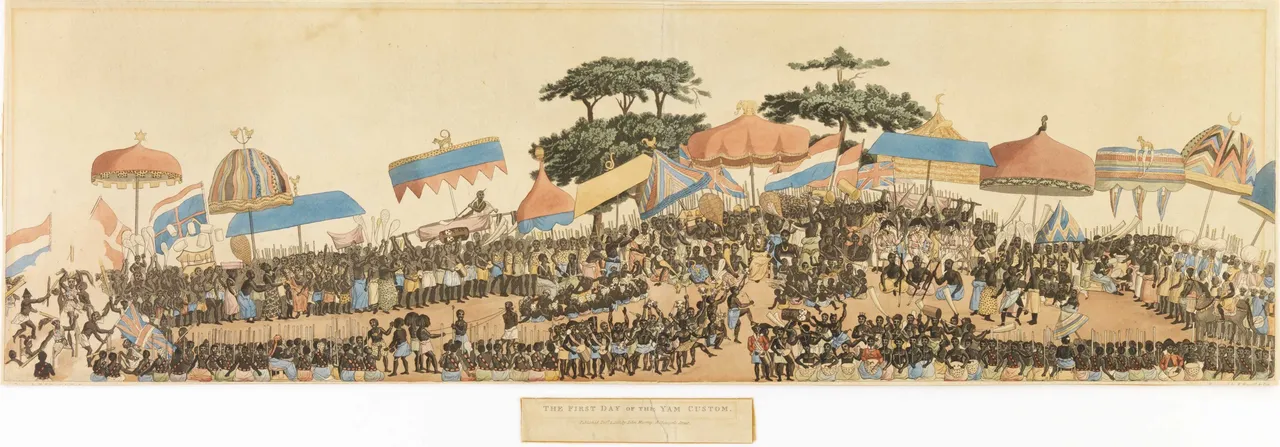
Osei Tutu Kwame’s reign was the high point of the empire. Bowdich’s mission of 1817 made a treaty of trade with him, and when it was ratified on Sept. 7, 1817, Bowdich wrote, the king displayed the mission’s presents to his court: “the flags were all sewn together, and wrapped around him as a cloth.” The art historian Fiona Sheales reads it as a deliberate display of the new alliance.100 The next year his army marched against Gyaman in the northwest, whose ruler Kwadwo Adinkra had rebelled, and defeated him. Adinkra’s skull joined Ntim Gyakari’s in the royal mausoleum at Bantama, from where they were brought out at each Odwira.101
War with Britain began in the 1820s. On Jan. 21, 1824, an Asante army destroyed the column of the Gold Coast governor, Sir Charles MacCarthy, at Nsamankow. Ricketts, MacCarthy’s brigade-major, wrote that MacCarthy had said on the eve of battle he would see “how the Ashantees liked our balls”; the colonial secretary J. T. Williams saw him shot and fall, and was later locked up at night in the Asante camp with his preserved head.102 Two years later, on Aug. 7, 1826, an Asante army under Osei Yaw Akoto was routed at Katamanso on the Accra plains, and the southern provinces were lost.103 A treaty in April 1831 brought peace; the Asantehene sent a son and a nephew as hostages and 600 ounces of gold as security.104
Kwaku Dua Panin, who reigned from 1834 to 1867, is described by Parker as an autocratic and effective ruler under whom trade grew and the treasury filled.105 Another war began in 1863 and ended in 1864 with a British withdrawal, its troops lost mostly to disease, and no treaty.106 When the Dutch handed Elmina to Britain in 1872, the Asantehene Kofi Kakari, who claimed the town, sent an army across the Pra in January 1873.107
A British force under Sir Garnet Wolseley entered Kumasi on Feb. 4, 1874, and burned it.108 The Treaty of Fomena, dated Feb. 13, 1874, required Asante to pay 50,000 ounces of gold, give up its claims over Denkyira, Assin, Akyem, Adanse and Elmina, keep the road to the Pra open and allow free trade. Its clause on human sacrifice was a promise to “use his best endeavours to check” the practice.109 Asante paid 1,000 ounces at once and never paid the rest, and Wolseley, his campaign narrative says, “did not contemplate that the remainder of this money would ever be obtained from the king.”110
Civil war and Prempeh, 1874-1896
After 1874 the empire came apart. Dwaben broke away, the northern Bono states rebelled and the tributaries of the north, Gyaman and Salaga among them, seceded.111 In 1882 Mensa Bonsu imposed a 50% tax on gold mining; in 1883 he was destooled.112 A Bekwai stool history traces the rising to the gold-mining center of Manso Nkwanta: “The conspiracy was hatched in the gold pits and no elders were present.”113 Kwaku Dua II was installed in 1884 and died of smallpox within weeks, and civil war followed until 1888, when the Asantehemaa Yaa Kyaa secured the stool for her son Agyeman Prempeh.114
Britain now pressed Asante to accept its protection. In 1891 the Asantehene’s councils debated an offer and refused it, answering that the kingdom “must remain independent as of old, at the same time to be friendly with all white men.”115 In 1894 the Asantemanhyiamu sent an embassy to London, which the Colonial Office refused to receive.116 In September 1895 the Colonial Secretary, Joseph Chamberlain, ordered an ultimatum requiring Asante to accept a British Resident. The envoys in London accepted it in November, and the expedition went ahead anyway.117
The force entered Kumasi unopposed on Jan. 17, 1896. On Jan. 20 Governor William Maxwell took the submission of Agyeman Prempeh and his mother, demanded the indemnity at once and, when it could not be paid, arrested them with the leading chiefs.118 Chamberlain cabled that deportation was “not contemplated by ultimatum,” and a Colonial Office official wrote in December, “We do not hold Ashanti either by conquest or cession.”119 The prisoners were held at Elmina, shipped, 44 people in all, to Freetown in Sierra Leone at the start of 1897, and moved to the Seychelles in 1900.120
The war of 1900 and annexation
On March 28, 1900, Governor Frederic Hodgson told the chiefs in Kumasi that the kingship was abolished, that they would pay a yearly sum as interest on the costs of 1874 and 1896, and that they should give up the Golden Stool.121 His words as noted at the meeting included: “Why am I not sitting on the Golden Stool at this moment?”122 His wife, Lady Hodgson, wrote that he asked for the stool to be handed over “not, of course, for him to sit upon, as was recorded by this calumnious correspondent.”123 Sources differ on the sum by a factor of ten, as set out below.
A party under Captain C. H. Armitage searching for the stool was attacked on April 2, and the governor’s party was besieged in the Kumasi fort until he broke out on June 23; a relief column reached Kumasi on July 15.124 The stool was never found. It was hidden throughout the war at Wawase, guarded by armed men. Fighting ended in December, and the war formally ended when Yaa Asantewaa, queen mother of Ejisu, surrendered on March 3, 1901.126
What she did in the war is disputed. Arhin Brempong argued that the chiefs chose her as their war leader, and A. Adu Boahen that she was its leader and commander-in-chief, though he notes that “none of the British captains ever reported seeing Yaa Asantewaa actually firing a gun.”127 Thomas Lewin called her the war’s symbolic leader, and McCaskie writes of her “supposed leadership role,” noting that the Asante-written History of Ashanti of the 1930s and 1940s gives her none.128 She was deported to the Seychelles with 14 other leaders in 1901 and died there in 1921.129
The Ashanti Order in Council of Sept. 26, 1901, declared that the territories “heretofore known as Ashanti, have been conquered by His Majesty’s forces” and annexed them to the Crown. It was published in the Gold Coast Government Gazette on Jan. 1, 1902, the date some accounts give for the annexation.130
The Golden Stool and the restored kingdom
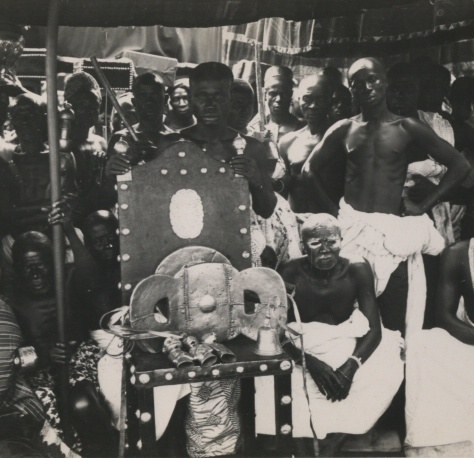
The Golden Stool stayed in hiding. In 1914 its keepers moved it to Aboabogya for fear that a new road would expose it, and in 1921 road workers dug it up by accident; men including the Nseniehene Kwasi Nsenie Agya stripped its gold.131 Prempeh was allowed home in 1924 as a private citizen. Tordoff wrote that the official view “meant nothing to the thousands of people who were waiting there to greet him; for it was their King who had returned to them after an absence of twenty-eight years.”132 He became Kumasihene in 1926 and died in 1931, and his nephew succeeded as Osei Agyeman Prempeh II.133 The Golden Stool was carried in public through Kumasi on June 17, 1928, for the first time since 1896.134
On Jan. 31, 1935, the governor announced at a durbar in Kumasi that the Ashanti Confederacy was restored under the occupant of the Golden Stool; there was, he said, “no new creation but a return to former institutions.”135 The restored Asantehene presided over a council and a court under British supervision, and Tordoff marks the difference plainly: before 1896 Asante was an independent sovereign state, and after 1935 it was not.136 The Asantehemaa’s office continues alongside the Asantehene’s at Manhyia in Kumasi.137
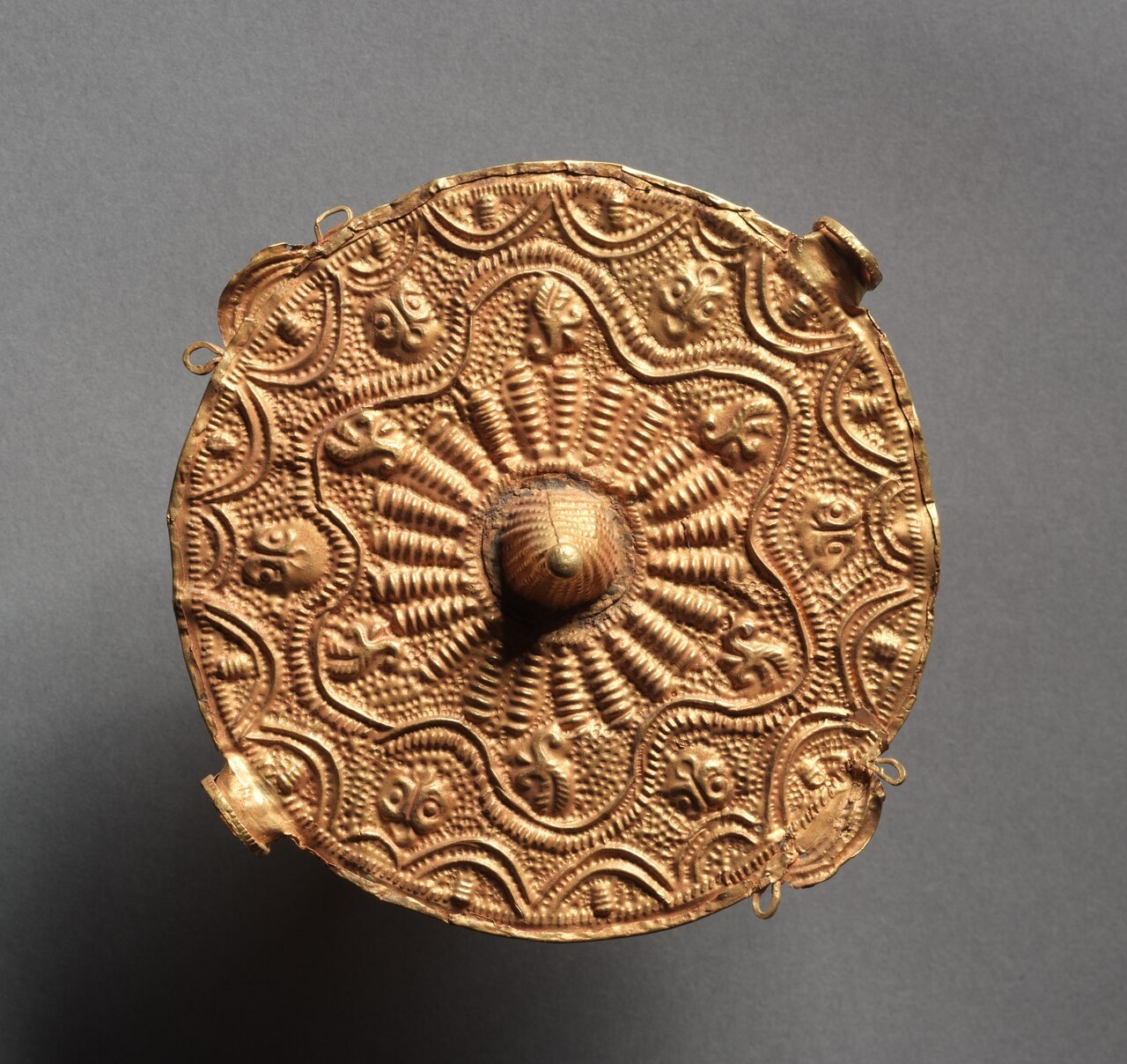
In 2024 museums in Britain and the United States sent regalia taken from Kumasi back to the city. The Fowler Museum at the University of California, Los Angeles, returned seven objects permanently, handing them to the Asantehene, Osei Tutu II, on Feb. 5, 2024, the 150th anniversary of the sack of Kumasi. The Victoria and Albert Museum lent 17 objects and the British Museum 15 for an exhibition at the Manhyia Palace Museum that opened on May 1, 2024; the V&A’s loan runs for three years, with an option to extend.138
How we know
Asante left a large written record, almost all of it written by others. Dutch and English letters from the coast give dates from the late 17th century. Bowdich in 1817 and Dupuis in 1820 lived in Kumasi and described it, and Clifford Williams counts them more dispassionate than later writers who sensationalized the kingdom, some of them missionaries raising money.139 Ricketts and Brackenbury give the British side of the wars, and Hodgson and Armitage that of 1900.
Some of these texts are less direct than they look. Four Years in Ashantee (1875), the account of the missionaries Ramseyer and Kühne, is, Adam Jones showed, at least five texts by different hands, rewritten by its editors; “many of the so-called ‘primary’ sources for African history are in fact largely secondary,” he wrote.140 Rattray’s books of the 1920s are rich on ritual, but McCaskie warns that Rattray spent little time in Kumasi, took genealogies from interested informants and was careless with dates, giving the battle of Nsamankow as 1828.141
The Asante’s own history comes through oral tradition and through the History of Ashanti Kings, which Agyeman Prempeh dictated in exile from 1907, drawing on his mother Yaa Kyaa; Parker calls it perhaps the first history written in English by an African ruler.142 Its editors say its king list is right on the order of rulers but “unreliable for the chronology.”143 Modern historians disagree sharply, Wilks against McCaskie above all, and much of what is known about the 18th century still rests on Wilks’s reading of a thin record. The population figures are estimates from army returns, and none of them was a count.144
Notes
-
McCaskie 2007a, p. 2; Parker 2023, ch. 8. ↩
-
McCaskie 2007a, pp. 2-3; Wilks 1993, p. 111. ↩
-
Parker 2023, ch. 8; Wilks 1967, pp. 211-212. ↩
-
Austin 2005, p. 40; Austin 2005, pp. 37-38. ↩
-
Wilks 2000a, p. 59; Tordoff 1965, pp. 349-350. ↩
-
Wilks 1993, pp. 42-43, 94. ↩
-
Chouin and DeCorse 2010, pp. 129, 136, 138. ↩
-
Shinnie 2005, para. 15. ↩
-
Chouin and DeCorse 2010, pp. 142-143. ↩
-
Parker 2023, ch. 8. ↩
-
Wilks 1993, pp. 66, 101. ↩
-
McCaskie 2007a, p. 1; Wilks 1993, p. 101. ↩
-
McCaskie 2007a, p. 7; Wilks 1993, p. 109; Parker 2023, ch. 8. ↩
-
McCaskie 2007a, p. 10. ↩
-
Wilks 1993, pp. 102, 109; Shinnie 2005, para. 23; Prempeh I 2003, p. 128. ↩
-
Wilks 1993, p. 111. ↩
-
McCaskie 2007a, pp. 2-3. ↩
-
Bosman 1705, p. 73. ↩
-
Dupuis 1824, p. 229. ↩
-
Wilks 1993, p. 111; Parker 2023, ch. 8. ↩
-
Wilks 1993, pp. 114-115. ↩
-
Parker 2023, ch. 8. ↩
-
Parker 2023, ch. 8. ↩
-
Wilks 1993, p. 115. ↩
-
Wilks 1993, p. 116. ↩
-
Parker 2023, ch. 8. ↩
-
Wilks 1993, pp. 104, 107-108, 124 n. 69. ↩
-
McCaskie 2007a, pp. 12-13. ↩
-
McCaskie 2007a, p. 23; Dupuis 1824, pp. 231-233; Parker 2023, ch. 8. ↩
-
Parker 2023, ch. 8. ↩
-
Sanders 1979, p. 357; Arhin 1967a, p. 73. ↩
-
Parker 2023, ch. 8. ↩
-
Parker 2023, ch. 8. ↩
-
Wilks 1993, pp. 112-113; Parker 2023, ch. 8. ↩
-
Parker 2023, ch. 8; Wilks 1967, pp. 209-210. ↩
-
Wilks 1975, p. 80. ↩
-
Arhin 1967a, pp. 67, 76-78, 81. ↩
-
Arhin 1967b, pp. 286-287. ↩
-
Dupuis 1824, p. xxxix. ↩
-
Arhin 1967a, p. 83. ↩
-
Arhin 1967a, pp. 81-82. ↩
-
Arhin 1967a, p. 85. ↩
-
Parker 2023, ch. 8. ↩
-
Bowdich 1819, pp. 321-323. ↩
-
Parker 2023, ch. 8. ↩
-
Bowdich 1819, pp. 323-324; Wilks 1975, pp. 93-94; Wilks 1966, p. 215. ↩
-
Parker 2023, ch. 8; McCaskie 1995a, p. 16. ↩
-
Parker 2023, ch. 8. ↩
-
Parker 2023, ch. 8. ↩
-
McCaskie 1995b, p. 358; McCaskie 1989, p. 438. ↩
-
McCaskie 1989, p. 438; Wilks 1975, pp. 329, 372. ↩
-
Wilks 1975, pp. 544-545. ↩
-
Wilks 1975, pp. 333-334. ↩
-
Stoeltje 1997, pp. 43, 63. ↩
-
Parker 2023, ch. 8. ↩
-
Wilks 1975, p. 332; Parker 2023, ch. 8. ↩
-
Tordoff 1965, p. 14. ↩
-
McCaskie 1995b, pp. 363, 367-368. ↩
-
McCaskie 1995a, pp. 146-147, 396-397. ↩
-
Wilks 1966, pp. 221-226; Wilks 1967, pp. 212-219. ↩
-
McCaskie 1980a, pp. 190, 195, 199. ↩
-
Wilks 1966, pp. 216-217. ↩
-
Wilks 1966, p. 228. ↩
-
McCaskie 1995a, pp. 9, 15. ↩
-
McCaskie 1992, pp. 472-473. ↩
-
Parker 2023, ch. 8. ↩
-
Wilks 1992, pp. 188-189. ↩
-
Dupuis 1824, p. xxvii; Wilks 1961, p. 33. ↩
-
Wilks 1992, pp. 181, 183. ↩
-
Austin 2005, p. 41; Wilks 1992, p. 175. ↩
-
McCaskie 1995a, p. 10. ↩
-
McCaskie 1980b, pp. 181, 190-191. ↩
-
McCaskie 1980b, pp. 184, 186. ↩
-
McCaskie 1980b, p. 192; McCaskie 1995a, pp. 146, 227. ↩
-
Austin 2005, p. 46. ↩
-
Austin 2005, pp. 40, 128; Parker 2023, ch. 8. ↩
-
Austin 1996, pp. 5, 11, 20-21; Arhin 1970, p. 367; Austin 2005, pp. 102-103. ↩
-
Austin 1996, pp. 20-22. ↩
-
McCaskie 1986, p. 4. ↩
-
Austin 2005, pp. 46-47; Parker 2023, ch. 8. ↩
-
Arhin 1970, p. 366. ↩
-
Austin 2005, pp. 41, 47. ↩
-
Greene 2012, p. 15. ↩
-
Austin 2005, p. 122; Adu-Boahen 2010, p. 125. ↩
-
Adu-Boahen 2010, pp. 124-125. ↩
-
Austin 2005, p. 126. ↩
-
Austin 2005, p. 116. ↩
-
Austin 2005, p. 126. ↩
-
Austin 2005, pp. 118-119; Parker 2023, ch. 8. ↩
-
Austin 2005, pp. 142-144; Arhin 1990, p. 527. ↩
-
Wilks 1988, pp. 443-445, 451. ↩
-
Williams 1988, pp. 434-435. ↩
-
Williams 1988, pp. 435, 439; Bosman 1705, p. 231; Wilks 1988, p. 448 n. 20. ↩
-
McCaskie 1989, p. 434. ↩
-
Rattray 1923, p. 95 n.; Rattray 1929, p. 342. ↩
-
McCaskie 1984, pp. 223, 227-229, 233. ↩
-
Sanders 1979, p. 363; Arhin 1967a, p. 74. ↩
-
Arhin 1967b, p. 287. ↩
-
Yarak 1986a, p. 34 n. 5; Yarak 1986b, p. 375. ↩
-
Sheales 2012, pp. 47, 57, 64-65. ↩
-
McCaskie 1983, p. 189; Parker 2023, ch. 8. ↩
-
Ricketts 1831, pp. 54-58, 82-83; Wilks 1975, p. 174. ↩
-
Reindorf 1895, p. 210; Parker 2023, ch. 8. ↩
-
Ricketts 1831, p. 175; Reindorf 1895, pp. 258-260. ↩
-
Parker 2023, ch. 8. ↩
-
Brackenbury 1874, vol. 1, pp. 20-23, 28; Ramseyer and Kühne 1875, p. xiii. ↩
-
Brackenbury 1874, vol. 1, pp. 30-35, 52. ↩
-
Brackenbury 1874, vol. 2, pp. 222-223, 244-245. ↩
-
Brackenbury 1874, vol. 2, pp. 268-270. ↩
-
Brackenbury 1874, vol. 2, pp. 273-274. ↩
-
Austin 2005, p. 47; Parker 2023, ch. 8; Ramseyer and Kühne 1875, pp. vii-viii. ↩
-
McCaskie 1986, p. 4; Austin 2005, p. 45. ↩
-
Austin 1996, pp. 23-25. ↩
-
Wilks 1975, p. 368; Tordoff 1965, p. 25; Parker 2023, ch. 8. ↩
-
Wilks 2000a, pp. 16-17. ↩
-
Wilks 2000a, pp. 26-27, 32-33. ↩
-
Wilks 2000a, pp. 37, 40-42. ↩
-
Wilks 2000a, p. 43; Tordoff 1965, p. 68; Boahen 2003, p. 28. ↩
-
Wilks 2000a, pp. 45, 49; Wilks 2000b, p. 70. ↩
-
Tordoff 1965, pp. 85-87, 167; Boahen 2003, p. 29. ↩
-
Wilks 2000a, pp. 53-54; Armitage and Montanaro 1901, pp. 3-4. ↩
-
Wilks 2000a, p. 54; McCaskie 2000, p. 80. ↩
-
Hodgson 1901, p. 80. ↩
-
Wilks 2000a, p. 55; Armitage and Montanaro 1901, pp. 130-133; Boahen 2003, p. 89. ↩
-
Boahen 2003, p. 28. ↩
-
Arhin Brempong 2000, p. 110; Boahen 2000, pp. 116, 125. ↩
-
Lewin 1978, p. 224; McCaskie 2007b, pp. 161, 178. ↩
-
Boahen 2000, p. 132; Tordoff 1965, p. 169; McCaskie 2007b, p. 159. ↩
-
Wilks 2000a, p. 59 and n. 162; Tordoff 1965, p. 113; Boahen 2003, p. 177. ↩
-
McCaskie 2000, p. 92; McCaskie 1986, pp. 14-16. ↩
-
Tordoff 1965, pp. 184-186. ↩
-
Wilks 2000b, pp. 85-86; Tordoff 1965, pp. 287-289. ↩
-
McCaskie 2000, p. 95. ↩
-
Tordoff 1965, pp. 349-350, 385. ↩
-
Tordoff 1965, pp. 359-361, 364. ↩
-
Stoeltje 1997, pp. 59, 63. ↩
-
Fowler Museum 2024; Victoria and Albert Museum 2024. ↩
-
Williams 1988, pp. 433, 435-436. ↩
-
Jones 1991, pp. 173, 197. ↩
-
McCaskie 1983, pp. 188-191, 193. ↩
-
Parker 2023, ch. 8; Wilks 1975, p. 327 n. 1. ↩
-
Prempeh I 2003, pp. 127-128. ↩
-
Wilks 1975, p. 80. ↩
Where the estimates differ
| Estimate | Who holds it | Source |
|---|---|---|
| Probably the early 1680s, as ruler of Kumasi | Ivor Wilks, reasoning from the reigns of the Denkyira and Akwamu kings he lived under | Wilks 1993, p. 109 |
| 1699, the traditional date for the founding of the kingdom | Asante tradition, as reported by Peter Shinnie | Shinnie 2005, para. 23 |
| About 1700 | The king list in Agyeman Prempeh I's History of Ashanti Kings (1907), whose own editors call it unreliable for dates | Prempeh I 2003, pp. 127-128 |
| Estimate | Who holds it | Source |
|---|---|---|
| 1701 | Dutch reports from the coast in May and November 1701; Wilks; McCaskie; Parker | McCaskie 2007a, p. 2; Wilks 1993, p. 111 |
| Begun in 1719 (A.H. 1132) | Joseph Dupuis, from Muslim records in Kumasi in 1820 | Dupuis 1824, p. 229 |
| Estimate | Who holds it | Source |
|---|---|---|
| About 1 million in the kingdom, 1817 | Thomas Bowdich, multiplying a return of 204,000 men able to bear arms by five | Bowdich 1819, pp. 316-317 |
| About 725,000 in metropolitan Asante, 1817 | Ivor Wilks, accepting Bowdich's return but correcting his ratio of women to men | Wilks 1975, p. 88 |
| 700,000 to 800,000 in all of Ashanti, 1839 | The missionary Thomas Birch Freeman, as reported by Wilks | Wilks 1975, p. 88 |
| About 1 million early in the 19th century, 340,000 at its end | Kwame Arhin, after K. Boakye-Boaten | Arhin 1990, p. 530 |
| Similar in 1860 to 1817, and close to the 1911 level; Wilks's 1817 total improbably high | Gareth Austin | Austin 2005, pp. 56-57 |
| Probably 3 to 5 million in the whole area under Asante ascendancy | Ivor Wilks, on what he calls a conservative estimate | Wilks 1967, pp. 211-212 |
| Estimate | Who holds it | Source |
|---|---|---|
| 12,000 to 15,000 average residents; more than 100,000 when the people were collected | Thomas Bowdich in 1817; the larger figure is what his Asante hosts told him | Bowdich 1819, pp. 323-324 |
| 30,000 in 1839; 25,000 in 1848, rising above 80,000 at the Odwira festival | Thomas Birch Freeman; Governor William Winniett | Wilks 1975, pp. 93-94 |
| Most probably 15,000 to 25,000 in the first half of the 19th century | Ivor Wilks, from the visitors' estimates | Wilks 1975, p. 93 |
| Perhaps 30,000 to 40,000 in the early 19th century | Ivor Wilks in 1966 | Wilks 1966, p. 215 |
| At most 25,000 under Kwaku Dua Panin (1834-67) | T. C. McCaskie | McCaskie 1989, p. 435 |
| Estimate | Who holds it | Source |
|---|---|---|
| Not more than 14,000 square miles, the kingdom proper | Thomas Bowdich, 1817 | Bowdich 1819, p. 316 |
| About 10,000 square miles for metropolitan Asante; somewhat over 20,000 for the southern provinces | Ivor Wilks | Wilks 1975, pp. 80, 126 |
| Some 125,000 to 150,000 square miles of ascendancy, coast to northern savanna | Ivor Wilks, on what he calls a conservative estimate | Wilks 1967, pp. 211-212 |
| Estimate | Who holds it | Source |
|---|---|---|
| 1,436 | The Basel missionary de Heer, the lowest count | McCaskie 1989, p. 434 |
| 3,000 | Watts, on the coast, December 1867 | McCaskie 1989, p. 434 |
| 3,600 | Musa Datari | McCaskie 1989, p. 434 |
| Estimate | Who holds it | Source |
|---|---|---|
| 2,000 peredwans, or £16,000 | Ivor Wilks; T. C. McCaskie gives £16,000 | Wilks 2000a, p. 54; McCaskie 2000, p. 80 |
| £160,000 | Arhin Brempong; A. Adu Boahen, in one passage | Arhin Brempong 2000, p. 100; Boahen 2003, p. 31 |
| Estimate | Who holds it | Source |
|---|---|---|
| Born around 1830; died Oct. 17, 1921 | A. Adu Boahen, citing a Seychelles government letter of Oct. 18, 1921 | Boahen 2000, pp. 112, 132 |
| Died Oct. 18, 1921 | A. Adu Boahen in his 2003 book | Boahen 2003, p. 110 |
| Born in the 1830s; died in 1921 | T. C. McCaskie | McCaskie 2007b, pp. 155, 159 |
| About 50 years old in 1900 | Thomas Lewin | Lewin 1978, p. 221 |
Rulers of Asante
| Ruler | Reign | Note |
|---|---|---|
| Osei Tutu | c. 1680 to c. 1717 | Ruler of Kumasi probably from the early 1680s, in Ivor Wilks's reckoning; led the coalition that defeated Denkyira in 1701 and was killed fighting Akyem in 1717. |
| Opoku Ware I | c. 1720 to c. 1750 | Led the campaigns that made Greater Asante, from Takyiman to Gonja, Gyaman and Akyem. |
| Kusi Obodom | 1750 to 1764 | Left office in 1764; Wilks calls it an abdication, John Parker a destoolment. |
| Osei Kwadwo | 1764 to 1777 | Created new appointed offices, the reforms Wilks called a revolution in government. |
| Osei Kwame | 1777 to 1798 | Came to the throne as a boy and was removed; Parker dates his overthrow and execution to 1803. |
| Opoku Fofie | 1798 to 1799 | |
| Osei Tutu Kwame (Osei Bonsu) | 1800 to 1823 | Received the British missions of 1817 and 1820. Parker dates the reign 1804-1823. |
| Osei Yaw Akoto | 1824 to 1833 | His army was defeated at Katamanso in 1826. |
| Kwaku Dua Panin (Kwaku Dua I) | 1834 to 1867 | |
| Kofi Kakari | 1867 to 1874 | Removed from office after the British took Kumasi in 1874. |
| Mensa Bonsu | 1874 to 1883 | Destooled in 1883. |
| Kwaku Dua II | 1884 to 1884 | Died of smallpox weeks after his installation in 1884. |
| Agyeman Prempeh I | 1888 to 1931 | Installed in 1888; arrested by the British in 1896 and exiled until 1924; recognized only as Kumasihene from 1926. |
| Osei Agyeman Prempeh II | 1931 to 1970 | Installed as Kumasihene in 1931 and recognized as Asantehene at the restoration of Jan. 31, 1935. |
Timeline
- c. 1680 Osei Tutu begins to rule
- c. 1701 Asante emerges
- c. 1701 Capital at Kumasi
- c. 1720 Opoku Ware I begins to rule
- 1750 Kusi Obodom begins to rule
- 1764 Osei Kwadwo begins to rule
- 1777 Osei Kwame begins to rule
- 1798 Opoku Fofie begins to rule
- 1800 Osei Tutu Kwame (Osei Bonsu) begins to rule
- 1824 Osei Yaw Akoto begins to rule
- 1834 Kwaku Dua Panin (Kwaku Dua I) begins to rule
- 1867 Kofi Kakari begins to rule
- 1874 Mensa Bonsu begins to rule
- 1884 Kwaku Dua II begins to rule
- 1888 Agyeman Prempeh I begins to rule
- 1901 Britain annexes Asante by an Order in Council of Sept. 26, 1901; the Asantehene's office is restored in 1935
- 1931 Osei Agyeman Prempeh II begins to rule
Correction
Our Asante Empire overview has moved into the new Asante page, and it dated the annexation to 1902.The overview at /history/articles/asante-empire-osei-tutu-golden-stool/ now redirects to the new state page. It dated the British annexation to 1902; the Order in Council annexing Asante is dated Sept. 26, 1901, and was published in the colony's gazette on Jan. 1, 1902 (Wilks 2000a, p. 59; Tordoff 1965, p. 113). It said Asante governed 3 to 4 million people at its peak; the estimates we found run from about 725,000 to about 1 million for 1817 (Wilks 1975, p. 88; Bowdich 1819, pp. 316-317). It said Asante controlled nearly 500 miles of the Gold Coast, which we could not trace to any source. It called Asante West Africa's most militarily formidable power and said it made conquest expensive more often than any other West African state, superlatives no source we used supports. It said the 1900 rising was suppressed within six months; fighting ran to December 1900 and Yaa Asantewaa surrendered in March 1901 (Boahen 2003, p. 28). The new page sets out the disputed figures.Corrected in October 2026. See the log entry.
Sources
- Ivor Wilks. “Asante in the Nineteenth Century: The Structure and Evolution of a Political Order”, Cambridge University Press, 1975.
- Ivor Wilks. “Forests of Gold: Essays on the Akan and the Kingdom of Asante”, Ohio University Press, 1993.
- T. C. McCaskie. “State and Society in Pre-Colonial Asante”, Cambridge University Press, 1995.
- John Parker. “The Akan Forest Kingdom of Asante”, in John Parker (ed.), Great Kingdoms of Africa, Thames & Hudson / University of California Press, ch. 8, 2023.
- A. Adu Boahen, Emmanuel Akyeampong, Nancy Lawler, T. C. McCaskie and Ivor Wilks (eds.). “"The History of Ashanti Kings and the Whole Country Itself" and Other Writings, by Otumfuo Nana Agyeman Prempeh I”, Oxford University Press for the British Academy, 2003.
- William Tordoff. “Ashanti under the Prempehs, 1888-1935”, Oxford University Press, 1965.
- Thomas J. Lewin. “Asante before the British: The Prempean Years, 1875-1900”, Regents Press of Kansas, 1978.
- Gareth Austin. “Labour, Land and Capital in Ghana: From Slavery to Free Labour in Asante, 1807-1956”, University of Rochester Press, 2005.
- A. Adu Boahen (ed. Emmanuel Akyeampong). “Yaa Asantewaa and the Asante-British War of 1900-1”, Sub-Saharan Publishers / James Currey, 2003.
- Ivor Wilks. “Ashanti Government”, in Daryll Forde and P. M. Kaberry (eds.), West African Kingdoms in the Nineteenth Century, Oxford University Press, pp. 206-238, 1967.
- Kwame Arhin. “The Structure of Greater Ashanti (1700-1824)”, Journal of African History 8.1, pp. 65-85, 1967.
- T. C. McCaskie. “Denkyira in the Making of Asante c. 1660-1720”, Journal of African History 48.1, pp. 1-25, 2007.
- Gérard L. Chouin and Christopher R. DeCorse. “Prelude to the Atlantic Trade: New Perspectives on Southern Ghana's Pre-Atlantic History (800-1500)”, Journal of African History 51.2, pp. 123-145, 2010.
- Ivor Wilks. “Asante at the End of the Nineteenth Century: Setting the Record Straight”, Ghana Studies 3, pp. 13-59, 2000.
- T. C. McCaskie. “The Golden Stool at the End of the Nineteenth Century: Setting the Record Straight”, Ghana Studies 3, pp. 61-96, 2000.
- T. Edward Bowdich. “Mission from Cape Coast Castle to Ashantee”, John Murray, London, 1819.
- Joseph Dupuis. “Journal of a Residence in Ashantee”, Henry Colburn, London, 1824.
- Major Ricketts. “Narrative of the Ashantee War”, Simpkin and Marshall, London, 1831.
- Henry Brackenbury. “The Ashanti War: A Narrative Prepared from the Official Documents”, William Blackwood and Sons, 2 vols., 1874.
- Fiona M. Sheales. “Wrapping and Ratification: An Early Nineteenth Century Display of Diplomacy Asante 'Style'”, World Art 2.1, pp. 47-66, 2012.
- Ivor Wilks. “Asante: Human Sacrifice or Capital Punishment? A Rejoinder”, International Journal of African Historical Studies 21.3, pp. 443-452, 1988.
- Clifford Williams. “Asante: Human Sacrifice or Capital Punishment? An Assessment of the Period 1807-1874”, International Journal of African Historical Studies 21.3, pp. 433-441, 1988.
- Ivor Wilks. “Aspects of Bureaucratization in Ashanti in the Nineteenth Century”, Journal of African History 7.2, pp. 215-232, 1966.
- Ivor Wilks. “The Northern Factor in Ashanti History: Begho and the Mande”, Journal of African History 2.1, pp. 25-34, 1961.
- Ivor Wilks. “On Mentally Mapping Greater Asante: A Study of Time and Motion”, Journal of African History 33.2, pp. 175-190, 1992.
- Ivor Wilks. “Asante Nationhood and Colonial Administrators, 1896-1935”, in Carola Lentz and Paul Nugent (eds.), Ethnicity in Ghana: The Limits of Invention, Macmillan, pp. 68-96, 2000.
- T. C. McCaskie. “Office, Land and Subjects in the History of the Manwere Fekuo of Kumase”, Journal of African History 21.2, pp. 189-208, 1980.
- T. C. McCaskie. “Time and the Calendar in Nineteenth-Century Asante: An Exploratory Essay”, History in Africa 7, pp. 179-200, 1980.
- T. C. McCaskie. “R. S. Rattray and the Construction of Asante History: An Appraisal”, History in Africa 10, pp. 187-206, 1983.
- T. C. McCaskie. “Drake's Fake: A Curiosity concerning a Spurious Visit to Asante in 1839”, History in Africa 11, pp. 223-236, 1984.
- T. C. McCaskie. “Accumulation: Wealth and Belief in Asante History, II: The Twentieth Century”, Africa 56.1, pp. 3-23, 1986.
- T. C. McCaskie. “Death and the Asantehene: A Historical Meditation”, Journal of African History 30.3, pp. 417-444, 1989.
- T. C. McCaskie. “Empire State: Asante and the Historians”, Journal of African History 33.3, pp. 467-476, 1992.
- T. C. McCaskie. “Konnurokusem: Kinship and Family in the History of the Oyoko Kokoo Dynasty of Kumase”, Journal of African History 36.3, pp. 357-389, 1995.
- T. C. McCaskie. “The Life and Afterlife of Yaa Asantewaa”, Africa 77.2, pp. 151-179, 2007.
- Kwame Arhin. “The Financing of the Ashanti Expansion (1700-1820)”, Africa 37.3, pp. 283-291, 1967.
- Kwame Arhin. “Aspects of the Ashanti Northern Trade in the Nineteenth Century”, Africa 40.4, pp. 363-373, 1970.
- Kwame Arhin. “Trade, Accumulation and the State in Asante in the Nineteenth Century”, Africa 60.4, pp. 524-537, 1990.
- Arhin Brempong. “The Role of Nana Yaa Asantewaa in the 1900 Asante War of Resistance”, Ghana Studies 3, pp. 97-110, 2000.
- A. Adu Boahen. “Yaa Asantewaa in the Yaa Asantewaa War of 1900: Military Leader or Symbolic Head?”, Ghana Studies 3, pp. 111-135, 2000.
- Gareth Austin. “'No Elders Were Present': Commoners and Private Ownership in Asante, 1807-96”, Journal of African History 37.1, pp. 1-30, 1996.
- Kwabena Adu-Boahen. “Abolition, Economic Transition, Gender and Slavery: The Expansion of Women's Slaveholding in Ghana, 1807-1874”, Slavery & Abolition 31.1, pp. 117-136, 2010.
- Sandra E. Greene. “Oral Traditions about Individuals Enslaved in Asante”, in Alice Bellagamba, Sandra E. Greene and Martin A. Klein (eds.), African Voices on Slavery and the Slave Trade, Cambridge University Press, pp. 15-28, 2012.
- Peter Shinnie. “Early Asante and European Contacts”, Journal des Africanistes 75.2, pp. 25-42, 2005.
- James Sanders. “The Expansion of the Fante and the Emergence of Asante in the Eighteenth Century”, Journal of African History 20.3, pp. 349-364, 1979.
- Larry W. Yarak. “Elmina and Greater Asante in the Nineteenth Century”, Africa 56.1, pp. 33-52, 1986.
- Larry W. Yarak. “The 'Elmina Note': Myth and Reality in Asante-Dutch Relations”, History in Africa 13, pp. 363-382, 1986.
- Adam Jones. “Four Years in Asante: One Source or Several?”, History in Africa 18, pp. 173-203, 1991.
- Beverly J. Stoeltje. “Asante Queen Mothers: A Study in Female Authority”, Annals of the New York Academy of Sciences 810, pp. 41-71, 1997.
- Willem Bosman. “A New and Accurate Description of the Coast of Guinea”, London (English translation; cited from the 1907 reprint), 1705.
- Carl Christian Reindorf. “History of the Gold Coast and Asante”, Printed for the author, Basel, 1895.
- F. A. Ramseyer and J. Kühne. “Four Years in Ashantee”, Robert Carter and Brothers, New York (the edition cited), 1875.
- Lady (Mary Alice) Hodgson. “The Siege of Kumassi”, Longmans, Green and Co., New York (the edition cited), 1901.
- C. H. Armitage and A. F. Montanaro. “The Ashanti Campaign of 1900”, Sands and Co., London, 1901.
- R. S. Rattray. “Ashanti”, Clarendon Press, 1923.
- R. S. Rattray. “Ashanti Law and Constitution”, Clarendon Press, 1929.
- UCLA Newsroom (Fowler Museum). “Fowler Museum at UCLA permanently returns objects to Asante kingdom in Ghana”, University of California, Los Angeles, 2024.
- Victoria and Albert Museum. “Homecoming exhibition of Asante gold regalia at Manhyia Palace Museum, Kumasi”, V&A, 2024.
Further Reading
The sources above support the specific claims on this page. The works below are the scholarship behind them. Citations are given in full so readers can find them through a library or database; some are paywalled.
Peer-reviewed articles
- McCaskie, T. C. (2007). "DENKYIRA IN THE MAKING OF ASANTE <i>C</i>. 1660–1720." The Journal of African History 48(1): 1-25. DOI: 10.1017/S0021853706002507.
- Chouin, Gerard L.; DeCorse, Christopher R. (2010). "PRELUDE TO THE ATLANTIC TRADE: NEW PERSPECTIVES ON SOUTHERN GHANA'S PRE-ATLANTIC HISTORY (800–1500)." The Journal of African History 51(2): 123-145. DOI: 10.1017/S0021853710000241.
- Wilks, Ivor (2005). "The Forest and the Twis." Journal des Africanistes 75(1): 19-75. DOI: 10.4000/africanistes.188.
- Shinnie, Peter (2005). "Early Asante and European Contacts." Journal des Africanistes 75(2): 25-42. DOI: 10.4000/africanistes.113.
- Wilks, Ivor (1982). "The State of the Akan and the Akan States: A Discursion." Cahiers d'études africaines 22(1-2): 231-249. DOI: 10.3406/cea.1982.3377.
- Chouin, Gerard (2002). "Sacred Groves as Historical and Archaeological Markers in Southern Ghana." Ghana Studies 5(1): 177-196. DOI: 10.3368/gs.5.1.177.abstract free
- Wilks, Ivor (1961). "The Northern Factor in Ashanti History: Begho and the Mande." The Journal of African History 2(1): 25-34. DOI: 10.1017/S0021853700002127.
- Posnansky, Merrick (2015). "Begho: Life and Times." Journal of West African History 1(2): 95-118. DOI: 10.14321/jwestafrihist.1.2.0095.abstract free
- Sanders, James (1979). "The Expansion of the Fante and the Emergence of Asante in the Eighteenth Century." The Journal of African History 20(3): 349-364. DOI: 10.1017/S0021853700017357.
- Hanserd, Robert (2015). "Okomfo Anokye formed a tree to hide from the Akwamu: priestly power, freedom, and enslavement in the Afro-Atlantic." Atlantic Studies 12(4): 522-544. DOI: 10.1080/14788810.2015.1006421.
- Wilks, Ivor (1966). "Aspects of Bureaucratization in Ashanti in the Nineteenth Century." The Journal of African History 7(2): 215-232. DOI: 10.1017/S0021853700006289.
- Wilks, Ivor (1967 (Routledge reprint 2018)). "Ashanti Government." In Daryll Forde and P. M. Kaberry (eds.), West African Kingdoms in the Nineteenth Century, pp. 206-238 null: 206-238. DOI: 10.4324/9780429491641-8.
- Arhin, Kwame (1967). "The Structure of Greater Ashanti (1700–1824)." The Journal of African History 8(1): 65-85. DOI: 10.1017/S0021853700006836.
- Arhin, Kwame (1967). "The Financing of the Ashanti Expansion (1700–1820)." Africa 37(3): 283-291. DOI: 10.2307/1158151.
- Wilks, Ivor (1992). "On Mentally Mapping Greater Asante: A Study of Time and Motion." The Journal of African History 33(2): 175-190. DOI: 10.1017/S0021853700032199.
- McCaskie, T. C. (1984). "<i>Ahyiamu</i>-‘A Place of Meeting’: an Essay on Process and Event in the History of the Asante State." The Journal of African History 25(2): 169-188. DOI: 10.1017/S0021853700022842.
- McCaskie, T. C. (1980). "Office, land and subjects in the history of the Manwere<i>fekuo</i>of Kumase: an essay in the political economy of the Asante state." The Journal of African History 21(2): 189-208. DOI: 10.1017/S0021853700018168.
- McCaskie, T. C. (1995). "<i>KonnurokusΣm</i>: Kinship and Family in the History of the <i>Oyoko KɔKɔɔ</i> Dynasty of Kumase." The Journal of African History 36(3): 357-389. DOI: 10.1017/S0021853700034460.
- McCaskie, T. C. (1989). "Death and the<i>Asantehene</i>: A Historical Meditation." The Journal of African History 30(3): 417-444. DOI: 10.1017/S0021853700024464.
- McCaskie, T. C. (1980). "Time and the Calendar in Nineteenth - Century Asante: An Exploratory Essay." History in Africa 7: 179-200. DOI: 10.2307/3171661.
- McCaskie, T. C. (1972). "Innovational Eclecticism: The Asante Empire and Europe in the Nineteenth Century." Comparative Studies in Society and History 14(1): 30-45. DOI: 10.1017/S0010417500006484.
- Arhin, Kwame (1990). "Trade, accumulation and the state in Asante in the nineteenth century." Africa 60(4): 524-537. DOI: 10.2307/1160206.
- Arhin, Kwame (1970). "Aspects of the Ashanti Northern Trade in the Nineteenth Century." Africa 40(4): 363-373. DOI: 10.2307/1159472.
- McCaskie, T. C. (1986). "Accumulation: wealth and belief in Asante history: II the twentieth century." Africa 56(1): 3-23. DOI: 10.2307/1159730.
- Austin, Gareth (1996). "‘No Elders Were Present’: Commoners and Private Ownership In Asante, 1807–96." The Journal of African History 37(1): 1-30. DOI: 10.1017/S0021853700034770.
- Dumett, Raymond (1971). "The rubber trade of the Gold Coast and Asante in the nineteenth century: African innovation and market responsiveness." The Journal of African History 12(1): 1-24. DOI: 10.1017/S0021853700000086.
- Greene, Sandra E. (2012). "Oral Traditions about Individuals Enslaved in Asante." In Alice Bellagamba, Sandra E. Greene and Martin A. Klein (eds.), African Voices on Slavery and the Slave Trade (Cambridge University Press), pp. 15-28 null: 15-28. DOI: 10.1017/CBO9781139022552.005.
- Kea, R. A. (1971). "Firearms and warfare on the Gold and Slave Coasts from the sixteenth to the ninteenth centuries." The Journal of African History 12(2): 185-213. DOI: 10.1017/S002185370001063X.
- Yarak, Larry W. (1986). "Elmina and Greater Asante in the nineteenth century." Africa 56(1): 33-52. DOI: 10.2307/1159732.
- Yarak, Larry W. (1986). "The “Elmina Note:” Myth and Reality in Asante-Dutch Relations." History in Africa 13: 363-382. DOI: 10.2307/3171552.
- Williams, Clifford (1988). "Asante: Human Sacrifice or Capital Punishment? An Assessment of the Period 1807-1874." The International Journal of African Historical Studies 21(3): 433-442. DOI: 10.2307/219449.
- Wilks, Ivor (1988). "Asante: Human Sacrifice or Capital Punishment? A Rejoinder." The International Journal of African Historical Studies 21(3): 443-448. DOI: 10.2307/219450.
- Wilks, Ivor (2000). "Asante at the End of the Nineteenth Century: Setting the Record Straight." Ghana Studies 3(1): 13-59. DOI: 10.1353/ghs.2000.0002.
- McCaskie, T. C. (2000). "The Golden Stool at the End of the Nineteenth Century: Setting the Record Straight." Ghana Studies 3(1): 61-96. DOI: 10.1353/ghs.2000.0003.
- Brempong, Arhin (2000). "The Role of Nana Yaa Asantewaa in the 1900 Asante War of Resistance." Ghana Studies 3(1): 97-110. DOI: 10.1353/ghs.2000.0004.
- Boahen, Albert Adu (2000). "Yaa Asantewaa in the Yaa Asantewaa War of 1900: Military Leader or Symbolic Head?." Ghana Studies 3(1): 111-135. DOI: 10.1353/ghs.2000.0005.
- Day, Lynda R. (2000). "Long Live the Queen! The Yaa Asantewaa Centenary and the Politics of History." Ghana Studies 3(1): 153-166. DOI: 10.1353/ghs.2000.0007.
- McCaskie, T. C. (2007). "The Life and Afterlife of Yaa Asantewaa." Africa 77(2): 151-179. DOI: 10.3366/afr.2007.77.2.151.
- Fuller, Harcourt (2014). "Commemorating an African Queen: Ghanaian Nationalism, the African Diaspora, and the Public Memory of Nana Yaa Asantewaa, 1952–2009." African Arts 47(3): 72-85. DOI: 10.1162/afar_a_00183.
- Wilks, Ivor (2000). "Asante nationhood and colonial administrators, 1896–1935." In Carola Lentz and Paul Nugent (eds.), Ethnicity in Ghana: The Limits of Invention (Palgrave Macmillan), pp. 68-96 null: 68-96. DOI: 10.1007/978-1-349-62337-2_4.
- McCaskie, Tom (2018). "African mediators, the Asante and British colonial rule: Introduction." Africa 88(2): 203-204. DOI: 10.1017/S0001972017000870.
- Berry, Sara (1998). "UNSETTLED ACCOUNTS: STOOL DEBTS, CHIEFTAINCY DISPUTES AND THE QUESTION OF ASANTE CONSTITUTIONALISM." The Journal of African History 39(1): 39-62. DOI: 10.1017/S0021853797007147.
- McCaskie, T. C. (1983). "R.S. Rattray and the Construction of Asante History: An Appraisal." History in Africa 10: 187-206. DOI: 10.2307/3171695.
- Adjaye, Joseph K. (1990). "Asantehene Agyeman Prempe I, Asante History, and the Historian." History in Africa 17: 1-29. DOI: 10.2307/3171803.
- Jones, Adam (1991). "<i>Four Years in Asante</i>: One Source or Several?." History in Africa 18: 173-203. DOI: 10.2307/3172062.
- McCaskie, T. C. (1984). "Drake's Fake: A Curiosity Concerning a Spurious Visit to Asante in 1839." History in Africa 11: 223-236. DOI: 10.2307/3171635.
- McCaskie, Tom (2014). "TELLING THE TALE OF OSEI BONSU: AN ESSAY ON THE MAKING OF ASANTE ORAL HISTORY." Africa 84(3): 353-370. DOI: 10.1017/S0001972014000394.
- McCaskie, Tom C. (2011). "Local Knowledge: An Akuapem Twi History of Asante." History in Africa 38: 169-192. DOI: 10.1353/hia.2011.0003.
- Akyeampong, Emmanuel; Obeng, Pashington (1995). "Spirituality, Gender, and Power in Asante History." The International Journal of African Historical Studies 28(3): 481-504. DOI: 10.2307/221171.
- Sheales, Fiona M. (2012). "Wrapping and ratification: an early nineteenth century display of diplomacy Asante ‘Style’." World Art 2(1): 47-66. DOI: 10.1080/21500894.2012.655059.
- McCaskie, T. C. (1992). "Empire State: Asante and the Historians." The Journal of African History 33(3): 467-476. DOI: 10.1017/S0021853700032576.
- McCaskie, T. C. (2007). "Asante History: A Personal Impression of Forty Years." Ghana Studies 10(1): 145-161. DOI: 10.1353/ghs.2007.0005.
- Adu-Boahen, Kwabena (2010). "Abolition, Economic Transition, Gender and Slavery: The Expansion of Women's Slaveholding in Ghana, 1807–18741." Slavery & Abolition 31(1): 117-136. DOI: 10.1080/01440390903481696.
- Anquandah, James; Kankpeyeng, Benjamin (2014). "Archaeology of Ghana:." In James Anquandah, Benjamin Kankpeyeng and Wazi Apoh (eds.), Current Perspectives in the Archaeology of Ghana (Sub-Saharan Publishers / African Books Collective), pp. 1-17 null: 1-17. DOI: 10.2307/j.ctvk3gn0j.8.abstract free
- Stahl, Ann B.; Logan, Amanda L. (2014). "Resilient Villagers:." In Anquandah, Kankpeyeng and Apoh (eds.), Current Perspectives in the Archaeology of Ghana, pp. 45-63 null: 45-63. DOI: 10.2307/j.ctvk3gn0j.10.abstract free
- DeCorse, Christopher R. (2014). "Historical Archaeology:." In Anquandah, Kankpeyeng and Apoh (eds.), Current Perspectives in the Archaeology of Ghana, pp. 139-163 null: 139-163. DOI: 10.2307/j.ctvk3gn0j.15.abstract free
- Kumah, Daniel (2024). "Early Trade and Urbanization in Pre-modern Ghana:." In Kwame Osei Kwarteng et al. (eds.), History, Culture and Heritage of Ghana (JSTOR / African Books Collective), pp. 165-200 null: 165-200. DOI: 10.2307/jj.19458598.9.abstract free
- Opoku, Benjamin; Biveridge, Fritz (2026). "An Archaeological and Ethnohistorical Appraisal of the Nyarko Quarter in Begho, Ghana." Journal of African Archaeology 24.1 (2026), pp. 1-21 24(1): 1-21. DOI: 10.1163/21915784-bja10052.abstract free
- Abaka, Edmund (2021). "'Red gold'." In Edmund Abaka and Kwame Osei Kwarteng (eds.), The Asante World (Routledge), pp. 169-187 null: 169-187. DOI: 10.4324/9781351184076-12.
- Digbun, Limpu I. (2021). "The Asante Factor in the Political Reorientation of Northern Ghana." In Abaka and Kwarteng (eds.), The Asante World (Routledge), pp. 57-73 null: 57-73. DOI: 10.4324/9781351184076-4.
- Kwarteng, Kwame Osei; Adum-Kyeremeh, Kwame (2021). "Ahafo-Asante relations, 1712-1935." In Abaka and Kwarteng (eds.), The Asante World (Routledge), pp. 25-56 null: 25-56. DOI: 10.4324/9781351184076-3.
- Prempeh, Eric Osei (2021). "Historical reconstruction of an Asante ancillary state." In Abaka and Kwarteng (eds.), The Asante World (Routledge), pp. 111-128 null: 111-128. DOI: 10.4324/9781351184076-8.
- Prempeh, Charles; Amoah, Lydia (2021). "Secular governmentality and the court of the Asante Ahemaa in 21st-century Ghana." In Abaka and Kwarteng (eds.), The Asante World (Routledge), pp. 281-300 null: 281-300. DOI: 10.4324/9781351184076-20.
- Abaka, Edmund; Kwarteng, Kwame Osei (2021). "Introduction." In Abaka and Kwarteng (eds.), The Asante World (Routledge), pp. 1-21 null: 1-21. DOI: 10.4324/9781351184076-1.
- DeCorse, Christopher R. (2013). "Postcolonial or Not?." IFRA-Nigeria (open access monograph) null. DOI: 10.4000/books.ifra.1517.
- Hargrove, Jarvis (2024). "Early Asante, Akan, and Mossi States." Oxford Research Encyclopedia of African History null. DOI: 10.1093/acrefore/9780190277734.013.1354.abstract free
- Stoeltje, Beverly J. (2021). "Asante Queen Mothers in Ghana." Oxford Research Encyclopedia of African History null. DOI: 10.1093/acrefore/9780190277734.013.796.abstract free
- Valsecchi, Pierluigi (2023). "Akan Slavery in Africa and the Atlantic." Oxford Research Encyclopedia of African History null. DOI: 10.1093/acrefore/9780190277734.013.915.abstract free
- Obeng, Pashington (2015). "Asante and the Akan and Mossi States." Oxford Bibliographies in African Studies null. DOI: 10.1093/obo/9780199846733-0166.abstract free
- Parker, John (2023). "The Akan Forest Kingdom of Asante." In John Parker (ed.), Great Kingdoms of Africa (Thames & Hudson / University of California Press), pp. 223-252 null: 223-252. DOI: 10.1525/9780520395688-010.
- McCaskie, T. C. (2025). "Following the Money: Gold and Power in the Life of Asantehene Kwaku Dua Panin." Africa: Rivista semestrale di studi e ricerche 1/2025 1/2025. DOI: 10.52056/9791257010911/02.abstract free
Books
- Abaka, Edmund; Kwarteng, Kwame Osei (2021). The Asante World. Routledge (Routledge Worlds series).
- Wilks, Ivor (1975 (reissue 1989)). Asante in the Nineteenth Century: The Structure and Evolution of a Political Order. Cambridge University Press (African Studies Series).
- McCaskie, T. C. (1995). State and Society in Pre-Colonial Asante. Cambridge University Press (African Studies Series).
- Wilks, Ivor (1993). Forests of Gold: Essays on the Akan and the Kingdom of Asante. Ohio University Press.
- Boahen, A. Adu et al. (2003). "The History of Ashanti Kings and the Whole Country Itself" and Other Writings, by Otumfuo Nana Agyeman Prempeh I. Published for the British Academy by Oxford University Press.
- Tordoff, William (1965). Ashanti under the Prempehs, 1888-1935. Oxford University Press (West African History Series; general editor Gerald S. Graham).
- Lewin, Thomas J. (1978). Asante before the British: The Prempean Years, 1875-1900. The Regents Press of Kansas.
- Austin, Gareth (2005). Labour, Land and Capital in Ghana: From Slavery to Free Labour in Asante, 1807-1956. University of Rochester Press (Rochester Studies in African History and the Diaspora).
- Daaku, K. Y. (1970). Trade and Politics on the Gold Coast, 1600-1720: A Study of the African Reaction to European Trade. Clarendon Press (Oxford Studies in African Affairs).
- Kea, Ray A. (1982). Settlements, Trade, and Polities in the Seventeenth-Century Gold Coast. Johns Hopkins University Press (Johns Hopkins Studies in Atlantic History and Culture).
- Boahen, A. Adu (2003 (Sub-Saharan Publishers; also James Currey)). Yaa Asantewaa and the Asante-British War of 1900-1. Sub-Saharan Publishers / James Currey (edited by Emmanuel Akyeampong).
- Schildkrout, Enid (1987). The Golden Stool: Studies of the Asante Center and Periphery. Anthropological Papers of the American Museum of Natural History 65.1.
- Forde, Daryll; Kaberry, P. M. (1967 (Routledge reprint 2018)). West African Kingdoms in the Nineteenth Century. Oxford University Press for the International African Institute (reprinted Routledge).
- Lentz, Carola; Nugent, Paul (2000). Ethnicity in Ghana: The Limits of Invention. Palgrave Macmillan / St Martin's Press.
- (2018). The Power of Gold: Asante Royal Regalia from Ghana. Dallas Museum of Art (A&AePortal). abstract free
More on Asante
Asante: c. 1701 to 1901.