By Princewill Ubani · Published
Research ID: PA-ART-sokoto-caliphate-fulani-jihad-state
The Sokoto Caliphate: West Africa's Most Populous 19th-Century State
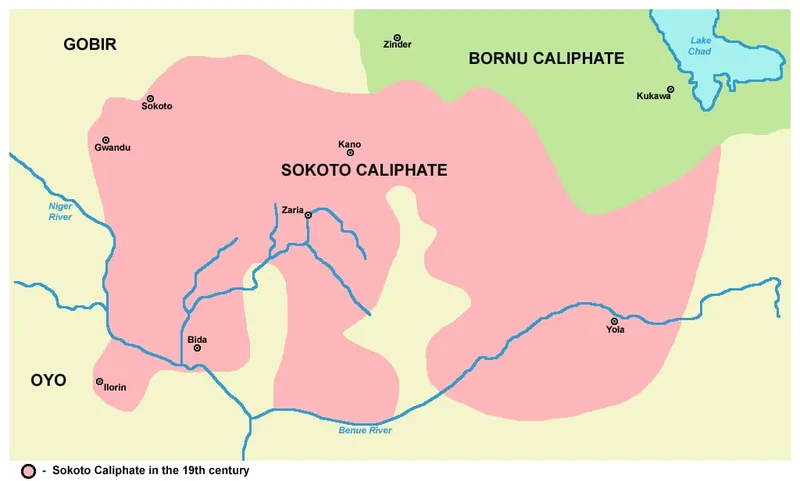
By the 1830s, the Sokoto Caliphate governed more people than any other state in West Africa, a confederation of Islamic emirates that had grown, within a single generation, out of a religious uprising against the region’s existing Hausa kingdoms.
The caliphate’s founder, Usman dan Fodio, was a Fulani Islamic scholar and preacher based in the Hausa city-state of Gobir, in what is now northern Nigeria. Frustrated by what he saw as un-Islamic practices among the Hausa ruling elite and growing persecution of his followers, he declared a jihad on Feb. 21, 1804. Fighting spread across the Hausa states over the following four years, and in 1808 dan Fodio’s forces captured Alkalawa, Gobir’s capital, completing the conquest. Rather than rule directly, dan Fodio divided the new territory among trusted lieutenants and family members as emirs, loosely bound together under a caliph based at Sokoto, a structure that would define the state for the rest of its existence.
The caliphate expanded and consolidated through the early 19th century, absorbing territory from the collapsing Oyo Empire to the southwest and extending its authority across dozens of emirates. By 1837, according to historian Toyin Falola, the Sokoto Caliphate had a population of between 10 and 20 million people, making it the most populous state in West Africa. By around 1900, near the end of its independent existence, its core territory covered roughly 388,500 square kilometers. It functioned less as a single centrally administered empire than as a confederation, with individual emirates retaining substantial local authority under the overall religious and political leadership of the Sultan of Sokoto.
The caliphate’s end came in stages. In 1893 the Sudanese warlord Rabih az-Zubayr conquered the neighboring Kanem-Bornu Empire to the northeast, and by the 1890s European powers were carving up the surrounding region in the Scramble for Africa. British forces under Frederick Lugard began their conquest of Sokoto’s territory around 1900, and though the wider region is often treated as falling under British control that year, the caliphate itself held out for three more years. Muhammadu Attahiru I, the caliphate’s last independent, pre-conquest Sultan, was killed resisting British forces at the Battle of Burmi on July 27, 1903, the actual end of independent Sokoto rule; Britain had already installed a rival claimant, Attahiru II, as the 13th Sultan four months earlier, and the Sultanate of Sokoto has continued as an institution, under British and later Nigerian federal authority, to this day. Under British indirect rule, the emirate structure the caliphate had built survived largely intact, absorbed into the colonial and later Nigerian federal system rather than dismantled outright.
Sources
- “Sokoto Caliphate”, Britannica.
- Luigi Vittorio Muci. “Research Note: Social Transformation and the Spread of 'Purified' Islamic Principles in the 19th-Century Sokoto Caliphate”, International Journal of African Historical Studies, vol. 56, no. 3 (2023), Boston University African Studies Center.
Books & Further Reading
Murray Last, The Sokoto Caliphate (Longmans, 1967)