By Princewill Ubani · Published
Research ID: PA-ART-nok-civilisation-nigeria-terracotta
The Nok Civilisation: Central Nigeria's Terracotta Culture, and What Its Dates Actually Show
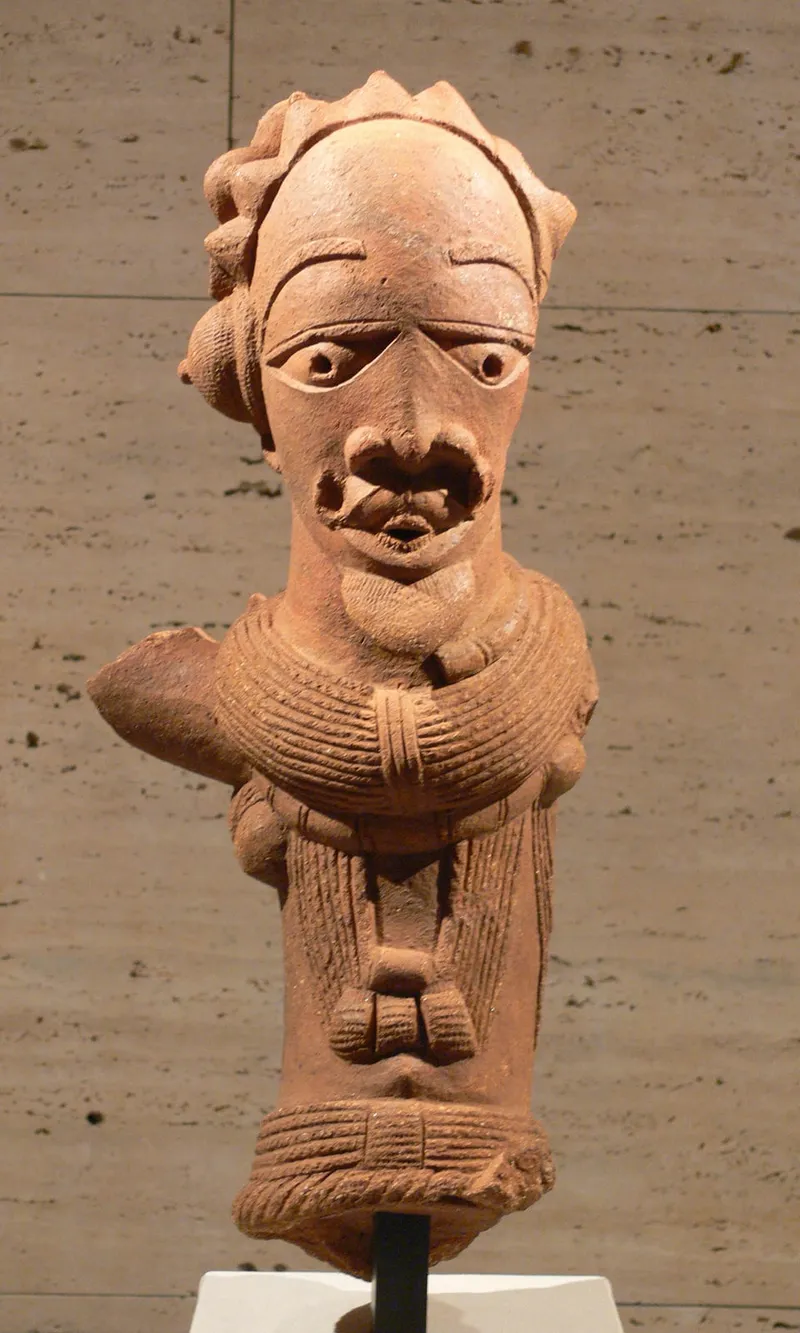
In 1928, a tin miner working an alluvial pit near the village of Nok, in what is now Kaduna State in central Nigeria, dug up a small terracotta head unlike anything documented in the region before. It took another two decades before anyone recognized what he’d found. British colonial archaeologist Bernard Fagg began systematically studying similar figurines turning up across the Nigerian tin fields in the late 1940s and 1950s, and by the time he was done, “Nok” had become the name for one of the earliest and most technically accomplished sculptural traditions ever documented in sub-Saharan Africa.
The figurines themselves are hollow and coil-built, a demanding technique that lets a sculptor shape large forms, some life-size heads and full figures, without the piece collapsing or exploding in the kiln. Human figures typically feature stylized, triangular or elliptical eyes, perforated pupils, and elaborate hairstyles or ornamentation, while animal figures depict elephants, snakes, and other wildlife with comparable detail. What the figurines were for is still debated. Excavations at the site of Taruga uncovered 13 iron-smelting furnaces alongside broken terracotta pieces, leading some archaeologists to argue the objects served a ritual function tied to metalworking itself, though direct evidence for that connection remains circumstantial.
Dating the culture has been an evolving project rather than a settled fact. Early radiocarbon work in the 1960s and 70s, using charcoal and plant matter embedded in the clay, produced a range of roughly 500 BC to 200 AD that circulated widely in popular accounts for decades. More recent research, including the joint archaeological project run by Goethe University Frankfurt and Nigeria’s National Commission for Museums and Monuments since 2005, has pushed the picture both earlier and more precise: an early developmental phase beginning around the middle of the second millennium BC, with the culture’s signature combination of terracotta figurine production and iron smelting emerging in a narrower window from roughly the 9th to the 4th century BC. That makes Nok one of the earliest known sites of iron metallurgy in West Africa, developed independently of, and not clearly derived from, ironworking traditions elsewhere.
What’s better established than the exact dates is what happened to Nok culture and why it took so long to be properly studied. It wasn’t organized as a kingdom or centralized state in any documented sense, no ruler lists or capital cities have been identified, which is part of why archaeologists describe it as a culture rather than an empire. And its recognition was badly delayed by looting: because Nok terracottas command high prices on international art markets, unregulated digging by treasure hunters destroyed the archaeological context of a large share of known pieces before scientists could study them properly, stripping away exactly the stratigraphic evidence that would pin down dates and function with more certainty.
Nigeria’s National Commission for Museums and Monuments has worked with international partners in recent years on both continued excavation and repatriation efforts aimed at recovering looted pieces from foreign collections. What survives, both in museums and in the ground still awaiting proper excavation, remains one of the strongest pieces of physical evidence that sub-Saharan Africa was producing sophisticated, technically demanding art and metallurgy well over two thousand years before European contact, a fact that the accident of a tin miner’s shovel brought to light only in the 20th century.
Sources
- “Bernard Fagg, "Radiocarbon Dating of the Nok Culture, Northern Nigeria," Nature 205, 212 (1965)”.
- “The Archaeology of Nok Culture in Nigeria (2nd/1st Millennium BCE)”, Oxford Research Encyclopedia of African History, Oxford University Press.
Books & Further Reading
Peter Breunig (ed.), Nok: African Sculpture in Archaeological Context (Africa Magna Verlag, 2014, ISBN 9783937248462)