By Princewill Ubani · Published
Research ID: PA-ART-kanem-bornu-empire-lake-chad
Kanem-Bornu: One of Africa's Longest-Lived States
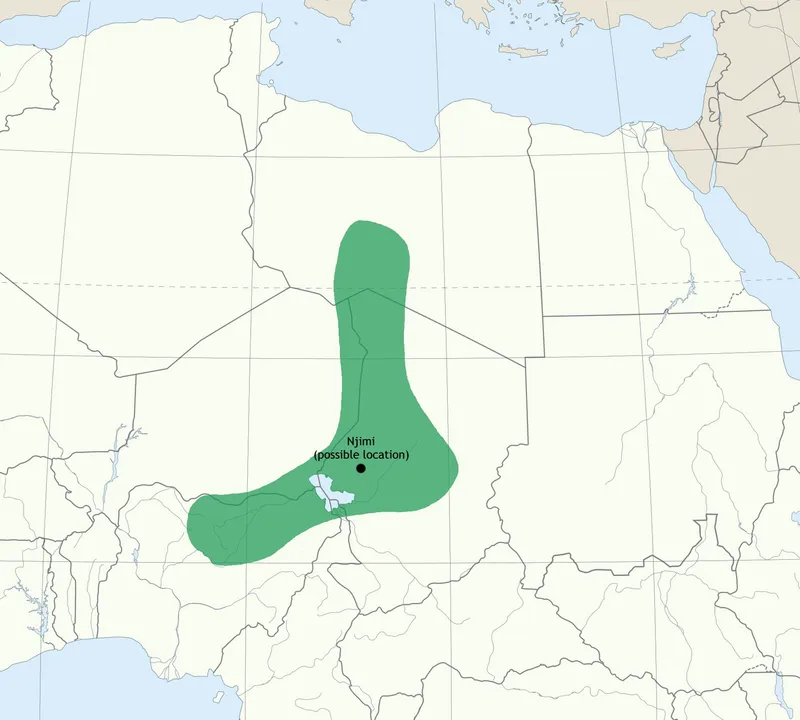
Few African states matched Kanem-Bornu’s staying power. Centered on the Lake Chad basin, it governed some form of continuous territory for roughly a thousand years, from its founding around the 9th century until French forces destroyed its last incarnation in 1900, a span that puts it among the longest-lived states in African history. That millennium of statehood was not the work of a single unbroken dynasty, though: the Sayfawa line that formalized the kingdom in the 11th century ruled for close to 800 years before dying out in 1846, and a separate Kanemi dynasty governed the state’s final decades until Rabih’s 1893 conquest.
The empire began as Kanem, founded on the eastern shore of Lake Chad, with an early capital at Njimi. Its rulers converted to Islam by the 11th century, giving the state a durable link to trans-Saharan trade networks and to the wider Islamic world, including possessions reaching north into the Fezzan region of modern Libya. Political pressure and internal conflict pushed the ruling Sayfawa dynasty to relocate west across the lake into Bornu during the 13th and 14th centuries, where the state, now generally known as Kanem-Bornu, continued under the same royal line.
Kanem-Bornu reached its greatest territorial extent in the 16th and 17th centuries, at various points controlling territory across what is now southern Chad, northeastern Nigeria, eastern Niger, northern Cameroon and southern Libya, sustained by control of trans-Saharan trade routes and a professional army. The empire’s long survival owed much to this trade-based wealth and to a political structure durable enough to weather repeated succession disputes and periods of decline without collapsing outright, a resilience later historians have contrasted with the shorter reigns of empires like Mali and Songhai further west.
Kanem-Bornu’s end was sudden after centuries of continuity. In 1893, the Sudanese warlord Rabih az-Zubayr, a former lieutenant in the Mahdist forces of Sudan, invaded and conquered the empire, ruling the region from the town of Dikwa rather than the traditional capital. Rabih’s own rule proved short-lived: French colonial forces killed him at the Battle of Kousséri on April 22, 1900, just across the modern Cameroon border, and his son Fadlallah was killed the following year resisting the same colonial advance. What remained of Bornu’s territory was subsequently partitioned among Britain, France and Germany, closing out a millennium of continuous statehood in the Lake Chad basin.
Sources
- “Kanem-Bornu”, Britannica.
- “Empire of Kanem-Bornu (ca. 9th century-1900)”, BlackPast.
- Vincent Hiribarren. “Kanem-Bornu Empire”, The Encyclopedia of Empire, Wiley-Blackwell (2016).
Books & Further Reading
Vincent Hiribarren, A History of Borno: Trans-Saharan African Empire to Failing Nigerian State (Hurst, 2017)