By Princewill Ubani · Published
Research ID: PA-ART-gold-coast-to-ghana-1957-independence-naming
From Gold Coast to Ghana: The 1957 Independence and the Name Nkrumah Chose
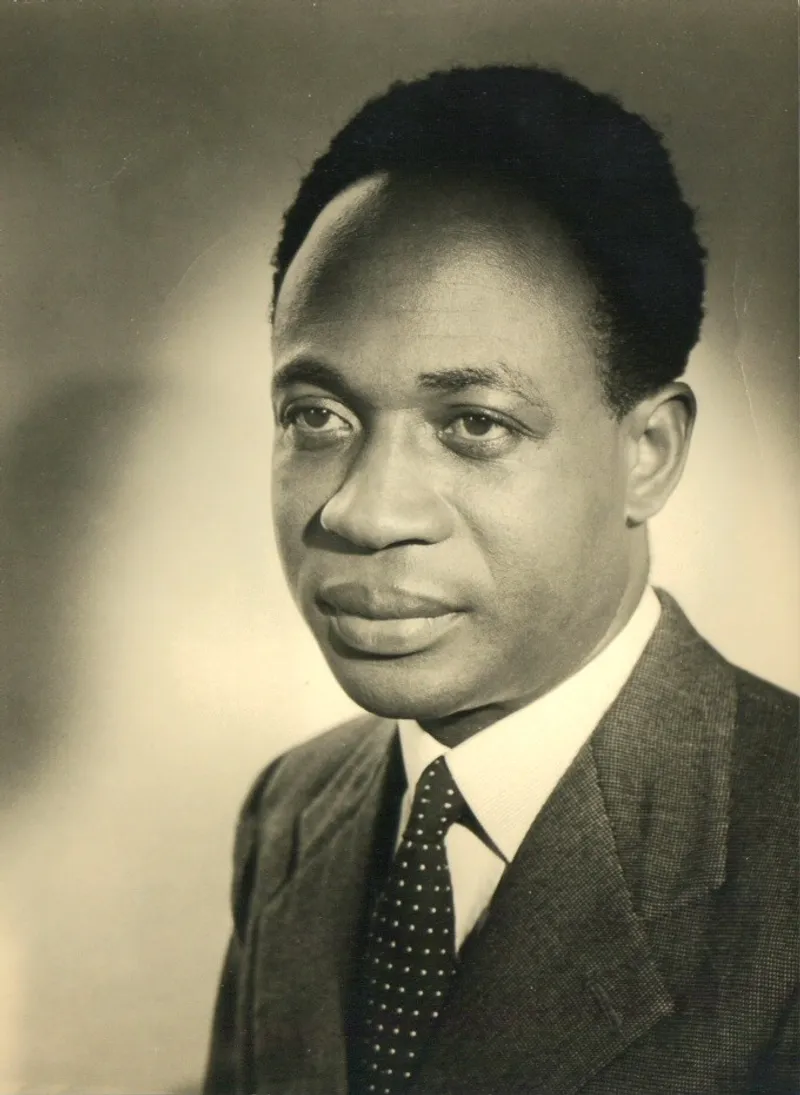
On March 6, 1957, at midnight in Accra, Kwame Nkrumah stood before a crowd and declared: “At long last the battle has ended! And thus Ghana, your beloved country, is free for ever.” With those words, the territory Britain had administered as the Gold Coast, Ashanti, the Northern Territories Protectorate, and British Togoland became the independent state of Ghana, the first sub-Saharan African colony to break from European colonial rule, seven years before most of the continent would follow.
The path there ran through the ballot box rather than armed struggle. Nkrumah’s Convention People’s Party won a decisive majority, 71 of 104 seats, in the 1956 Legislative Assembly election, and on August 3, 1956, the newly elected Assembly adopted his motion demanding independence, specifically under the name Ghana rather than a continuation of “Gold Coast.” The British government, having already committed to accepting the results of a fair election as a mandate, moved to finalize the transfer of power, and independence followed roughly seven months later.
The choice of name was deliberate, not incidental. “Gold Coast” was a European commercial label, one of a set of West African coastal names, the Gold Coast, the Ivory Coast, the Slave Coast, that identified entire stretches of the continent and their peoples by whichever resource colonial traders had come to extract, with no reference to the people who actually lived there. Nkrumah rejected that framing outright, choosing instead to name the new nation after the medieval Ghana Empire, the powerful West African trading state that had flourished centuries earlier controlling the trans-Saharan gold trade, covered in full in “The Ancient Empire of Ghana, and Why It Isn’t the Modern Country”. The two Ghanas share no direct territorial overlap, the medieval empire’s core lay hundreds of miles to the northwest in what is now Mauritania and Mali, but the naming was an act of historical reclamation rather than genealogy: a former colony announcing its independence by reaching past its colonial name to claim descent from a precolonial African power on its own terms.
Nkrumah closed his independence address by widening the moment’s stakes beyond Ghana itself: “Our independence is meaningless unless it is linked up with total liberation of the African continent,” a line that would prove prophetic, as Ghana’s 1957 independence became the opening chapter of a wave of decolonization that reshaped the map of Africa over the following decade, and Nkrumah himself went on to become one of the leading voices of continental Pan-Africanism until his own government was overthrown in 1966, an event covered in “The 1966 Coup Against Nkrumah and the Disputed Question of US Involvement”.
Sources
- “W. Scott Thompson, *Ghana's Foreign Policy, 1957-1966: Diplomacy, Ideology, and the New State* (Princeton University Press, JSTOR)”.
- “Kwame Nkrumah: 'At long last, the battle has ended!' Independence Day, 1957”, Speakola.
- “March 6, 1957: Gold Coast achieves independence as Ghana”, Edward A. Ulzen Memorial Foundation.
- “Ghana demands independence from Britain”, South African History Online.
Books & Further Reading
Jeffrey S. Ahlman, Kwame Nkrumah: Visions of Liberation (Ohio Short Histories of Africa, Ohio University Press, ISBN 9780821424520)