By Princewill Ubani · Published · Updated
Research ID: PA-ART-ancient-empire-of-ghana-wagadou
The Ancient Empire of Ghana, and Why It Isn't the Modern Country
The Ghana of the Middle Ages lay far from the modern republic. The republic is a coastal nation on the Gulf of Guinea, between Côte d’Ivoire and Togo. The medieval kingdom stood in the western Sahel, on the desert edge between the Senegal and Niger rivers, in what is now southeastern Mauritania and western Mali. The Gold Coast took the older kingdom’s name when it declared independence in 1957, as the historian François-Xavier Fauvelle notes, and that story is told in From Gold Coast to Ghana: The 1957 Independence and the Name Nkrumah Chose.
The name itself was never a place name. “Ghana is a title given to their kings,” the Andalusian geographer al-Bakri wrote in 1068; “the name of the region is Awkar.” Arabic writers then used the word for the king’s city and for his realm. Soninke oral tradition remembers a kingdom called Wagadu, which the historian Nehemia Levtzion judged very likely to be the same state.
Al-Bakri never went there. He wrote in Cordoba from the reports of merchants. The king in 1068 was Tunka Manin, who had come to the throne in 1063. The capital, al-Bakri was told, was two towns on a plain six miles apart: a Muslim town with 12 mosques and a royal town beside sacred groves where the kings were buried. The king kept his ancestral religion, but most of his ministers were Muslims.
Ghana’s wealth came from trade, not from mines of its own. The gold came from fields to the south, and the king took tolls: one golden dinar on each donkey-load of salt coming into the country, two on each load going out, five mithqals on a load of copper and ten on a load of other goods. He also reserved every gold nugget for himself and left the dust to his people. Al-Bakri reported that the king could put 200,000 men into the field, more than 40,000 of them archers; the historian Michael Gomez notes that this may describe a force raised in an emergency rather than a standing army.
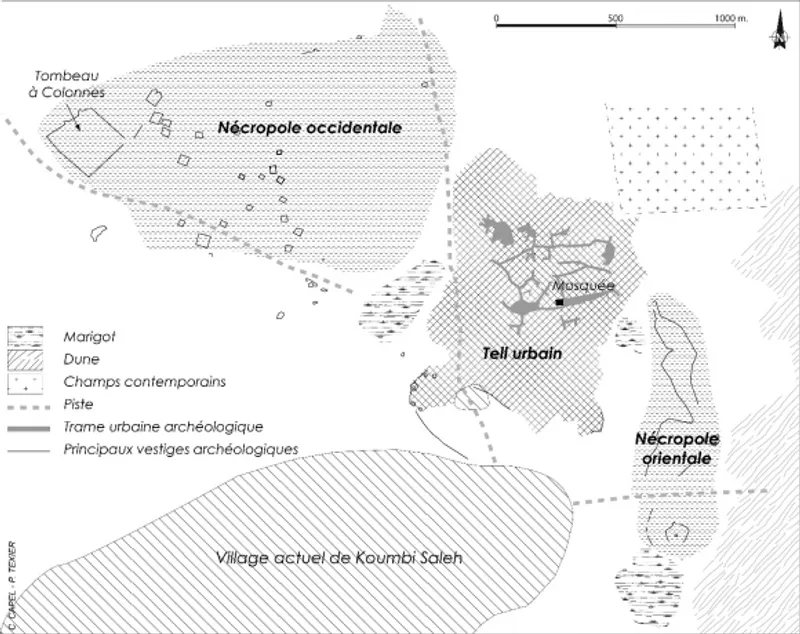
Where exactly the capital stood is still disputed. The ruins at Koumbi Saleh, in southeastern Mauritania, are the leading candidate. Their excavator, Sophie Berthier, found occupation from about the ninth century to the early 15th and judged the identification strengthened for that span, while the archaeologist Timothy Insoll holds that the royal capital itself has not been found.
For much of the 20th century, histories said Ghana fell to an Almoravid conquest in 1076. Historians David Conrad and Humphrey Fisher showed in 1982 and 1983 that no Arabic writer describes that conquest until the 15th century, and that the story took its familiar form in Europe, above all in Maurice Delafosse’s work of 1912. Ghana was still there long afterward. In about 1336 the Cairo writer al-Umari listed it as a province of Mali whose ruler was the only one of the mansa’s subjects still called king.
The full history, with its sources, is on our page on Ghana, the Kingdom of Wagadu.
Correction
Our article on ancient Ghana got al-Bakri's tolls wrong and repeated several claims no source supports.It said the king took about one-sixth of an ounce of gold on each load of salt coming in and one-third of an ounce on goods going out. Al-Bakri gives one golden dinar on each donkey-load of salt brought in, two dinars when it is sent out, five mithqals on a load of copper and ten on a load of other goods (Levtzion and Spaulding 2003, p. 17). It attributed to al-Bakri a goldfield called Wangara kept secret by its miners; the name Wangara is al-Idrisi's, and accounts of a silent gold trade have been largely discredited (Levtzion and Spaulding 2003, p. 33; Garrard 1982, p. 444 n. 9). It said most historians treat al-Bakri's army of 200,000 as inflated, which we could not trace to any historian. It said deforestation strained the capital and that Ghana fell by 1203; we found no source for the first, and the 1203 date rests only on the approximate date of a letter sent to Ghana's king (Conrad and Fisher 1982, pp. 30-31). It dated the kingdom from the sixth century and gave it seven centuries of dominance, placed it partly in eastern Senegal and called Koumbi Saleh its capital without qualification. The article has been rewritten from the sources.Corrected in September 2026. See the log entry.
Sources
- “Nehemia Levtzion and Jay Spaulding (eds.), Medieval West Africa: Views from Arab Scholars and Merchants (Markus Wiener, 2003), pp. 9-18 (al-Bakri)”.
- “Michael A. Gomez, African Dominion: A New History of Empire in Early and Medieval West Africa (Princeton University Press, 2018), pp. 30-42”.
- “François-Xavier Fauvelle, The Golden Rhinoceros: Histories of the African Middle Ages (Princeton University Press, 2018), pp. 56-61”.
- “David Conrad and Humphrey Fisher, "The Conquest That Never Was: Ghana and the Almoravids, 1076," History in Africa 9 (1982) and 10 (1983)”.
- “Patrick J. Munson, "Archaeology and the Prehistoric Origins of the Ghana Empire," The Journal of African History, Vol. 21, No. 4 (1980)”.
Books & Further Reading
Nehemia Levtzion, Ancient Ghana and Mali (Studies in African History 7, Methuen, 1973, ISBN 9780416758207)