By Princewill Ubani · Published
Research ID: PA-ART-lydenburg-heads-south-africa
The Lydenburg Heads: Southern Africa's Oldest Known Sculpture
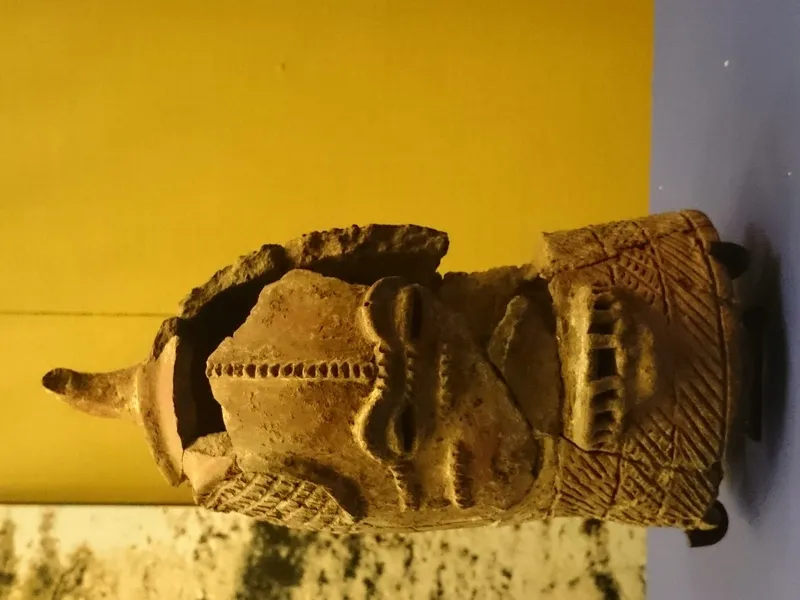
Seven terracotta heads, some large enough to fit over a person’s own head, sat buried in a pit on a farm outside Lydenburg, in what is now South Africa’s Mpumalanga province, for well over a thousand years before a boy named Ludwig von Bezing found them while playing on his father’s land in the late 1950s. He reported the discovery to Ray Inskeep, an archaeologist at the University of Cape Town, and the excavation that followed uncovered a set of sculptures unlike anything previously documented from the region’s ancient past.
Inskeep and fellow archaeologist Tim Maggs published the first full scholarly description of the find in 1975, in a paper for the South African Archaeological Bulletin titled “Unique Art Objects in the Iron Age of the Transvaal.” Their analysis identified seven hollow ceramic heads in total, ranging from roughly life-size down to smaller versions likely designed to be mounted on poles rather than worn, decorated with raised lines, punctate patterns and stylized facial features that Inskeep and Maggs interpreted as evidence of a coherent ritual tradition rather than isolated artistic experiments. Radiocarbon dating placed the heads to roughly the 5th through 7th centuries AD, squarely within the Early Iron Age period in southern Africa, a time when Bantu-speaking farming communities were establishing settled agricultural life across much of the region.
That dating makes the Lydenburg Heads the oldest known sculptural art from anywhere south of the equator on the African continent, predating other well-documented southern African sculptural traditions by centuries. Their function remains a matter of ongoing archaeological interpretation: the larger heads, sized to be worn, suggest use as ceremonial masks in initiation rites or other communal rituals, though no written record survives from the community that made them to confirm exactly how or why they were used, and researchers have continued refining that picture, including more recent organic residue analysis of pottery from the same site aimed at reconstructing the daily lives of the farming community that produced the heads.
The original Lydenburg Heads are now held by the Iziko Museums of South Africa in Cape Town, with replicas displayed at the South African Museum and elsewhere, and they remain one of the country’s most significant Iron Age archaeological finds, a set of objects that pushed back the documented history of figurative sculpture in southern Africa by centuries and did so because a child happened to notice something unusual in the dirt of his father’s farm.
Sources
- “Lydenburg heads”, University of Cape Town, Centre for Curating the Archive.
- “Lydenburg Bantus Sculpt Life-Size Terra-cotta Heads”, EBSCO Research Starters.
Books & Further Reading
R.R. Inskeep and T.M. O'C. Maggs, "Unique Art Objects in the Iron Age of the Transvaal," South African Archaeological Bulletin, Vol. 30 (1975), pp. 114-138