
By Princewill Ubani · Published
Research ID: PA-ART-adams-calendar-south-africa-myth
Adam's Calendar: A 400-Year-Old Cattle Enclosure Marketed as a 200,000-Year-Old Metropolis
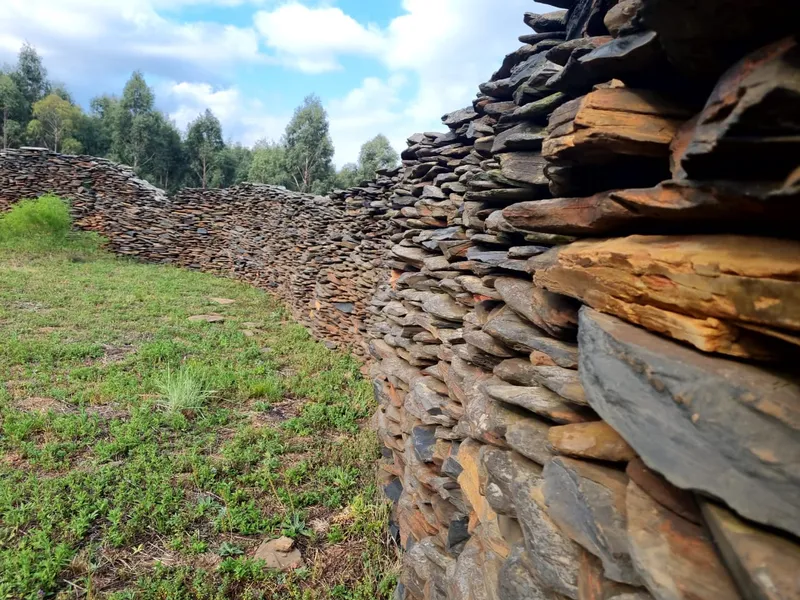
A stone circle in South Africa’s Mpumalanga province, near the town of Kaapsehoop, has circulated online for two decades under a name it never had in any archaeological record: “Adam’s Calendar,” described in viral posts and self-published books as a 200,000-to-300,000-year-old astronomically aligned metropolis, sometimes attributed to ancient alien builders. Its formal archaeological name is the Blaauboschkraal stone ruins, and the gap between that designation and the popular one traces to a specific pair of promoters rather than to any archaeological excavation or peer-reviewed dating study.
The site was brought to public attention in 2003 by Johan Heine, a South African bush pilot who had spotted stone circles from the air. Heine partnered with Michael Tellinger, a businessman and self-published author with no formal training in archaeology, geology, or archaeoastronomy, who rebranded the site “Adam’s Calendar” and built a body of popular books and media appearances around claims that it was built roughly 200,000 to 300,000 years ago, aligned to Orion, and possibly linked to extraterrestrial or “ancient astronaut” builders, a framework explicitly influenced by Zecharia Sitchin’s discredited ancient-astronaut writings.
Archaeologists who have examined the site’s actual construction reach a very different conclusion. The stone circles and surrounding walled enclosures across the Mpumalanga escarpment are widely identified as the work of the Bakoni people, whose stone-walled agricultural and pastoral settlements date to a period roughly spanning the 15th to 19th centuries, not tens or hundreds of thousands of years ago. Some archaeologists assess specific structures like the Blaauboschkraal circle as likely functioning as a cattle enclosure rather than an astronomical instrument, and independent technical review of Tellinger’s claimed stellar alignments, including the purported orientation toward Orion, found the alignments simply don’t hold up under measurement.
No radiocarbon dating, stratigraphic excavation, or peer-reviewed archaeological study has ever produced evidence supporting the 200,000-year figure attached to the site in popular circulation; the number appears to originate entirely from Tellinger’s own claims rather than from any dated archaeological sample. The Bakoni stone-walled settlements themselves are a real and significant part of precolonial southern African history in their own right, evidence of established agropastoral communities that built extensive stone infrastructure across the highveld well before European contact, a genuine archaeological story that doesn’t require an invented age ten thousand times older than what the physical evidence supports.
Sources
- “Peter Delius and Maria Schoeman, "Bokoni: Old Structures, New Paradigms? Rethinking Pre-colonial Society from the Perspective of the Stone-Walled Sites in Mpumalanga," Journal of Southern African Studies, Vol. 38, No. 2”.
- “Adam's Calendar: A 300,000-Year-Old Alien Site in Africa?”, Historic Mysteries.
Books & Further Reading
Peter Delius, Tim Maggs, and Alex Schoeman, Forgotten World: The Stone-Walled Settlements of the Mpumalanga Escarpment (Wits University Press, 2014, ISBN 9781868147748)