
By Princewill Ubani · Published
Research ID: PA-ART-laetoli-footprints-tanzania-australopithecus
The Laetoli Footprints: 3.6 Million Years Old, Preserved by a Volcano
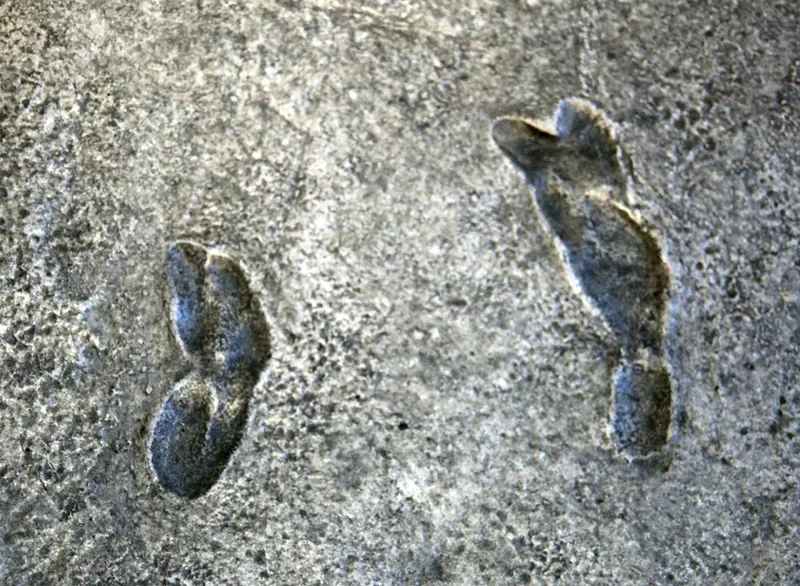
In 1978, a team led by paleoanthropologist Mary Leakey, working at the Laetoli site in northern Tanzania, uncovered something no fossil bone could ever show directly: a trail of actual footsteps, preserved in what had once been a layer of wet volcanic ash. The trail runs about 27 meters and contains roughly 70 individual footprints made by at least two, and probably three, individuals walking side by side, their prints later blanketed and sealed by additional ash falls from a nearby volcano, most likely Sadiman, that hardened into rock and protected the impressions for millions of years.
The dating is precise for evidence this old. Radiometric analysis of the surrounding volcanic layers places the footprints at roughly 3.6 million years, within a broader Laetoli fossil sequence spanning from about 3.76 to 3.46 million years ago. That makes them older than any other confirmed hominin footprint site and, more importantly, the earliest direct physical evidence anywhere of a defining human trait: walking upright on two legs with a modern, heel-to-toe stride pattern, rather than the more ape-like, bent-hip gait some scientists had assumed characterized our ancestors at this stage of evolution.
No skeleton was found walking through that ash, so the footprints can’t be attributed to a specific fossil individual with certainty, but the timing and location point strongly to Australopithecus afarensis, the same species as the famous “Lucy” skeleton found at Hadar in Ethiopia, dated to a similar period and known to have inhabited the region. Analysis of the footprint sizes shows a smaller individual walking to the left of a notably larger one, with a third, medium-sized individual apparently stepping directly into the larger one’s prints, a detail that’s fueled ongoing scientific discussion about the social behavior, possible pair-bonding, and body-size variation among these early hominins, questions bones alone can’t answer nearly as directly.
Additional footprint trails have been found at Laetoli in subsequent decades, including a second, previously overlooked set uncovered and properly excavated only in the 2010s that showed even more pronounced size variation between individuals than the original 1978 discovery. Laetoli remains one of only a small number of footprint sites anywhere in the human fossil record, and by a wide margin the oldest, giving paleoanthropologists something rarer than bones: a literal, frozen moment of ancient behavior rather than an inference drawn from anatomy alone.
Sources
- “"New footprints from Laetoli (Tanzania) provide evidence for marked body size variation in early hominins," eLife”.
- “Laetoli Footprint Trails”, Smithsonian Institution's Human Origins Program.
Books & Further Reading
M. D. Leakey and J. M. Harris (eds.), Laetoli: A Pliocene Site in Northern Tanzania (Oxford University Press, 1987, ISBN 0198544413)