
By Princewill Ubani · Published
Research ID: PA-ART-idi-amin-justification-asian-expulsion
Idi Amin's Own Justification for Expelling Uganda's Asians
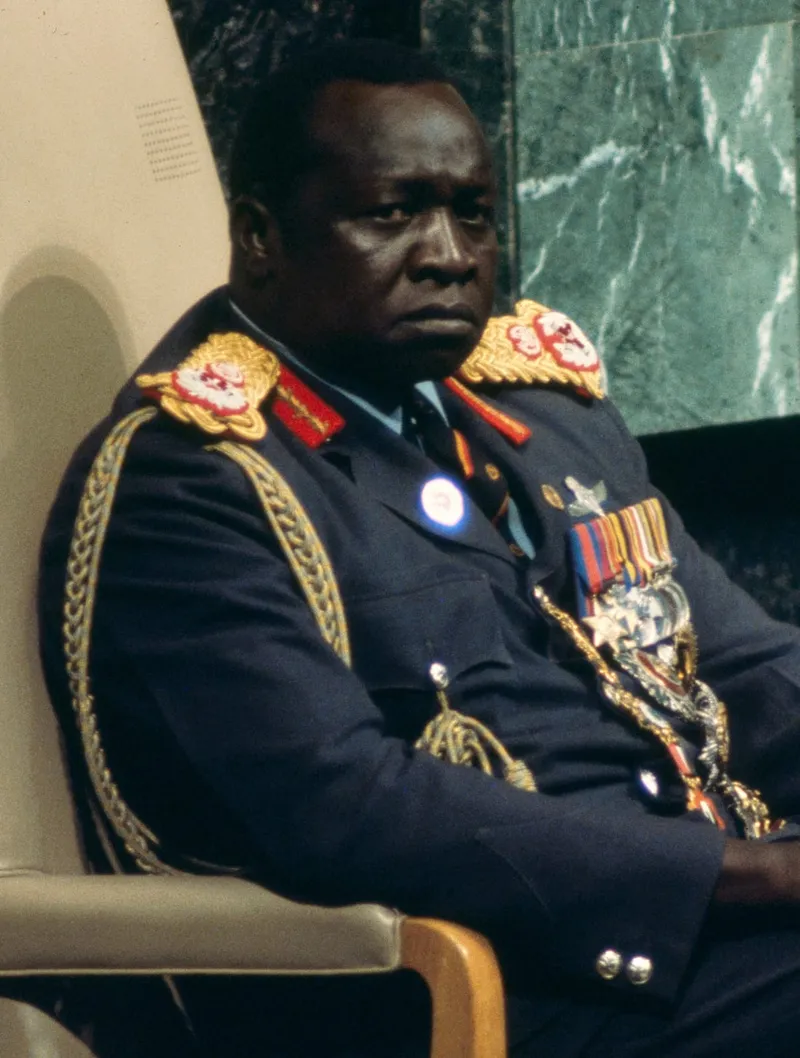
When Idi Amin ordered Uganda’s roughly 80,000 Asians to leave the country in August 1972, a decision covered in full elsewhere on this site in “Idi Amin’s 1972 Expulsion of Uganda’s Asian Population”, he did not present it as a straightforward act of state policy. He told Ugandans that God had spoken to him directly in a dream, instructing him to expel the community, a claim he repeated publicly and one that shaped how the expulsion was received domestically as much as any economic argument he made. According to accounts of his statements at the time, Amin’s version of the divine instruction was blunt and specific: “Asians came to Uganda to build the railway. The railway is finished. They must leave now,” a reference to the Uganda Railway workforce many Ugandan Asian families’ ancestors had originally arrived to build under British colonial rule decades earlier.
Alongside the dream, Amin offered a harder-edged economic case, framing the expulsion as what he called an “economic war” to transfer control of Uganda’s commerce from its Asian minority, whom he accused of “sabotaging Uganda’s economy” and “encouraging corruption,” to Black Ugandans he said had been “enslaved economically since the time of the colonialists.” He cast the policy in redemptive, almost religious terms that went beyond ordinary political rhetoric: “This is the day of salvation for the Ugandan Africans,” he declared. “This is the day of the redemption of the Ugandan Africans.” The mix of claimed divine sanction and economic nationalism gave the expulsion a moral certainty in Amin’s own telling that made it difficult for outside governments to argue against without appearing to defend a colonial-era economic order.
Foreign governments, watching an already unpredictable leader, largely chose not to confront him directly over the justification. A declassified US State Department telegram from the period instructed American diplomats to “minimize our public involvement” in the matter and avoid taking a lead role in raising it internationally, reasoning that public pressure was more likely to harden Amin’s position than soften it. The approach reflected a wider diplomatic caution toward Amin in the early 1970s, one that left his own stated reasons, dream, economic grievance, and redemptive nationalism largely unchallenged in the international arena even as the expulsion’s human and economic toll became clear.
Sources
- “"Expulsion as Decolonization: Idi Amin's Ghost, Asian 'Repossession,' and Redomination of Uganda's Economy," Public Culture, Vol. 36, No. 3 (Duke University Press)”.
- “Idi Amin: The Expulsion of South Asians from Uganda”, Manchester Historian.
- “Telegram 157288 From the Department of State to the Embassy in Uganda”, US Department of State, Office of the Historian.
Books & Further Reading
Yusuf K. Serunkuma, "Expulsion as Decolonization: Idi Amin's Ghost, Asian 'Repossession,' and Redomination of Uganda's Economy," Public Culture, Vol. 36, No. 3 (2024), pp. 393-411