
By Princewill Ubani · Published
Research ID: PA-ART-972540665434460160
The 1900 Buganda Agreement and the Limits It Set on the Kabaka
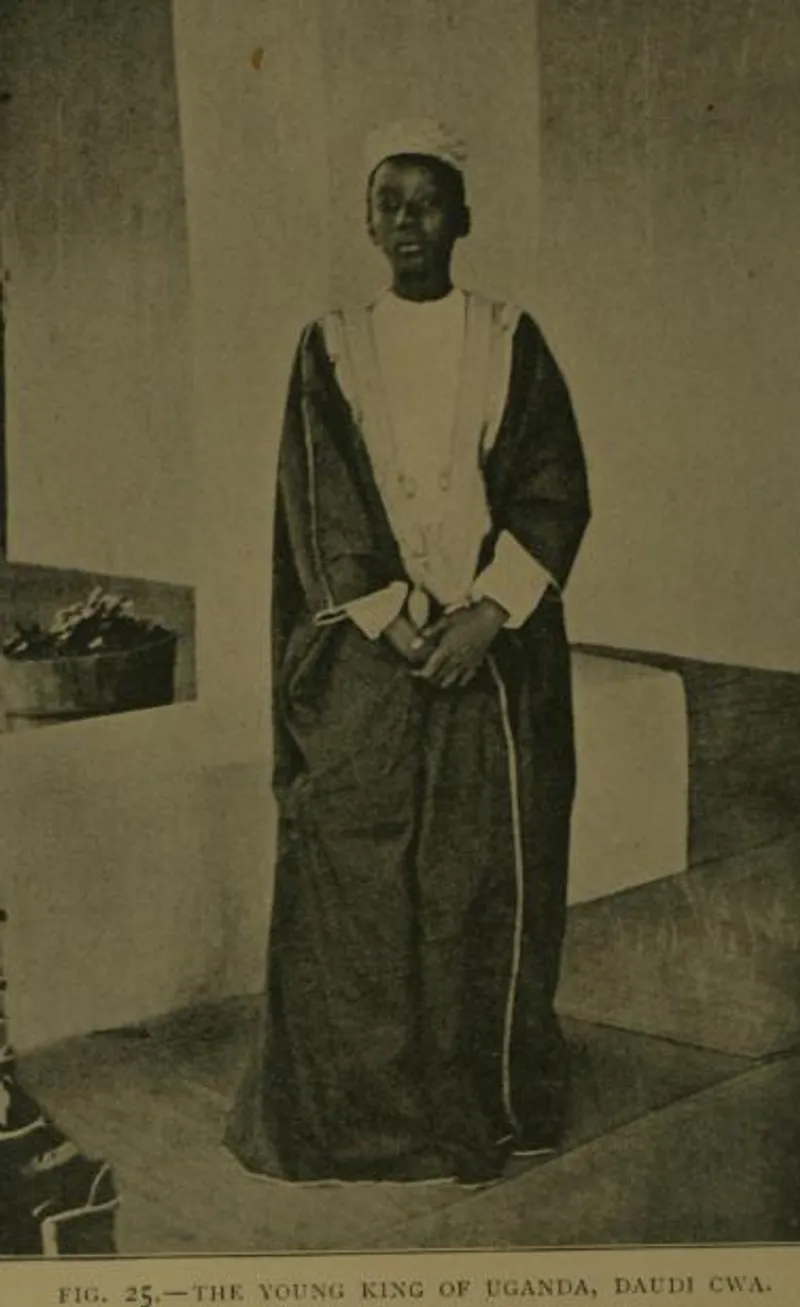
Sir Harry Johnston, who had arrived in Uganda the previous year as Britain’s special commissioner, signed an agreement at Mengo on March 10, 1900, with three men governing Buganda on behalf of its infant king: Katikiro Apollo Kaggwa, Stanislaus Mugwanya and Zakaria Kisingiri, regents for the young Kabaka, Daudi Chwa II, who had taken the throne as a baby in 1897 after his father, Mwanga II, was deposed and exiled to the Seychelles. Historians Donald Anthony Low and Robert Cranford Pratt, in the academic study that remains the standard reference on the period, wrote that few colonial-era agreements were as consequential or as detailed as the document Johnston and the regents put their names to that day.
The agreement’s land settlement did the most to reorder Buganda society. British surveyors divided the kingdom’s roughly 19,600 square miles into four categories: 350 square miles became the Kabaka’s own royal estate, with further land set aside separately for the queen mother and other royals; a further share went to the three regents in their official capacities; about 8,000 square miles were parceled out as private mailo land to roughly 1,000 chiefs and other loyalists, creating an entirely new landed gentry; and the remainder, close to 9,000 square miles, was classified as Crown land under direct colonial control. Buganda also lost its traditional right to collect tribute from vassal kingdoms such as Busoga, which the British took over themselves while introducing a hut tax and a gun tax, each four shillings a year, and capping how many firearms Baganda could legally own, five per commoner and only 50 for the Kabaka himself, down sharply from the roughly 2,000 guns Mwanga had been able to mobilize during his own revolt against the British less than five years earlier.
The agreement gave the Lukiiko, Buganda’s native council, statutory recognition and let the Kabaka govern through it, appointing notables to sit alongside the county chiefs, but the British reserved final say over dismissing anyone the Kabaka appointed, and no future Kabaka could take the throne without London’s approval. In exchange, the Crown granted the Kabaka an annual stipend of 500 pounds and the three regents 300 pounds apiece. Kaggwa, who went on serving as Katikiro until 1926, later visited England in 1902 for King Edward VII’s coronation and was made a Knight Commander of the Order of St Michael and St George, an honor that sat uneasily against critics’ later charge that he and his fellow regents had used the 1900 land settlement to enrich themselves along with the kingdom’s new landholding class.
The 1900 Agreement outlasted its signatories by decades, remaining the basic legal framework governing British Uganda’s relationship with Buganda until a new agreement replaced it in 1955. Buganda’s comparatively favorable terms, more detailed and generous than the agreements Britain later signed with Toro in 1900 and Ankole in 1901, gave the kingdom a privileged position within the wider protectorate that shaped Ugandan politics well beyond the colonial period, while the mailo land system it created left a legacy of landless tenant farmers and disputed titles that Ugandan governments, from Idi Amin’s 1970s land decree to more recent legislation, have never fully resolved.
Sources
- “The 1900 Buganda Agreement That Sealed Colonial Rule”, Monitor (Uganda).
- “Review: Buganda and the British”, Cambridge University Press, Journal of African History.
Books & Further Reading
D. A. Low and R. C. Pratt, Buganda and British Overrule, 1900-1955: Two Studies (Oxford University Press for the East African Institute of Social Research, 1960)
Also posted once more between 2020 and 2018.