By Princewill Ubani · Published · Updated
Research ID: PA-ART-1897-benin-punitive-expedition-bronzes
The 1897 Sack of Benin City and the Looting of the Benin Bronzes
In February 1897, a British force marched on Benin City, the capital of the Kingdom of Benin in what is now southern Nigeria, in what British officials called a “punitive expedition.” The stated justification was retaliation: weeks earlier, a British delegation attempting to enter the city, against explicit warning that a religious ceremony made the visit impossible at that time, had been ambushed and most of its members killed. The naval commander had planned to land 1,200 men and cut the number to 700. Britain’s actual interest in Benin predated that incident by years, tied to control over the palm oil trade and the kingdom’s position as one of the last major precolonial West African states still resisting formal British annexation.
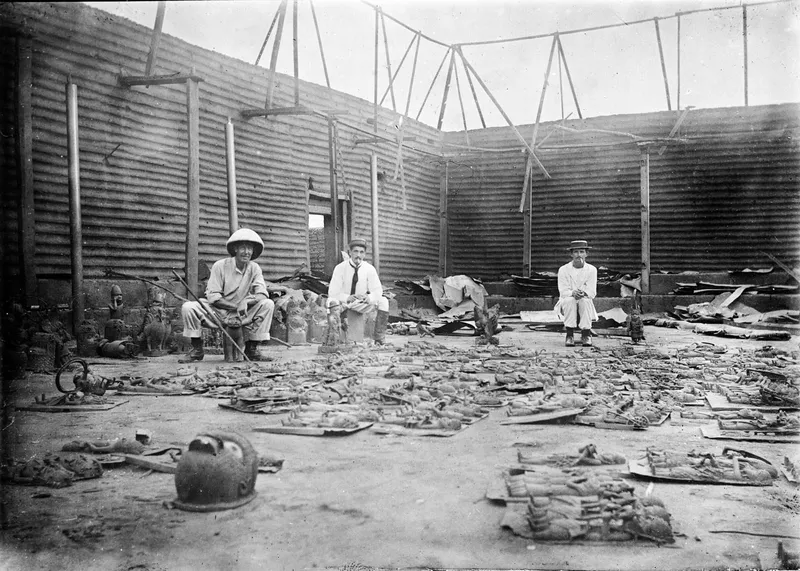
What followed went well beyond retaliation. British forces burned Benin City to the ground, killed an unknown but substantial number of its residents, and forced Oba Ovonramwen Nogbaisi, the kingdom’s ruler, into exile in Calabar, where he died in 1914 without returning home. Troops then systematically looted the royal palace and its shrines, carrying off thousands of objects. Felix von Luschan counted about 2,400 in 1919, and Philip Dark put the total at “some four thousand or so, or perhaps more” in 1982. They included bronze plaques and commemorative heads documenting centuries of Benin’s royal history, carved ivory tusks, coral regalia, and other ceremonial works produced by Benin’s guild artisans over a tradition stretching back to at least the 13th century.
The looted material didn’t stay together. British authorities sold a significant share of it at auction, both to offset the expedition’s costs and, according to the historical record Dan Hicks compiles in his 2020 study The Brutish Museums, to reward the officers and soldiers who took part. From those initial sales, the objects scattered across the art market and into museum collections throughout Europe and North America over the following decades, a dispersal so extensive that pieces from a single royal palace’s holdings now sit in roughly 165 different institutions and countless private collections worldwide, from the British Museum and Germany’s Ethnological Museum to university collections and small regional museums that acquired individual pieces without any documented connection to Benin’s history beyond a single 1897 sale record.
That scattering is what makes the Benin Bronzes’ restitution, an effort that has gathered pace since the early 2020s with Germany’s transfer of over 1,100 pieces to Nigeria in 2022 and smaller returns from institutions including the University of Aberdeen and the Church of England, logistically and legally complicated in a way few other cases of colonial-era looting are. Each holding institution negotiates its own return separately, on its own timeline, working from provenance records that trace back to the same ten-day expedition of February 1897, making the sack of Benin City not just a historical atrocity but the shared origin point of a restitution process still working itself out more than a century later.
Corrections
Our 1897 Benin expedition article overstated the loot and gave the planned size of the British force as its actual size.It said an estimated 4,000 to 5,000 objects were taken. The published estimates are about 2,400, counted by Felix von Luschan in 1919, and "some four thousand or so, or perhaps more," Philip Dark's 1982 figure (Lundén 2016, p. 7). It said a force of roughly 1,200 men marched on Benin City; that was the number planned, and the commander-in-chief cut the landing force to 700 (Bacon 1897, p. 34). Both are now corrected.Corrected in September 2026. See the log entry.
The 1897 sack of Benin City: the length of the expedition.Described as a three-day expedition. The Benin Expedition ran from February 9 to 18, 1897.Corrected in September 2026. See the log entry.
Sources
- Staffan Lundén. “Displaying Loot: The Benin Objects and the British Museum”, University of Gothenburg, 2016.
- Reginald Bacon. “Benin: The City of Blood”, Arnold, 1897.
- “The British raid on Benin 1897”, National Museums Scotland.
- “Britain's pillaging of the Benin Bronzes begs for a reasonable resolution”, The Art Newspaper.
Books & Further Reading
Dan Hicks, The Brutish Museums: The Benin Bronzes, Colonial Violence and Cultural Restitution (Pluto Press, 2020, ISBN 9780745341767)