By Princewill Ubani · Published
Research ID: PA-ART-1026559377157894146
The 1861 Treaty That Made Lagos a British Colony
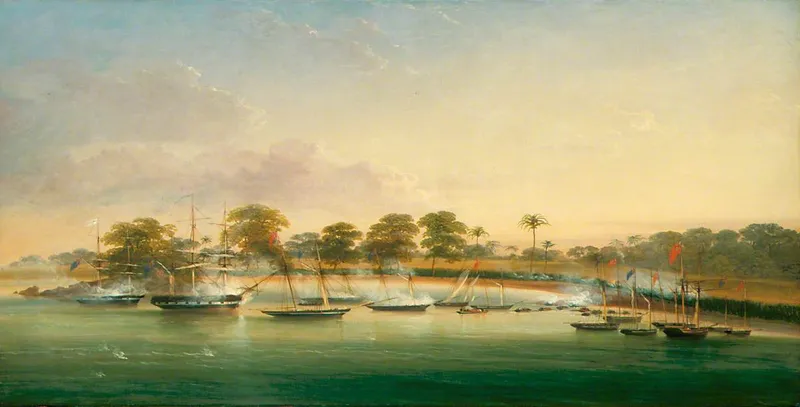
On August 6, 1861, Oba Dosunmu of Lagos, known to British officials as “Docemo,” signed a treaty ceding sovereignty over Lagos to the British Crown, ending the island kingdom’s independence and opening what would become Britain’s colonial rule in Nigeria.
The annexation was the culmination of a decade of escalating British pressure. In December 1851, the Royal Navy had already bombarded Lagos once, in what became known as the Reduction of Lagos, an operation aimed at suppressing the slave trade still passing through the port and at removing Oba Kosoko, whom British officials considered too committed to slave trafficking. That attack deposed Kosoko and installed his rival Akitoye, Dosunmu’s father, in his place, and it demonstrated that Britain was prepared to use naval force to get the outcomes it wanted from Lagos’s rulers. When Akitoye died in 1853 and Dosunmu inherited the throne, he inherited an unresolved contest for power in Lagos alongside growing British demands for control over customs revenue, land disputes and commercial regulation, demands that hardened into a push for outright annexation by 1861.
The final negotiation played out with British warships anchored in the harbor. Commander Norman Bedingfield of HMS Prometheus and Acting Consul William McCoskry met Dosunmu aboard the ship on July 30, 1861, laid out Britain’s terms, and gave him roughly a week to respond. Dosunmu resisted initially, but the threat of a bombardment similar to the one that had toppled Kosoko a decade earlier persuaded him to sign. Under the treaty’s terms, Dosunmu kept the local title and ceremonial powers of a king, including limited authority to adjudicate disputes among Lagos’s own people, but sovereignty passed entirely to Britain; he also received an annual pension, later fixed in a supplementary article signed in February 1862, in exchange for giving up his trading revenues and customs income. Lagos was formally proclaimed a British Crown Colony on March 5, 1862.
Administratively, the new colony did not stay independent for long: Lagos was governed from Sierra Leone between 1866 and 1874, then folded into the Gold Coast colony from 1874 to 1886, before regaining its own separate governor that year. Economically, annexation redirected Lagos’s trade networks toward British commercial interests, especially the palm oil trade that had become the region’s dominant export after the decline of the transatlantic slave trade. The colony’s boundaries would eventually expand far beyond the original island, and Lagos went on to become the administrative capital of the unified Colony and Protectorate of Nigeria in 1914, more than half a century after Dosunmu’s forced signature made it a British possession.
Sources
- “Gunboats at the Lagoon: How Britain Forced the Cession of Lagos and Turned It Into a Crown Colony”, Historical Nigeria.
- “Lagos”, Encyclopedia Britannica.
Books & Further Reading
Robert S. Smith, The Lagos Consulate, 1851-1861 (University of California Press, 1979/2020, ISBN 9780520325838)