
By Princewill Ubani · Published
Research ID: PA-ART-zanj-rebellion-abbasid-iraq
The Zanj Rebellion: A 14-Year Slave Revolt That Shook the Abbasid Caliphate
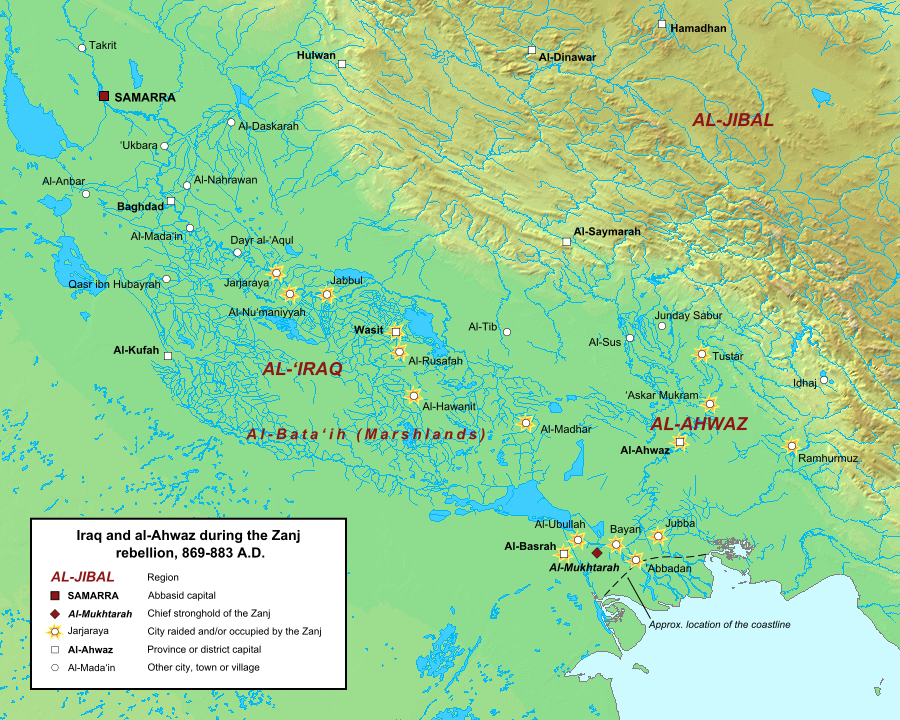
Long before the transatlantic slave trade, thousands of East Africans, known in Arabic sources as the Zanj, had been brought to southern Iraq to perform some of the most grueling forced labor of the medieval world: draining and clearing the salt-crusted marshlands east of Basra so the land could be farmed. Landowners subjected these laborers, most of whom spoke no Arabic and worked in large gangs under brutal conditions, to minimal food and no realistic path out of bondage. In September 869, that arrangement collapsed into one of history’s longest and largest slave uprisings.
The revolt’s leader wasn’t himself Zanj. Ali ibn Muhammad was a Persian who claimed descent from the Prophet Muhammad’s family and adopted the religious and political framework of the Kharijites, a movement that had long challenged mainstream Islamic political authority. He organized the enslaved laborers around a promise of freedom and material reward, and the rebellion spread quickly beyond its original base, drawing in not only Zanj slaves but also, according to the fullest modern academic study of the revolt, Bedouin fighters, other categories of enslaved and free laborers, and soldiers who deserted from Abbasid garrisons, complicating the popular characterization of the uprising as a purely Zanj slave revolt in ethnic terms alone.
What followed was 14 years of sustained conflict that the Abbasid Caliphate, then one of the most powerful states in the world, struggled badly to contain. Rebel forces captured and held territory across southern Iraq, including at points threatening Basra itself, and even established a fortified capital city of their own, named al-Mukhtara. Contemporary chroniclers writing decades and centuries after the fact, including the historians al-Tabari and al-Masudi, described the revolt in some of the most alarmed terms used for any internal Abbasid crisis, framing it as uniquely destructive among the many uprisings that troubled the caliphate’s central authority during this period.
The Abbasids eventually crushed the rebellion in 883, after mobilizing significant military resources under al-Muwaffaq, the Abbasid regent and de facto ruler who directed the caliphate’s military campaigns (he never became caliph himself, dying in 891, a year before his brother al-Mu’tamid; al-Muwaffaq’s own son, al-Mu’tadid, later took the throne), and Ali ibn Muhammad was killed as government forces retook al-Mukhtara. What happened to the rebellion’s Zanj participants afterward, and how directly the revolt shaped later patterns of slavery and labor in the Islamic world, is a subject modern historians describe as understudied relative to its scale, noting that mentions of the Zanj Rebellion in both Middle Eastern and Western historical writing have often been brief or treated as a minor footnote rather than examined on its own terms as one of the largest slave uprisings recorded anywhere before the modern era.
Sources
- “Zanj rebellion”, Encyclopaedia Britannica.
- “Zanj Revolt in the Abbasid Caliphate (Iraq), Oxford Research Encyclopedia of African History, Oxford University Press”.
Books & Further Reading
Alexandre Popovic, The Revolt of African Slaves in Iraq in the 3rd/9th Century (Markus Wiener Publishers, 1999, ISBN 9781558761636)