By Princewill Ubani · Published
Research ID: PA-ART-360032845932138498
The Jamaican Maroons: Escaped Slaves Who Fought the British to a Standstill
When England seized Jamaica from Spain in 1655, some of the enslaved Africans held on the island’s plantations did not wait to see what their new colonial masters intended. They fled into Jamaica’s mountainous, densely forested interior, joining earlier escapees and remnants of the island’s indigenous Taino population to form free communities the English called Maroons, a name drawn from the Spanish cimarrón, meaning wild or untamed. Over the following decades, those communities split geographically into two main groups, the Leeward Maroons in Jamaica’s western interior and the Windward Maroons in the rugged terrain of the east, each developing its own leadership and military tactics built around intimate knowledge of terrain the British found nearly impossible to navigate.
Leadership fell to figures who became central to Jamaican national memory. Cudjoe led the Leeward Maroons, commanding forces alongside Accompong, while the Windward Maroons were led militarily and spiritually by Quao and by Nanny, an Akan-descended priestess and strategist whose command of guerrilla warfare made her, by most accounts, the most formidable Maroon leader of either group. Sporadic resistance had simmered since the 1655 conquest, but organized fighting between Maroon communities and British colonial forces escalated into what came to be called the First Maroon War around 1728 and continued for roughly a decade, inflicting losses substantial enough that the British colonial government abandoned hope of subduing the Maroons militarily and moved instead toward negotiation.
That shift produced two treaties in 1739. Cudjoe signed for the Leeward Maroons on March 1, an agreement of 15 articles granting his people formal freedom and 1,500 acres of land in exchange for future cooperation with colonial authorities; Quao signed a similar 14-article treaty for the Windward Maroons on December 23 of the same year. Both treaties secured the Maroons’ own liberty and self-governance, a settlement that would let them remain free and largely autonomous until slavery itself was abolished across the British Empire in 1834, but at a lasting cost: both agreements obligated Maroon communities to help suppress future slave uprisings and to return any enslaved people who fled to them afterward, terms that tied the Maroons’ hard-won freedom to enforcing the bondage of others.
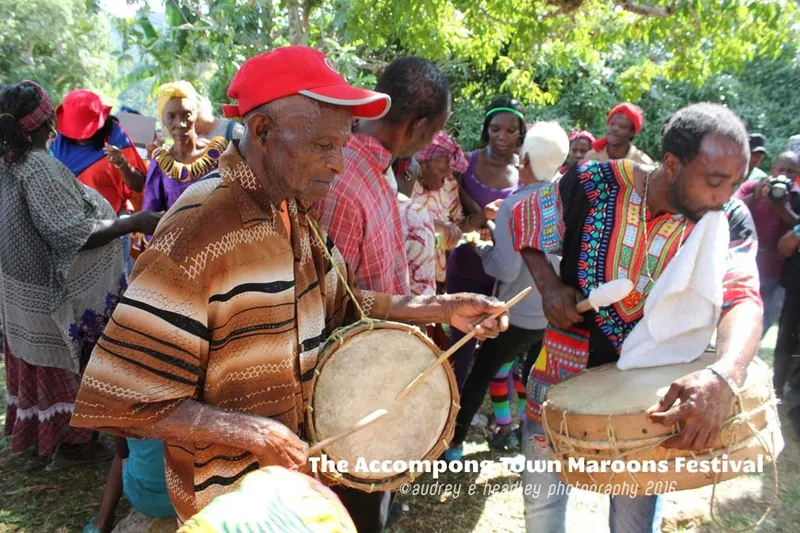
Maroon communities descended from that settlement still exist in Jamaica today, most visibly at Accompong in St. Elizabeth Parish, where residents gather every January 6 to mark the anniversary of Cudjoe’s 1739 treaty with drumming, feasting and ceremony. Nanny’s legacy has grown larger still: in 1976, Jamaica named her the country’s only female National Hero, and her image now appears on the Jamaican $500 banknote, a permanent place in the country’s currency for a woman British colonial forces once considered among their most dangerous adversaries.
Sources
- “The Maroons”, National Library of Jamaica.
- “Meet the legendary community that fought for its freedom in Jamaica”, National Geographic.
Books & Further Reading
Mavis C. Campbell, The Maroons of Jamaica, 1655-1796: A History of Resistance, Collaboration and Betrayal (Bergin & Garvey, 1988, ISBN 9780897891486)