
By Princewill Ubani · Published · Updated
Research ID: PA-ART-yoweri-museveni-bush-war-uganda-term-limits
Yoweri Museveni: From Bush War Rebel to Uganda's Longest-Ruling President
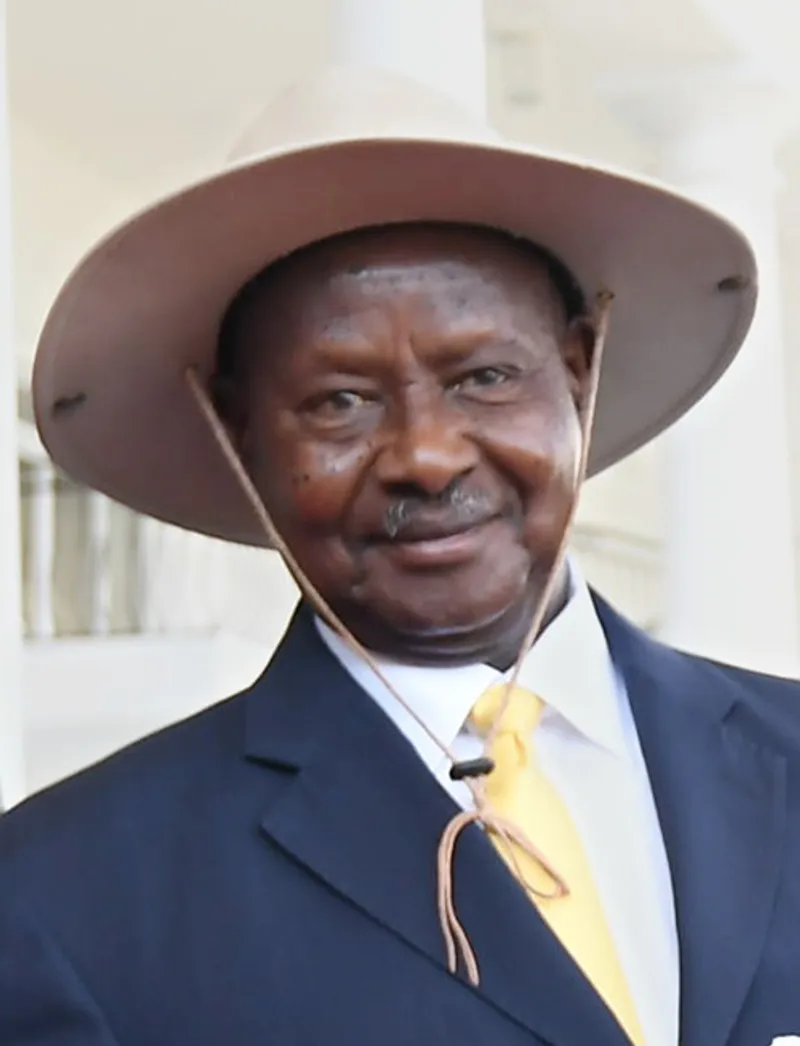
Yoweri Kaguta Museveni came to power in Uganda through five years of guerrilla warfare, not an election. After Milton Obote returned to the presidency in a December 1980 vote Museveni’s party alleged was rigged, he took his newly formed National Resistance Army into the bush, launching the conflict now known as the Bush War with an attack on the Kabamba military barracks on February 6, 1981. The war ran until January 1986, by which point Obote had already been ousted by his own army in a 1985 coup led by Tito Okello; Museveni’s NRA fought on against Okello’s government too, and after a two-day assault captured the capital, Kampala, on January 25-26, 1986; Museveni was sworn in as president in a separate ceremony on January 29. No reliable combined total exists for the war’s civilian toll. The U.S. State Department estimated in 1984 that Obote’s forces had killed 100,000 to 200,000 civilians in the Luwero Triangle, the war’s most violent zone; the International Committee of the Red Cross later put that toll at 300,000 or more. The oft-cited figure of up to 500,000 dead is usually attached instead to Idi Amin’s earlier, separate 1971-1979 regime, which had already fallen five years before Museveni’s war began.
Museveni entered office promising a genuinely different kind of African leadership: a “democratic and ethnically balanced government” meant to heal the country’s divisions after Amin and Obote. He initially governed through a no-party “Movement” system before a referendum restored multiparty competition, and he won internationally recognized elections in 1996 and 2001 under the two-term limit set by Uganda’s 1995 constitution, a document praised at the time as a genuine model of participatory constitutional design.
That limit did not survive his own government. In 2005, Uganda’s Parliament voted to remove the two-term cap entirely, clearing the way for Museveni to run again in 2006, a vote that critics both inside and outside Uganda saw as unraveling the constitution’s most important democratic safeguard. The pattern repeated more than a decade later: in December 2017, Parliament removed the presidential age limit of 75, which would otherwise have barred Museveni from running again in 2021, a change the country’s Constitutional Court upheld the following year despite legal challenges. Museveni has now governed Uganda continuously since January 1986, one of the longest-serving heads of state anywhere in Africa. That tenure rests on two separate constitutional amendments engineered specifically to extend it.
Correction
Uganda's Bush War death toll was borrowing a number from a different war.The article gave "100,000 to 500,000 dead" for the Bush War (1981-1986) itself. That range is the one commonly cited for Idi Amin's earlier, separate 1971-1979 regime (a 1999 Human Rights Watch report traces it to a New York City Bar Association estimate for Amin specifically). For the Bush War's own Luwero Triangle killings, the U.S. State Department estimated 100,000 to 200,000 civilians dead by 1984, and the International Committee of the Red Cross later put the toll at 300,000 or more. Fixed to cite the war's own figures and note where the larger number actually belongs.Corrected in September 2026. See the log entry.
Sources
- “"Popular Justice and Policing from Bush War to Democracy: Uganda 1981-2004," Theoretical Criminology (ScienceDirect)”.
- “Hostile to Democracy: The Movement System and Political Repression in Uganda (1999), Section V: Historical Background”, Human Rights Watch.
- “Ugandan Leader Signs Bill Removing Presidential Age Limit”, VOA News.
- “Scrapping Presidential Age Limits Sets Uganda on a Course of Instability”, Africa Center for Strategic Studies.
Books & Further Reading
Aili Mari Tripp, Museveni's Uganda: Paradoxes of Power in a Hybrid Regime (Lynne Rienner, 2010, ISBN 9781588267078)