
By Princewill Ubani · Published
Research ID: PA-ART-mussolini-adwa-revenge-african-american-volunteers-1935
Revenge for Adwa: Mussolini's 1935 Invasion and the African-Americans Who Tried to Fight It
When Benito Mussolini’s forces crossed from Italian-held Eritrea into Ethiopia on October 3, 1935, without ever formally declaring war, the campaign carried a grievance nearly forty years old. In 1896, an invading Italian army had been routed at the Battle of Adwa by Emperor Menelik II’s forces, the only time in the Scramble for Africa that an African state decisively defeated a European colonial power in open battle and forced it to accept its independence in a formal treaty, a history covered in full in “The Battle of Adwa: How Ethiopia Defeated Italy in 1896”. That defeat became what historians describe as a national trauma in Italy, one Mussolini’s fascist government deliberately invoked to build support for a second attempt, framing the 1935 invasion explicitly as redemption for Adwa and proof that fascist Italy could finish what the liberal Kingdom of Italy had failed to do.
News of the invasion galvanized Black communities across the United States, especially in Harlem, where Ethiopia held particular symbolic weight as Africa’s oldest independent state and, alongside Liberia, one of only two nations to escape colonization outright. Organizations such as Willis N. Huggins’s Friends of Ethiopia raised money and medical supplies, Black-owned newspapers including the Pittsburgh Courier, the Chicago Defender, and the New York Amsterdam News covered the war intensively and urged support, churches held vigils, and street protests and boycotts of Italian-owned businesses broke out in several cities. By July 1935, roughly 200 African-Americans had formally registered to volunteer for service in Ethiopia, though a separate recruiter’s claim of some 17,500 signees was later exposed as fraudulent, and protest marches in Harlem and other cities drew crowds estimated at 20,000 to 25,000, a measure of the scale of public sentiment rather than any verified enlistment roll, since almost none of those who registered ever set foot in the country.
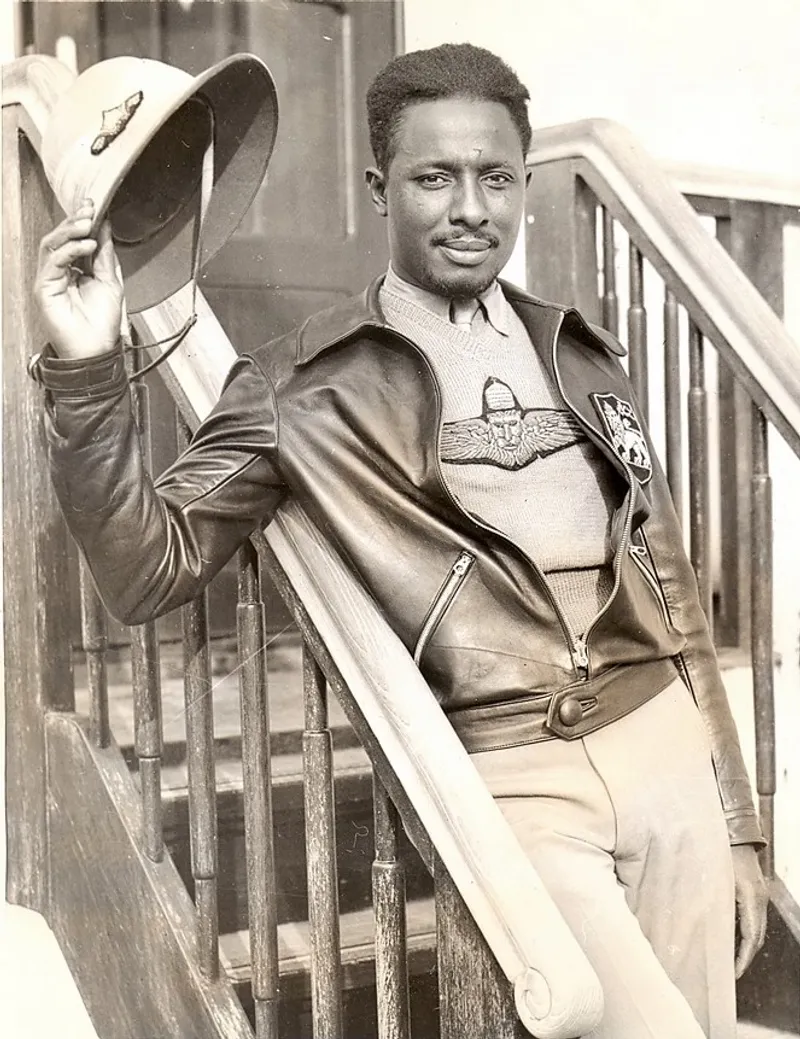
The reason was legal, not logistical. A federal law dating to 1818 made it a crime for U.S. citizens to enlist in a foreign military, punishable by fines, imprisonment, and loss of citizenship, and the State Department publicized the statute widely through the Black press specifically to discourage would-be volunteers, while also declining to issue the passports and visas that would have let them travel. Under that pressure, only two African-Americans are documented to have actually reached Ethiopia and taken part in its defense, both aviators who arranged their own passage rather than going through any organized volunteer channel: John C. Robinson, a Mississippi-born, Chicago-trained pilot who became known as the “Brown Condor,” was commissioned into the Ethiopian Air Force and flew and fought through the war, and Hubert Julian, the Trinidad-born “Black Eagle of Harlem,” who had already spent time in Ethiopia earlier in the decade. Robinson later returned to the United States and became a central figure in training the pilots of the Tuskegee Airmen.
One widely repeated detail from the war does not hold up under scrutiny: the claim that Ethiopian troops were issued gas masks to protect against Italy’s chemical attacks. The opposite was true. Italy’s use of mustard gas against Ethiopian soldiers and civilians, delivered by aircraft in violation of the 1925 Geneva Protocol that Italy had itself signed, was so devastating in large part because Ethiopian forces had no gas masks and no protective equipment of any kind, a total absence of defense that historians studying the war identify as a central reason chemical weapons proved so lethal against an army that was already outmatched in tanks and aircraft. That imbalance, and the emperor’s own conduct under it, is covered in detail in “Haile Selassie at the Front: His Own Wartime Record Against the 1935-36 Italian Invasion” and in his subsequent “Appeal to the League of Nations”, delivered in exile after Addis Ababa fell the following May.
Sources
- “Why did Mussolini invade Ethiopia?”, History Skills.
- “The Dream of Abyssinia: Two Black Aviators and Ethiopia”, Smithsonian Institution, National Air and Space Museum.
- “African-American Participation in the Italo-Ethiopian War”, William & Mary, Freshman Monroe Scholars Program.
Books & Further Reading
William R. Scott, The Sons of Sheba's Race: African-Americans and the Italo-Ethiopian War, 1935-1941 (Indiana University Press, 1993, ISBN 9780253351265)