
By Princewill Ubani · Published
Research ID: PA-ART-haile-selassie-front-italian-invasion-1935
Haile Selassie at the Front: His Own Wartime Record Against the 1935-36 Italian Invasion
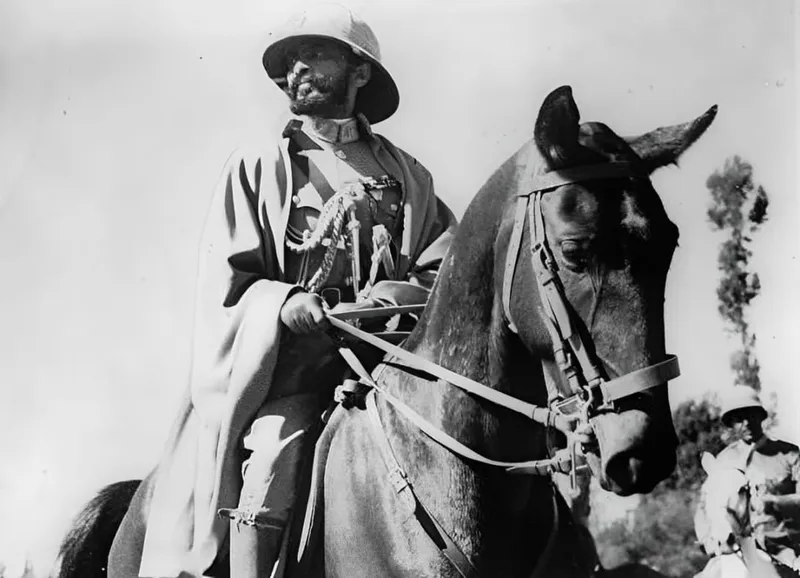
When Italian forces invaded Ethiopia on October 3, 1935, they faced an army of roughly half a million men, the large majority armed with little more than spears and outdated rifles, against a modern colonial military backed by tanks, aircraft and, decisively, chemical weapons, the invasion and the volunteers who tried to fight it covered in full in “Revenge for Adwa: Mussolini’s 1935 Invasion and the African-Americans Who Tried to Fight It”. Haile Selassie did not direct the war from the capital alone. At his advanced field headquarters in Dessie, according to an account drawn from contemporary reporting, the emperor personally manned an Oerlikon anti-aircraft gun and fired back at a formation of eighteen Italian Caproni bombers dropping high-explosive bombs on the position, reportedly shouting at his aides amid the attack, “Haven’t I told you not to crowd together?” No source establishes that he brought down an aircraft in the exchange, a claim that circulates in some retellings but isn’t independently verifiable; what is documented is that he was there, under fire, at the gun himself rather than commanding from safety.
His most consequential personal battlefield role came at the Battle of Maychew on March 31, 1936, where Selassie personally led Ethiopian troops in a direct engagement against Italian forces. It ended in disaster: Ethiopian losses exceeded 7,600, and the defeat effectively broke any prospect of organized Ethiopian resistance continuing. Italy’s advantage rested less on troop numbers than on technology and a war crime: the Italian military employed mustard gas and other chemical weapons against Ethiopian soldiers and civilians alike throughout the campaign, a violation of the 1925 Geneva Protocol that Italy had itself signed, delivered by aircraft in both spray and canister form and cited by historians as the single most decisive factor in the war’s outcome.
With his army broken and Italian forces closing on Addis Ababa, Selassie went into exile on May 2, 1936, traveling first to Djibouti and then by British ship to Palestine; the capital fell to Italian forces three days later. He would carry the record of that personal, direct battlefield engagement, not a distant or absent monarch but a wartime leader who came under fire and lost decisively, into the appeal he made to the League of Nations later that June, covered in full elsewhere on this site in “Haile Selassie’s 1936 Appeal to the League of Nations”, and into the five years of exile that preceded his eventual return, covered in “The Liberation of Ethiopia and Haile Selassie’s 1941 Return to Addis Ababa”.
Sources
- “The Second Italo-Abyssinian War (1935-1936)”, BlackPast.
- “Maychew / Second Italo-Ethiopian War / 1935”, The Second World War (thesecondworldwar.org).
- “Ethiopia's 'Fighting Emperor' Haile Selassie, essay by Blaine Taylor”, International Historic Films.
Books & Further Reading
Anthony Mockler, Haile Selassie's War (Oxford University Press, 1984, ISBN 9780192158673)