By Princewill Ubani · Published
Research ID: PA-ART-herto-skulls-ethiopia-homo-sapiens
The Herto Skulls: Once Called the Oldest Modern Humans, Now One of Several Contenders
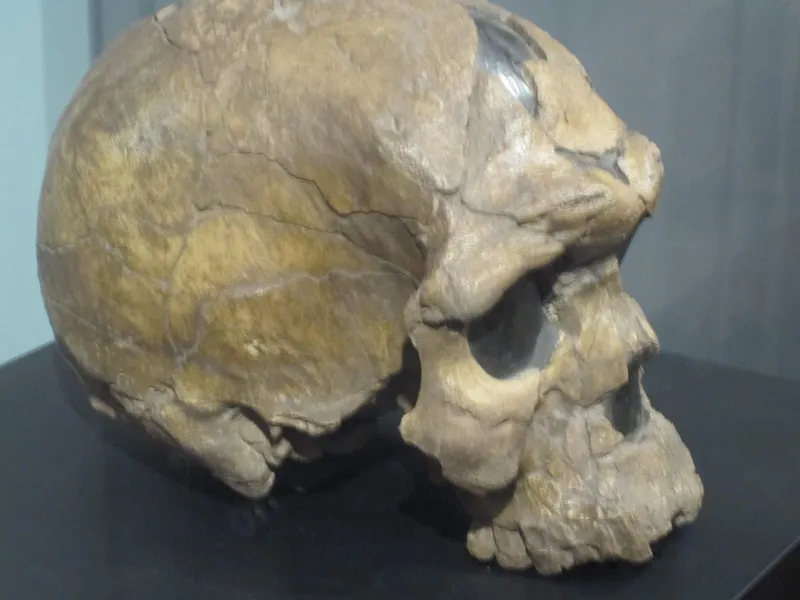
In 1997, a team of paleoanthropologists led by Tim White, working in the Middle Awash region of Ethiopia, uncovered three remarkably complete human skulls, two adults and one child, at a site called Herto. Radiometric dating of the surrounding volcanic layers placed the skulls at between roughly 154,000 and 160,000 years old, and when White’s team published their full description in the journal Nature in 2003, the find was reported internationally as the oldest confirmed fossil evidence of anatomically modern Homo sapiens anywhere in the world.
The skulls weren’t quite like living humans, and that mattered scientifically. Their braincases were tall and their cheekbones thinner than those of older, more archaic human relatives, features consistent with modern anatomy, but they also retained a heavy, projecting brow ridge and other traits that fell outside the normal range of variation seen in humans today. Rather than classify the Herto fossils as fully modern Homo sapiens or as a separate archaic species, White’s team placed them in their own subspecies, Homo sapiens idaltu, idaltu meaning “elder” in the Afar language spoken in the region where they were found, a designation meant to capture their status as anatomically transitional but unmistakably on the modern human branch.
At the time, Herto’s dating made it the strongest available evidence for what’s known as the “Out of Africa” model of human origins, the theory that modern humans evolved in Africa and later spread outward to replace other hominin populations elsewhere, rather than evolving in parallel across multiple continents as competing theories had proposed. Combined with genetic evidence pointing toward an African origin for all living humans, Herto’s skulls offered rare physical, datable proof placing that origin specifically in the Horn of Africa within the right time window.
The “oldest known” title didn’t last as long as the science initially suggested it might. In 2017, a team re-examining fossils originally found decades earlier at Jebel Irhoud in Morocco used improved dating techniques to push that site’s age back to approximately 300,000 years, nearly twice as old as Herto, and reclassified the Jebel Irhoud remains as showing early but genuine modern human features. The Jebel Irhoud fossils are more anatomically archaic in some respects than Herto’s, complicating any simple “oldest equals most modern” narrative, but their much greater age has made them, rather than Herto, the leading current contender for earliest known Homo sapiens. Herto’s significance hasn’t diminished as a result: it remains one of the most complete and best-dated modern human fossil finds from Africa’s Middle Pleistocene, and the Homo sapiens idaltu designation is still widely used in paleoanthropology, even as the specific “oldest” record it once held has moved to a different site with an older date.