By Princewill Ubani · Published
Research ID: PA-ART-703664061108641792
Medinet Habu: Ramses III's Fortified Temple on the Nile's West Bank
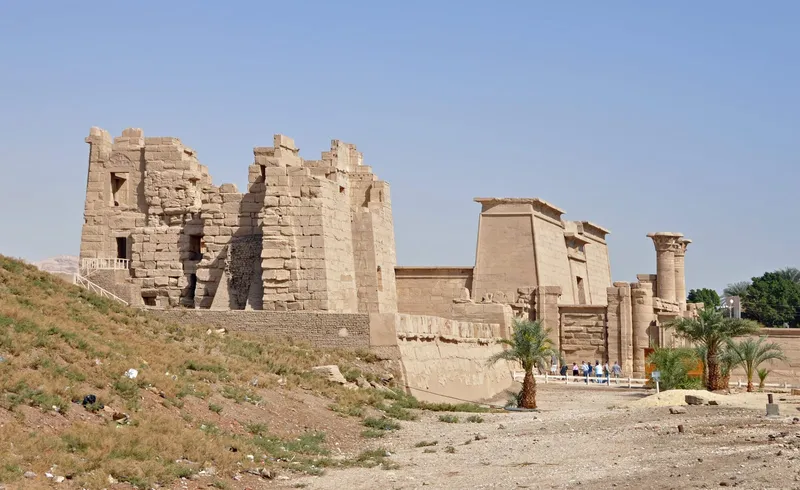
On the Nile’s west bank, facing modern Luxor across the river, stands the best-preserved of Egypt’s royal mortuary temples: the funerary complex Ramses III built for himself at Medinet Habu around 1160 BC, midway through a reign historians place at roughly 1184 to 1153 BC, during Egypt’s Twentieth Dynasty. Unlike some of the tombs and monuments scattered around the Theban necropolis, this one survives largely intact, ringed by its original massive enclosure wall and covering some 66,000 square meters, making it the second-largest ancient temple complex in Egypt after Karnak. Inside are not just the temple proper but workshops, storerooms, administrative buildings and a royal palace attached to the temple’s south side, evidence that the complex functioned as something closer to a fortified town than a single shrine.
The site had sacred associations before Ramses III arrived. Queen Hatshepsut and Thutmose III had built an earlier temple there roughly three centuries before, and rather than clearing it away, Ramses III’s builders enclosed the older structure within his own much larger complex, preserving it inside the newer walls. His temple served two overlapping purposes: it was where his funerary cult would be maintained after death, ensuring his name and offerings continued in perpetuity, and it was also a working temple of the god Amun, tying the king’s memory permanently to Egypt’s central state religion.
Medinet Habu owes much of its modern fame to its walls, which carry some of the most extensive surviving battle reliefs from ancient Egypt. Ramses III fought off a coalition of Libyan tribes invading the Nile Delta in his fifth regnal year and, three years later, faced a larger and more consequential threat: the Sea Peoples, a loose coalition of seaborne raiders, some later identified with groups such as the Philistines, whose incursions were already destabilizing other eastern Mediterranean powers. The temple’s inscriptions and carved scenes record both campaigns in detail, including a rare depiction of a full-scale naval battle, giving historians one of their primary sources for a period of eastern Mediterranean upheaval that toppled several other contemporary civilizations. Ramses III himself is generally regarded by Egyptologists as the last pharaoh of the New Kingdom to wield substantial military and political power, presiding over a long reign that nonetheless ended amid economic strain and, according to surviving trial records, a palace conspiracy against his life. Medinet Habu remains, more than three thousand years later, one of the fullest surviving records of how that reign wanted to be remembered.
Sources
- “The Temple of Medinet Habu”, Egyptian Ministry of Tourism and Antiquities.
- “Ramses III, Ancient Egyptian Pharaoh and Military Leader”, Britannica.
- “Issued by the Epigraphic Survey of the Oriental Institute of the University of Chicago”, International Association of Egyptologists / Chicago House Bulletin.
Books & Further Reading
Eric H. Cline and David O'Connor, eds., Ramesses III: The Life and Times of Egypt's Last Hero (University of Michigan Press, 2012, ISBN 9780472117604)