By Princewill Ubani · Published
Research ID: PA-ART-660807603287494657
The 42 Negative Confessions: How Ancient Egyptians Judged a Life Well Lived
In ancient Egyptian belief, arriving in the afterlife was not automatic. Before a soul could pass into the company of the gods, it had to enter the Hall of judgment, sometimes called the Hall of Two Truths, and stand before 42 divine assessors, one for each of Egypt’s provinces, and answer for the life just lived. The mechanism for that reckoning survives in dozens of papyri under the modern name the Negative Confession, a list of 42 declarations in which the deceased denies, one by one, having committed a specific wrong: theft, murder, adultery, cursing a god, taking more than a fair share of grain, causing a free person to weep. Rather than commandments telling the living how to behave, the confessions were framed as a defendant’s plea entered after death, a formal disavowal recited to each of the 42 judges by name.
The ritual bears the name of Ma’at, the goddess who personified truth, justice, balance and cosmic order in Egyptian religion, and against whose principles the deceased’s heart would ultimately be weighed. In the judgment scene that follows the confessions in most surviving copies, the heart is placed on one pan of a scale against Ma’at’s own feather on the other. A heart burdened by wrongdoing would sink, and Egyptian belief held that it would then be devoured by Ammit, a composite monster part crocodile, lion and hippopotamus, ending the deceased’s chance at eternal life. A heart that balanced evenly with the feather passed the judges’ scrutiny.
The best-preserved version of this text appears in the Papyrus of Ani, a roughly 1250 BC funerary scroll made for a royal scribe named Ani, now held by the British Museum and generally treated by Egyptologists as the finest surviving copy of the broader funerary text scholars call the Book of the Dead. Because the Negative Confession appears to list specific social and religious offenses rather than universal absolute moral rules, and because some popular writers have drawn direct lines between it and the Ten Commandments or other later ethical codes, historians of religion have cautioned against treating the comparison as evidence of direct influence, noting that the confessions functioned within a specifically Egyptian framework of provincial judges, funerary magic and a named goddess of order, distinct in structure and purpose from Biblical law even where individual prohibitions, such as against theft or killing, sound similar on the surface.
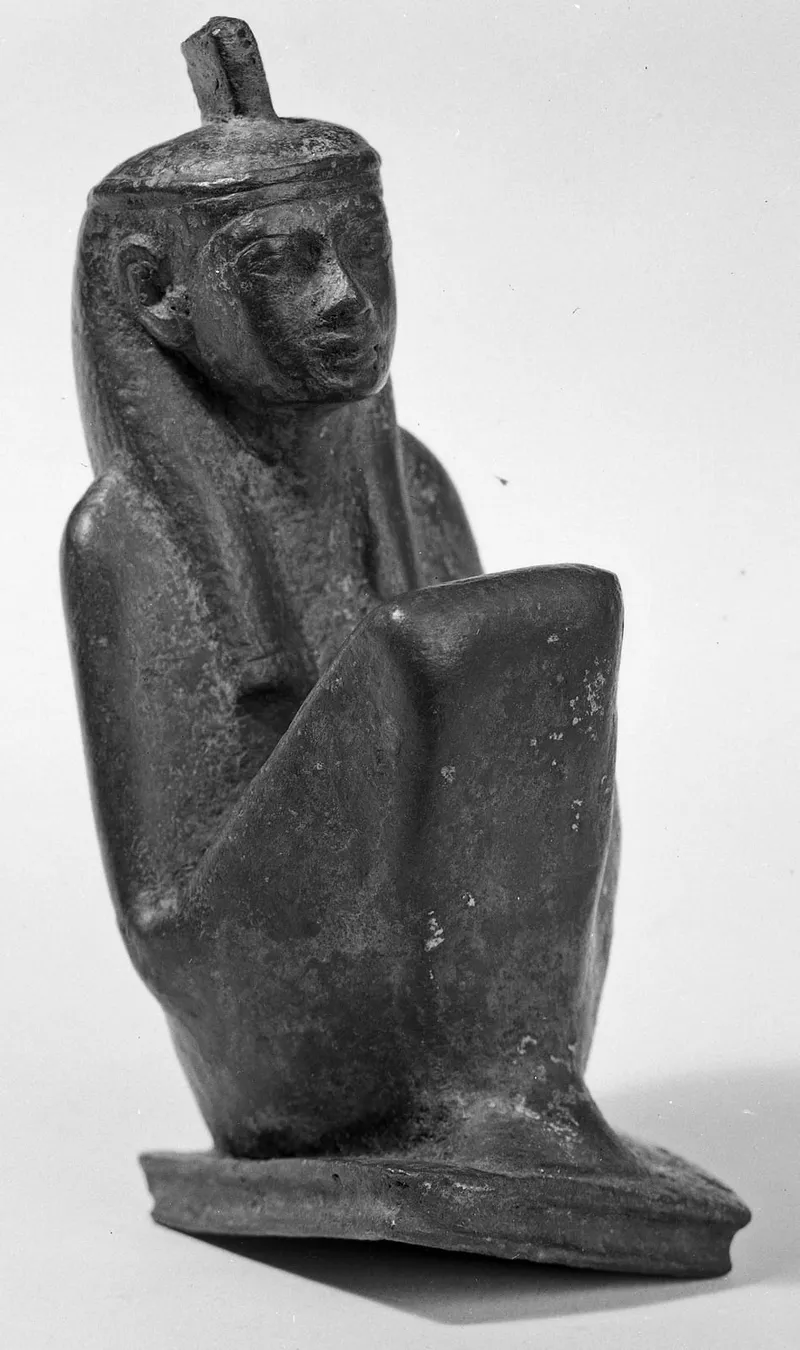
Ma’at herself remained one of the most consistently depicted figures in Egyptian religious art for close to three millennia, usually shown as a seated woman wearing a single ostrich feather on her head, the same feather set against the heart at judgment. Pharaohs described their rule as upholding Ma’at, and viziers and officials were expected to administer justice in her name, meaning the 42 confessions a person would eventually recite in death were, in principle, the same standard by which Egyptian society claimed to govern the living.
Sources
- “The Negative Confession”, World History Encyclopedia.
- “The 42 Laws of Maat and the Ten Commandments: Neither Influenced the U.S. Constitution”, Americans United for Separation of Church and State.
Books & Further Reading
Raymond Faulkner, Ogden Goelet, Carol Andrews and James Wasserman, The Egyptian Book of the Dead: The Book of Going Forth by Day (Chronicle Books, 1994, ISBN 9780811807678)