By Princewill Ubani · Published
Research ID: PA-ART-land-of-punt-ancient-egypt-trade
The Land of Punt: Egypt's Trading Partner That Modern Science Is Still Locating
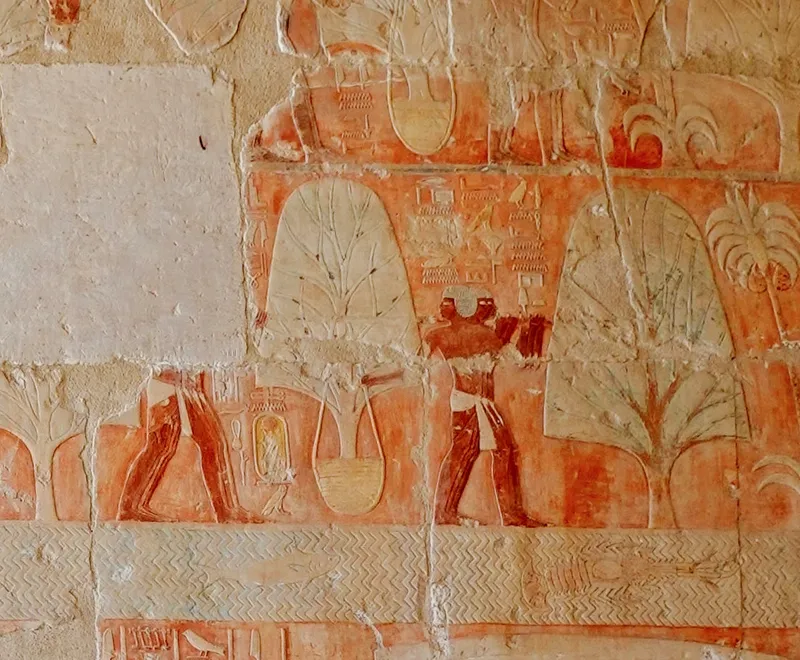
Ancient Egyptian texts and temple reliefs describe Punt, sometimes written Pwenet, as a wealthy trading partner across roughly 1,500 years of contact, from the 5th Dynasty around 2500 BC through the New Kingdom. Egyptian ships returned from Punt loaded with myrrh, frankincense, gold, ebony, ivory, exotic woods, and live animals, including the baboons kept and mummified as sacred to the god Thoth. What Egyptian sources never recorded, at least not in any surviving text, was exactly where Punt was.
The best-documented expedition is Queen Hatshepsut’s, carved in extensive relief and inscription on the walls of her mortuary temple at Deir el-Bahri, across the Nile from modern Luxor, and dated to roughly the 1470s BC. The reliefs show five ships, Puntite houses built on stilts, and a memorably rendered “Queen of Punt,” depicted with a body type ancient artistic conventions used to signal an unfamiliar, foreign appearance. The scene is Egypt’s most detailed surviving depiction of a foreign land and its people, and for over a century it was also the primary evidence scholars had to work with in trying to place Punt on a map, since the reliefs describe a coastal, incense-producing region reached by sea but say nothing more specific.
Historians spent the 20th century arguing over the answer, with proposals ranging across the Horn of Africa, the southern Arabian Peninsula, and even, in a few now-discarded theories, as far as Mozambique. The debate wasn’t idle: pinning down Punt matters for understanding how far Egyptian maritime trade actually reached and which African and Arabian societies Egypt was in sustained contact with. Excavations beginning in 2001 at Mersa/Wadi Gawasis, a Red Sea harbor site in Egypt itself, uncovered ship timbers, cargo boxes, and inscriptions confirming it as a genuine launching point for Punt expeditions, evidence detailed in Kathryn Bard and Rodolfo Fattovich’s excavation reports, but the harbor’s discovery confirmed how ships departed for Punt without settling where they arrived.
The strongest recent evidence comes from an unlikely source: mummified baboons. Egyptians imported live baboons from Punt and elsewhere and mummified them after death, and a team led by Dartmouth anthropologist Nathaniel Dominy analyzed the isotopic chemistry and, in later follow-up work, the mitochondrial DNA of these mummified animals, comparing them against modern baboon populations across eastern Africa and southern Arabia. The results, published in the journal eLife, pointed to origins in the region spanning modern Eritrea, Djibouti, Somalia, and Ethiopia, with the most recent genetic work narrowing the match specifically toward Eritrea’s Red Sea coast, near the later classical-era port of Adulis. It’s not a final answer. Punt likely wasn’t a single fixed kingdom with hard borders in the way later states were, and Egyptian sources may have used the name loosely across a broader Horn of Africa trading zone rather than one specific location.
What isn’t in dispute is that Punt represents one of history’s longest-running, best-recorded trade relationships between two ancient states separated by open sea, sustained across nearly a millennium and a half without either side leaving a map behind. That absence turned a straightforward trading partner into one of Egyptology’s longest-standing puzzles, one that took not new hieroglyphic translations but the genetic material of preserved animals to finally start resolving.
Sources
- “Punt”, World History Encyclopedia.
- “Adulis and the transshipment of baboons during classical antiquity”, eLife.
- “The Expedition to Punt”, PBS.
Books & Further Reading
Kathryn A. Bard and Rodolfo Fattovich, Seafaring Expeditions to Punt in the Middle Kingdom: Excavations at Mersa/Wadi Gawasis, Egypt (Brill, 2018, ISBN 9789004379602)