By Princewill Ubani · Published
Research ID: PA-ART-herero-nama-genocide-germany-reparations
The Herero and Nama Genocide, and Germany's Unresolved Reparations Question
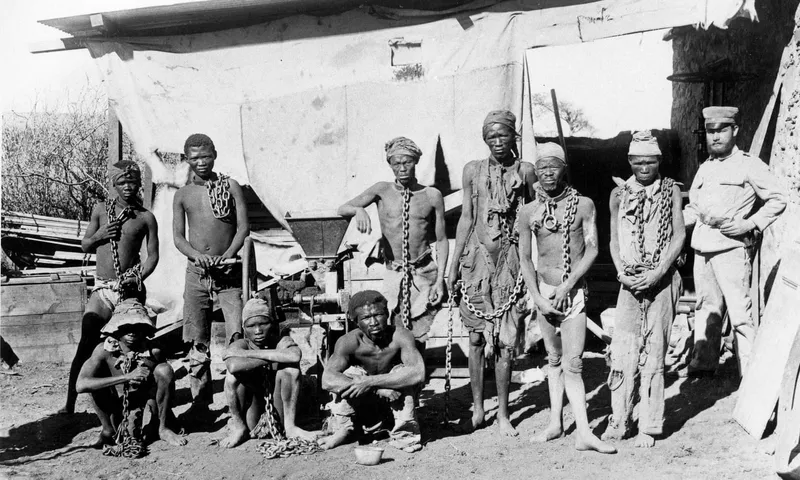
Between 1904 and 1908, German colonial forces in what was then German South West Africa carried out a campaign against the Herero and Nama peoples that is widely regarded as the twentieth century’s first genocide. After the Herero rose up against German land seizures and abuses, General Lothar von Trotha issued an extermination order following the Battle of Waterberg in October 1904, directing his troops to encircle Herero fighters and civilians and drive survivors into the waterless Omaheke desert, poisoning water holes and shooting on sight anyone who tried to escape. Berlin overturned the explicit extermination order weeks later, but replaced it with a scarcely less lethal policy: surviving Herero, and Nama people who rose up in a parallel rebellion, were forced into concentration camps, including the camp on Shark Island off the coast of Lüderitz, where overcrowding, starvation and forced labor killed thousands more. Death toll estimates vary by source: Al Jazeera cites figures of roughly 60,000 Herero and 10,000 Nama killed, other accounts put the total above 100,000, and Amnesty International frames the scale by proportion, estimating that 80 percent of the Ovaherero population and 50 percent of the Nama population were killed, the genocide’s full course covered in “Germany’s Herero and Nama Genocide in Namibia, 1904-1908”.
Germany’s formal reckoning with this history came only in 2021, after Special envoys Ruprecht Polenz for Germany and Zedekia Ngavirue for Namibia concluded nine rounds of negotiations begun in 2016. The resulting joint declaration officially recognized the killings as genocide for the first time and pledged 1.1 billion euros in development aid to affected Namibian regions over 30 years, while explicitly avoiding the word “reparations” and rejecting any German legal liability. Namibia’s Ovaherero Traditional Authority and Nama Traditional Leaders Association, whose communities the money is meant to reach, condemned the process from the moment the draft was announced, calling it, in their own words, “a public relations coup by Germany and an act of betrayal by the Namibian government,” and have pursued a Namibian High Court challenge since 2023 arguing the declaration was concluded unlawfully, without their direct participation in the talks.
The agreement remains unresolved years later. As of late 2025, according to The Conversation’s ongoing coverage of the process, the joint declaration still has not been formally signed or ratified by either country’s legislature, delayed by both the traditional authorities’ legal challenge and by political turnover in Germany. Namibia’s president, Netumbo Nandi-Ndaitwah, who took office in March 2025 as the country’s first elected female head of state, used the country’s inaugural Genocide Remembrance Day on May 28, 2025 to press the issue publicly: “We should find a degree of comfort in the fact that the German government has agreed that the German troops committed a genocide,” she told the gathering, “we must remain committed that as a nation, we shall soldier on until the ultimate conclusion is reached.” Germany’s president, Frank-Walter Steinmeier, has spoken in similar terms about reconciliation without committing to the direct reparations Herero and Nama communities are seeking, telling mourners at a 2024 state funeral in Namibia that “reconciliation is not about closing the past; it is about taking responsibility for our past.” Amnesty International’s regional director for East and Southern Africa, Tigere Chagutah, summarized the gap between rhetoric and outcome bluntly in 2025: “It is shameful that over a hundred years since German colonial forces waged a genocide against the Nama and Ovaherero peoples, Germany has failed to engage in meaningful consultations with these communities or provide reparations.”
The claim that Germany “refuses to pay a dime” for its Namibia crimes, sometimes repeated in popular discussion, is no longer accurate on its own terms: Germany has acknowledged the genocide and pledged over a billion euros. Whether that pledge, structured as development aid rather than reparations and still unratified, constitutes genuine accountability is precisely the question Namibia’s affected communities, Germany’s own negotiators, and independent human rights organizations remain unable to agree on.
Sources
- “Sarah Imani and Elise Pape, "The (Non)Recognition of the Herero and Nama Genocide: Transnational Struggles for Restorative Justice and Reparations" (SAGE)”.
- “Namibia: Germany must deliver reparatory justice for its brutal colonial past”, Amnesty International.
- “Germany's genocide in Namibia: deal between the two governments falls short of delivering justice”, The Conversation.
- “Namibia marks inaugural Genocide Remembrance Day with call for reparations”, Al Jazeera.
- “Decades Before The Holocaust, Germany Built Its First Concentration Camp On Namibia's Shark Island”, All That's Interesting.
Books & Further Reading
David Olusoga and Casper W. Erichsen, The Kaiser's Holocaust: Germany's Forgotten Genocide and the Colonial Roots of Nazism (Faber & Faber, 2011, ISBN 9780571231423)