
By Princewill Ubani · Published · Updated
Research ID: PA-ART-curse-of-ham-slavery-justification
The 'Curse of Ham': A Bible Story With No Mention of Race, Turned Into Slavery's Justification
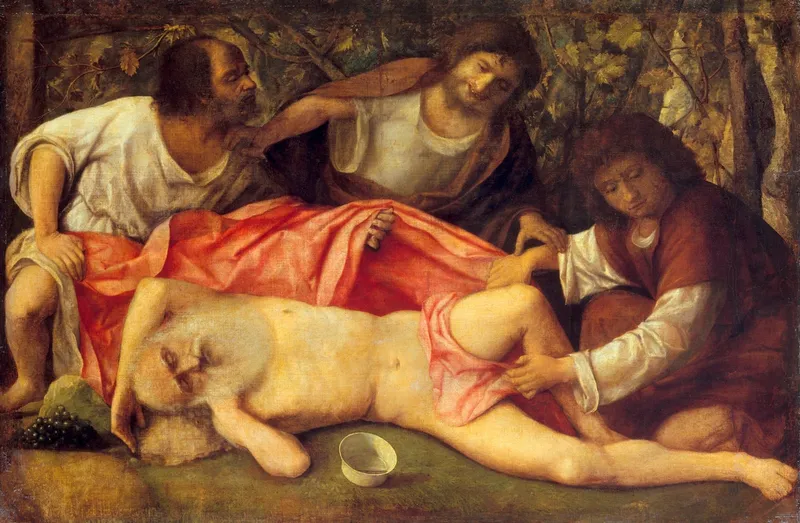
The Book of Genesis, chapter 9, describes Noah cursing his grandson Canaan to servitude after Canaan’s father, Ham, saw Noah drunk and naked in his tent. The text names no race. It says nothing about Africa, nothing about dark skin, and nothing connecting Ham’s other sons, whom later genealogies in Genesis 10 associate with regions including parts of Africa, to the curse itself, which the text applies specifically to Canaan and, by extension in ancient tradition, to the Canaanite peoples of the Levant. For roughly a thousand years after the text was written, that’s essentially how it was read.
The transformation of a story about Canaan into a justification for enslaving Black Africans developed gradually, across Jewish, Christian, and Islamic scriptural commentary, over a period historian David M. Goldenberg traces across roughly 1,500 years in his 2003 study The Curse of Ham: Race and Slavery in Early Judaism, Christianity, and Islam. Goldenberg, a scholar of Jewish studies and former editor of the Jewish Quarterly Review, found that the racialized reading, in which Ham himself, rather than Canaan, became identified as the ancestor of Black Africans and the curse was read as applying to Ham’s descendants broadly, solidified gradually through medieval biblical commentary and exegesis, well after the text’s original composition, rather than reflecting any claim present in the original Hebrew Bible.
Once established, the reinterpreted curse proved durable and useful to exactly the audiences who needed a religious justification for a labor system built on race. European and American slaveholders, clergy, and pro-slavery writers invoked the “Curse of Ham” extensively from the early modern period through the 19th century as a theological argument that Black African enslavement reflected divine will rather than human choice, a framing that offered slaveholders both a scriptural defense against abolitionist critics and cover from any personal moral reckoning with the institution they profited from.
The doctrine’s institutional afterlife extended well past the end of legal slavery in the Americas. The Church of Jesus Christ of Latter-day Saints, founded in 1830, formally barred Black men from its priesthood and Black members generally from full temple participation beginning in 1852 under church president Brigham Young, a policy the church grounded partly in a version of the Curse of Ham/Cain doctrine linking Black skin to a divine curse, for 126 years, only lifting the ban in 1978. The gap between the original Genesis text, which specifies neither race nor Africa, and the centuries of institutions built on top of a heavily reinterpreted version of it, is now treated by biblical scholars as one of the clearer documented cases of a scriptural text being retrofitted, over a very long stretch of history, to justify a system its original authors never described.
Sources
- “Review of David M. Goldenberg's The Curse of Ham: Race and Slavery in Early Judaism, Christianity, and Islam, Bryn Mawr Classical Review”.
- “Race and the Priesthood (Gospel Topics essay), on the 1852 restriction announced by Brigham Young, its 1978 removal, and the curse-of-Canaan justification the church now disavows”, The Church of Jesus Christ of Latter-day Saints.
Books & Further Reading
David M. Goldenberg, The Curse of Ham: Race and Slavery in Early Judaism, Christianity, and Islam (Princeton University Press, 2003, ISBN 9780691123707)