By Princewill Ubani · Published
Research ID: PA-ART-bunostegos-pareiasaur-niger-fossil
Bunostegos: The 260-Million-Year-Old, Impossibly Bumpy Reptile Found in Niger
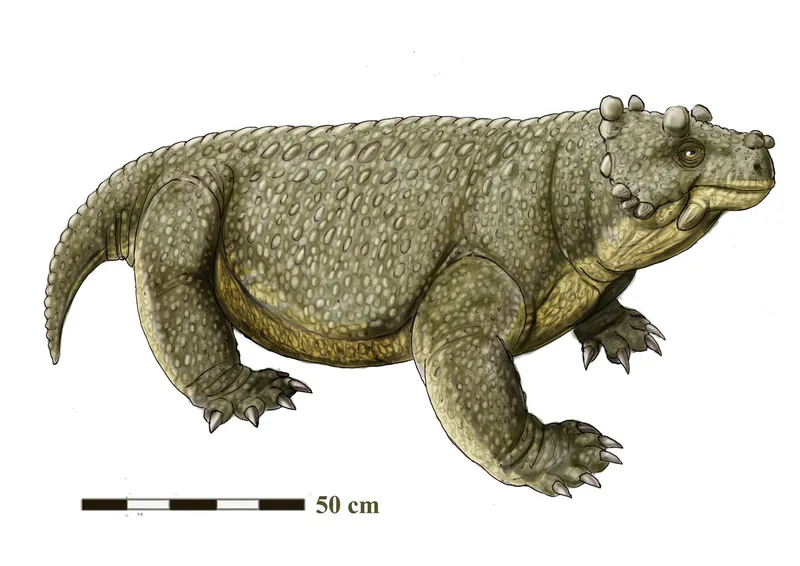
In 2000, a paleontology team excavating in the Moradi Formation of central Niger recovered a weathered, partial skull, missing its lower jaws, that turned out to belong to a species entirely new to science: a member of the pareiasaurs, a group of large, heavily armored plant-eating reptiles that lived during the Permian period, tens of millions of years before the first dinosaurs appeared. Paleontologists Christian Sidor, Boubé Adamou Gado, and Jacques Blackburn formally named the species Bunostegos akokanensis in 2003, with the species name honoring Akokan, the Nigerien uranium-mining town nearest the discovery site. A decade later, in 2013, a follow-up paper by Linda Tsuji and colleagues in the Journal of Vertebrate Paleontology provided a fuller description of the skull based on additional, better-preserved material recovered in the interim.
What set Bunostegos apart from every other known pareiasaur wasn’t its size or general body plan, both fairly typical for the group, but its skull ornamentation. Researchers found two or three rounded, dome-like bony bosses positioned above and between the animal’s nostrils, along with a horn-like projecting structure formed by an enlarged bone above the eye socket and additional bony bumps at the back corners of the skull roof. Taken together, the combination gave Bunostegos more pronounced cranial lumps and bumps than any other pareiasaur species described before or since, a distinctiveness striking enough that researchers and science journalists covering the find nicknamed it, only half-jokingly, the ugliest pareiasaur yet found.
The fossil dates to the Late Permian, roughly 260 million years ago, a period when Earth’s landmasses were joined into the single supercontinent Pangaea and the region that is now Niger sat in Pangaea’s arid interior, far from any coastline. Geological analysis of the surrounding rock formation indicated Bunostegos lived in a genuinely desert environment, evidence that helped researchers argue the species had likely evolved in relative isolation from other pareiasaur populations elsewhere on Pangaea, separated by the same desert conditions that preserved its remains, a pattern of localized evolution within a single interconnected supercontinent that paleontologists have found similarly documented in other Permian-era Niger fossils from the same formation.
Subsequent research teams have continued studying additional Bunostegos material recovered from the same Nigerien formation in the years since the 2013 description, including later papers examining its limb bones and bony skin plates, gradually building out a fuller picture of an animal known, for over a decade after its initial discovery, from little more than a single damaged skull. The species is part of the deep fossil record West Africa holds from a period roughly a quarter of a billion years before any human, or any mammal at all, existed to find it.