By Princewill Ubani · Published
Research ID: PA-ART-348336929470820352
Afrique sur Seine: The 1955 Film That Began Sub-Saharan African Cinema
Paulin Soumanou Vieyra wanted to make a film about ordinary life in Senegal, and French colonial law would not let him. Under the Laval Decree, a 1934 rule that required filmmakers in French West Africa to obtain official authorization before shooting, Vieyra could not get permission to film on Senegalese soil. So in 1955, working instead in Paris with fellow Senegalese students Mamadou Sarr and Jacques Melo Kane, he made a film about African students living in France, homesick for a homeland the camera itself was barred from showing them. The result, a roughly 20-minute short called “Afrique-sur-Seine,” Africa on the Seine, followed young African migrants through the city, capturing their encounters with French life and the nostalgia running under all of it.
Vieyra was around 30 years old when the film came out, born January 31, 1925, in Porto-Novo, in what is now Benin, and raised across the border in Senegal. He is widely credited today as the first sub-Saharan African to direct a film, and “Afrique-sur-Seine” is generally treated by film historians as the opening work of African cinema south of the Sahara, made about five years before Senegal’s own independence in 1960 and years before the continent’s better-known cinema pioneers, including Ousmane Sembene, released their first features. Scholar Melissa Thackway, in her study of Francophone African film, credits the film with “setting a precedent” for the wave of African filmmaking that followed, even though its subject matter, diaspora life in Paris rather than life in Africa itself, was itself a product of the colonial restrictions that shaped what Vieyra was and was not allowed to film.
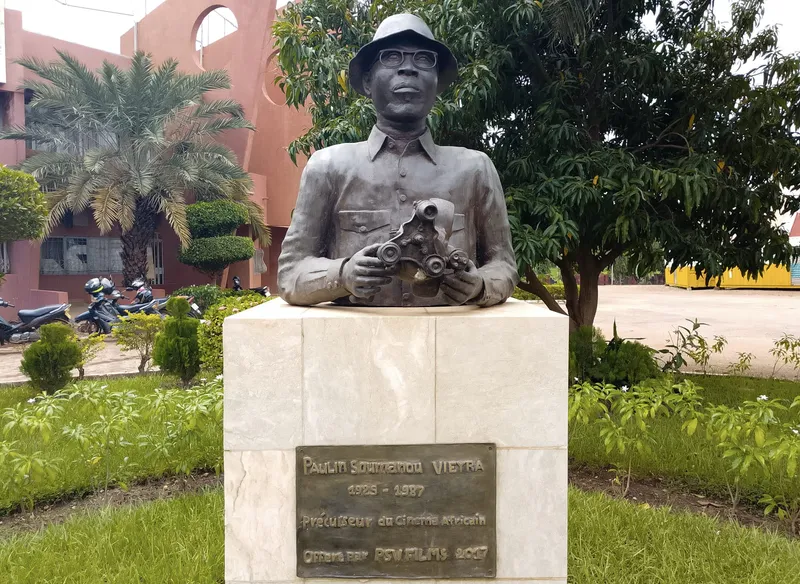
Vieyra’s influence extended well beyond his own camera work. He went on, in 1964, to direct “Sindiely,” an 11-minute film shot in Wolof, becoming the first filmmaker to make a film in an African language on the continent, and in 1975 he published one of the first full histories of African cinema, “Le cinema africain, des origines a 1973,” drawing on a doctorate in film studies he later completed at the Sorbonne under anthropologist and filmmaker Jean Rouch. He also helped found two institutions that shaped African film for decades afterward, the Pan-African Federation of Filmmakers and the Pan-African Film Festival of Ouagadougou, known as FESPACO, which today stands as the continent’s largest film festival. Vieyra died on November 4, 1987. A statue of him now stands at FESPACO’s headquarters in Ouagadougou, honoring a filmmaker whose most lasting contribution, by his own later account and that of the historians who followed him, was less the handful of films he personally directed than the institutions and archives he built to make African filmmaking by others possible.
Sources
- “Paulin Soumanou Vieyra (1925-1987)”, African Film Festival, Inc..
- “Paulin Soumanou Vieyra at 100: A Quiet Construction”, British Film Institute, Sight and Sound.
- “Paulin Vieyra: Pioneer of African Cinemas, Filmmaker, Producer, Historian”, Indiana University, Black Film Center & Archive.
Books & Further Reading
Melissa Thackway, Africa Shoots Back: Alternative Perspectives in Sub-Saharan Francophone African Film (Indiana University Press, 2003, ISBN 9780253216427), chapter 'Setting a Precedent: Afrique-sur-Seine'
Also posted once more between 2015 and 2013.