
By Princewill Ubani · Published
Research ID: PA-ART-abuna-yemata-guh-inaccessible-church-tigray
Abuna Yemata Guh, the World's Most Inaccessible Church
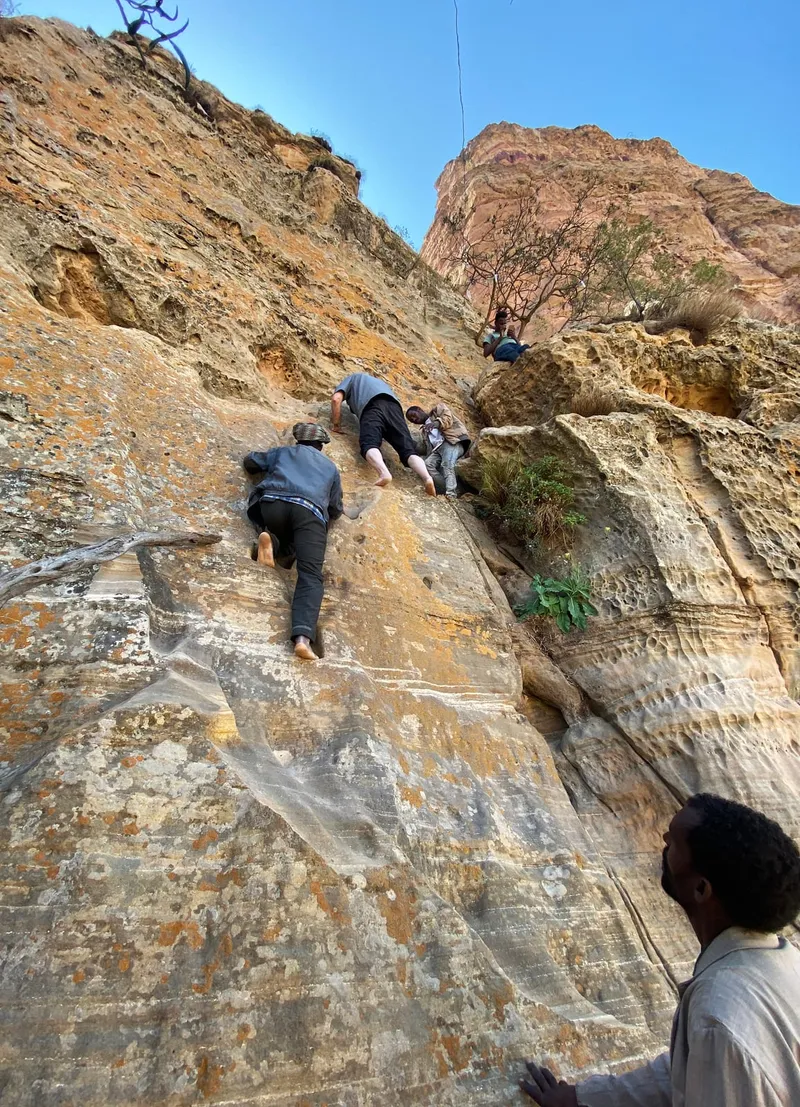
Abuna Yemata Guh sits carved into a sandstone cliff roughly 2,580 meters above sea level in Ethiopia’s Gheralta Mountains, in the Tigray region, a location that has earned it a widely repeated description as the world’s most inaccessible place of worship. Reaching it requires no equipment beyond bare feet and a willingness to trust hand and foot holds worn into rock: the climb involves crossing a natural stone bridge with drops of roughly 250 meters on either side, a narrow wooden footbridge, a vertical rock-face climb using only carved handholds, and a final walk along a ledge roughly 50 centimeters wide facing a sheer drop of nearly 300 meters. Visitors and priests climb barefoot by tradition, since the rock is considered holy ground.
The church takes its name from Abuna Yemata, one of the Nine Saints credited with bringing Christianity to Ethiopia from Syria, Constantinople and Rome in the late fifth and early sixth centuries, part of a wave of monastic missionary activity that helped establish Ethiopian Christianity as one of the oldest continuous Christian traditions anywhere in the world. Inside, the small chamber carved directly into the rock face contains wall paintings believed to date from roughly the same era as the church’s founding, depicting biblical figures and the nine saints themselves, remarkably preserved given the site’s centuries of exposure and its near-total isolation from casual visitors or restoration work.
Abuna Yemata Guh is one of well over a hundred rock-hewn churches scattered across Tigray, a regional concentration of religious architecture that UNESCO has placed on its tentative World Heritage list under the name “Sacred Landscapes of Tigray,” covering roughly 80 of the region’s churches dating from the fifth to fourteenth centuries. That tentative-list status is a meaningful distinction from full UNESCO World Heritage inscription: it signals that Ethiopia has formally nominated the site for future consideration, not that Abuna Yemata Guh or the broader Tigray church network has yet received the full designation UNESCO grants to Ethiopia’s already-inscribed sites, including the better-known rock-hewn churches of Lalibela.
Despite the climb’s genuine hazards, sheer drops on multiple sides with no safety equipment provided, no recorded deaths from the ascent have been documented among the priests and pilgrims who have made the climb over generations, a safety record that has done little to diminish the climb’s reputation among travelers as physically demanding.
Sources
- “Abuna Yemata Guh in East Tigray”, Atlas Obscura.
- “Sacred Landscapes of Tigray”, UNESCO World Heritage Centre.