
The Zulu Kingdom, from Shaka to Annexation, c. 1816-1887
By Princewill Ubani · Published
The kingdom Shaka built between the Thukela and Phongolo rivers from about 1816: its regiments and royal towns, its wars with the Voortrekkers and with Britain, its partition and its annexation in 1887, and the monarchy that continues today.

In about 1816 the Zulu were a chiefdom of some 2,000 people near the Mfolozi River, paying tribute to the Mthethwa. Twelve years later their king, Shaka kaSenzangakhona, was taking tribute from chiefdoms as far north as Delagoa Bay, and his four successors kept the kingdom between the Thukela and Phongolo rivers independent for another half-century.1
It was a state without writing. Its young men served the king in age regiments that worked his fields and herded his cattle as well as fighting his wars; royal women governed his towns; and the king was the nation’s ritual head as well as its ruler. The kingdom lost land to the Voortrekkers in 1840 and to the Transvaal Boers in the 1850s and 1860s. In January 1879 its army destroyed a British force at Isandlwana, and by August the British had burned the capital and captured the king. Britain divided the country among 13 chiefs, a civil war followed, Boers took the north-west in 1884 and Britain annexed the rest in 1887.
Much of what was long written about Shaka came from traders with reasons to exaggerate. This page sets their accounts beside Zulu testimony, British official papers and the archaeology of the royal towns, and says where they disagree.
The chiefdoms before Shaka
In the late 18th century the country between the Thukela (Tugela) and Phongolo rivers was divided among dozens of chiefdoms, most of them small groups of homesteads tied to a ruling family by kinship, marriage and clientship. Several were growing. John Wright, in the Cambridge History of South Africa, describes the rulers of the Nyambose and Nxumalo chiefdoms enlarging their territories and forming what became the Mthethwa and Ndwandwe kingdoms; Elizabeth Eldredge lists the Hlubi, Mthethwa, Ndwandwe and Qwabe as the largest powers north of the Thukela in the last quarter of the century.2 The Zulu were not among them. Their chiefdom near the Mfolozi River, which Wayne Dooling puts at about 2,000 people, paid tribute under Senzangakhona to Dingiswayo of the Mthethwa.3
Dingiswayo took power in the 1790s after years in exile, and by about 1816, in Dooling’s synthesis, some 30 chiefdoms between the Mfolozi and the Thukela owed him allegiance.4 He traded ivory and cattle to Delagoa Bay, the anchorage to the north where the Portuguese kept a small garrison. The trader Henry Francis Fynn later wrote that Dingiswayo “monopolised the whole market until he was killed by Zwide.”5 Zwide’s Ndwandwe, based in the Magudu hills near the Phongolo, were the other rising power; around 1815 they drove Sobhuza’s Ngwane, ancestors of the Swazi kingdom, north across the river.6
The instrument both rulers used was the ibutho (plural amabutho), an age set of young men called together to serve the chief. Older histories credited Dingiswayo with inventing it after his exile, some even saying he copied British soldiers at the Cape. James Gump calls that story, which Theophilus Shepstone put about in the late 19th century, “historically unfounded.”7 Dooling, following Mthethwa tradition, traces the regiments to Dingiswayo’s father, Jobe, after circumcision schools had lapsed; Wright describes age sets first gathered for circumcision and later put to other work, which probably included getting the ivory chiefs sold at the bay.8
Why larger states formed in this corner of southern Africa at this time is one of the longest arguments in the region’s history. Trade is one answer: ivory exports from Delagoa Bay grew from the 1760s, fell away in the 1790s and, some historians argue, gave way to selling cattle to whaling ships.9 Drought is another. A famine remembered as the Madlathule (“let one eat what he can and say naught,” in Dooling’s rendering) struck between 1800 and 1806 or 1807, and Jeff Guy argued that the grazing on which the chiefdoms depended was already strained.10 Guy himself wrote that the demographic evidence had “remained tenuous,” and Eldredge rejected his reading: “There is no evidence that environmental degradation had occurred.”11 Most recent writers, Eldredge and Dooling among them, decline to name a single cause.12
Shaka, about 1816 to 1828
Shaka was the son of Senzangakhona and Nandi, a daughter of the Langeni chief, and his birth year is unknown. The usual date, 1787, goes back to a single guess: the trader James Saunders King put Shaka’s age at 38 in 1824. Dan Wylie, working from that and two other rough estimates, settles on about 1781, and John Laband calls Wylie’s case persuasive.13 Shaka grew up in exile among the Mthethwa, where he served as a warrior under Dingiswayo, and in about 1816, after Senzangakhona died, he took the Zulu chieftaincy with Dingiswayo’s backing. Most accounts, Dooling notes, say he had his half-brother Sigujana, the heir with the better claim, killed.14
When Zwide killed Dingiswayo, in 1817 in Eldredge’s and Laband’s dating, the Mthethwa paramountcy collapsed and Shaka lost his patron.15 The Ndwandwe invaded and laid waste the valley of the White Mfolozi, and Shaka only just held them off. The decisive fight came when he drew a third Ndwandwe army south into the broken country near the Mhlathuze River and routed it. Laband dates that battle to 1819; Eldredge and Dooling, to 1821; Wylie declines to fix it, inclining to 1819 “and maybe even 1820.”16 What the battle was not is the “battle of Gqokli Hill” found in many textbooks. Wylie traces that story to A. T. Bryant’s Olden Times in Zululand and Natal (1929), where Gqokli is only a landmark, and to E. A. Ritter’s 1955 novelized biography, which turned it into a decisive victory with invented casualty figures. “It did not happen,” Wylie writes.17 Zwide fled north of the Phongolo and died there in about 1825. Ndwandwe groups under Soshangane and Zwangendaba moved toward Delagoa Bay, where the Portuguese first reported them in 1821; Wright argues they were leaving a zone of conflict that had lasted years, not simply fleeing Shaka.18 A last Ndwandwe army under Zwide’s son Sikhunyana was crushed in 1826, in May by Eldredge’s dating and October by Laband’s.19
Shaka did not invent the amabutho or the stabbing spear. What he changed, in Laband’s account, was who controlled them: every ibutho was now raised across the whole kingdom rather than by local chiefs, and men could marry only when the king allowed their ibutho to put on the head-ring.20 The regiments lived for part of each year in royal military homesteads, amakhanda, which doubled as the king’s towns.21 By mid-1824 chiefdoms on the coastal plain as far as the far side of Delagoa Bay were sending him tribute in ivory, and his armies raided south into Mpondo country in 1824 and 1828.22 Wright cautions that the scale of the conquests “has been greatly exaggerated”: Shaka’s forces were unlikely to have numbered more than 10,000 or 15,000, not the 50,000 often claimed, and the figure of a million deaths sometimes repeated in popular books “is a pure fabrication.”23
The kingdom’s praise-singers recorded his reign in their own form. The praise poem collected by James Stuart and translated by Daniel Malcolm opens:
Dlungwana son of Ndaba! Ferocious one of the Mbelebele brigade, Who raged among the large kraals, So that until dawn the huts were being turned upside-down.24
His half-brothers Dingane and Mhlangana, with his attendant Mbopha kaSithayi, stabbed him to death outside his homestead at kwaDukuza, near present-day KwaDukuza (Stanger). Eldredge and Laband date the killing to Sept. 23, 1828. The traders’ records disagree: Fynn wrote the 24th, the date South Africa still marks as Shaka Day within Heritage Day; Francis Farewell gave the 23rd and, in one later letter, the 21st; and Wylie reads Nathaniel Isaacs as pointing to the night of the 22nd. “We can never be entirely sure,” Laband writes.25 Eldredge reads the killing as an expression of “widespread popular discontent” with Shaka’s rule; Wylie lists the pressures behind it, among them campaigns that kept the army away at harvest, drought, and a store of “real or imagined cruelties.”26
The “Mfecane” argument
For most of the 20th century the wars and migrations of the 1820s and 1830s were told as a single story with Shaka at its center. The historian E. A. Walker gave the story its name in 1928, mfecane, “the crushing,” and in 1966 J. D. Omer-Cooper’s The Zulu Aftermath presented it as “a revolutionary climax in the Zulu kingdom of Shaka” which “sent defeated tribes fleeing from the storm centre” in a chain reaction felt over thousands of miles.27 Omer-Cooper, who glossed mfecane as an Nguni word, treated the period as an African revolution in state-building, not as mere destruction.
In 1988 Julian Cobbing attacked the whole idea. Walker’s word, he wrote, “has no root in any African language,” and the story of black-on-black destruction it carried served, he argued, as an alibi: it hid the labor raids of Griqua, Boer and British slavers and the slave trade at Delagoa Bay, and it justified the land division of 1913. The concept, he concluded, “should be abandoned.”28 The argument that followed reshaped the field. Eldredge showed that the Delagoa Bay slave trade grew large only around 1823 or 1824, after the wars of the region had begun, so it could not have started them; but she agreed that Cobbing was “right to absolve the Zulu from the responsibility for most of the regional conflicts of the 1820s and 1830s,” and she named Griqua and Korana raiders, who sold cattle and captured children to white farmers on the Cape frontier, “not Zulu or other Nguni, as the main sources of violence in the region throughout the 1820s and 1830s.”29 Omer-Cooper replied that the trade’s growth followed the upheaval rather than causing it.30 Hamilton argued that the image of Shaka as a monster was not simply a white invention either, because it drew on views of him already current among Africans in and around the kingdom.31
By the early 2000s, Wright wrote, a loose consensus had formed: the upheavals “could no longer be adequately explained in terms of ‘the wars of Shaka,’” and had to be set in the wider meeting of African societies with settlers and traders that began in the mid-18th century.32 The consensus has its own critics. Andrew Chewins and Peter Delius, working in Portuguese archives in Lisbon, argued in 2020 that a slave trade of some size existed before 1823 and that its role “has been previously underestimated”; they still found “little evidence that Shaka or Dingane sold subjects from the heartland of the Zulu kingdom into slavery.”33 Wright, for his part, doubts that for some years effective Zulu rule reached much beyond the Mkhuze River.34
How the kingdom was run
The kingdom’s main tax was labor. Young men were enrolled in amabutho by age across the whole kingdom, not by district, and until the king let them marry, often not long before 40 in R. L. Cope’s reckoning and about 35 in Laband’s, they spent part of every year at an ikhanda: building and repairing it, herding and guarding the king’s cattle, working his fields, collecting tribute and fighting. “The amabutho system might be described as the Zulu system of taxation,” R. L. Cope wrote; tribute “was paid directly in the form of labour.”35 Girls were formed into age sets too, and their marriages also needed the king’s leave. Jeff Guy called this control over marriage, and so over when new homesteads could be founded, the base on which the state stood.36
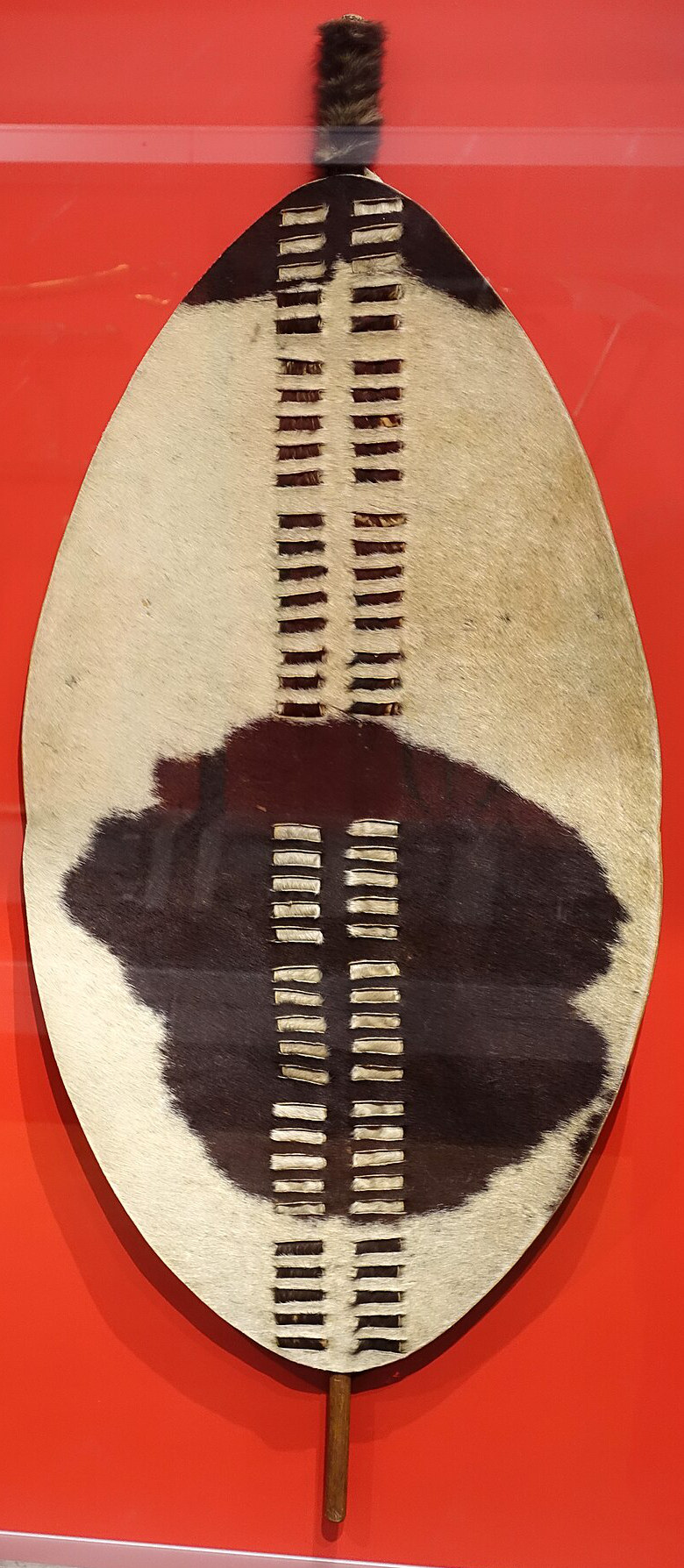
The amakhanda were the kingdom’s towns. Archaeologists have excavated two capitals, Dingane’s uMgungundlovu and Cetshwayo’s oNdini, and Renier van der Merwe and Innocent Pikirayi reconstruct a common plan: a great cattle enclosure and meeting ground at the center, two curving wings of regimental huts, and at the top the king’s isigodlo, the quarters of his household and the young women attached to it.37 Excavators estimated that uMgungundlovu enclosed 1,100 to 1,700 huts and 5,000 to 7,000 people, and oNdini about 1,500 huts.38 Eyewitness figures need the same checking. Fynn and Isaacs put the circumference of Shaka’s capital kwaBulawayo at nearly two and about three miles, and Isaacs gave it 1,400 huts; G. A. Whitelaw’s 1994 survey of the site suggests it was only some 200 to 250 meters across and 300 to 350 meters long, smaller than the later capitals.39 Beads mark the social map. At both excavated capitals they cluster in the isigodlo, and the regimental quarters are almost bare of them; certain colors were reserved for the king and his family, and Gardiner and other visitors reported that wearing them without the right was punishable by death.40
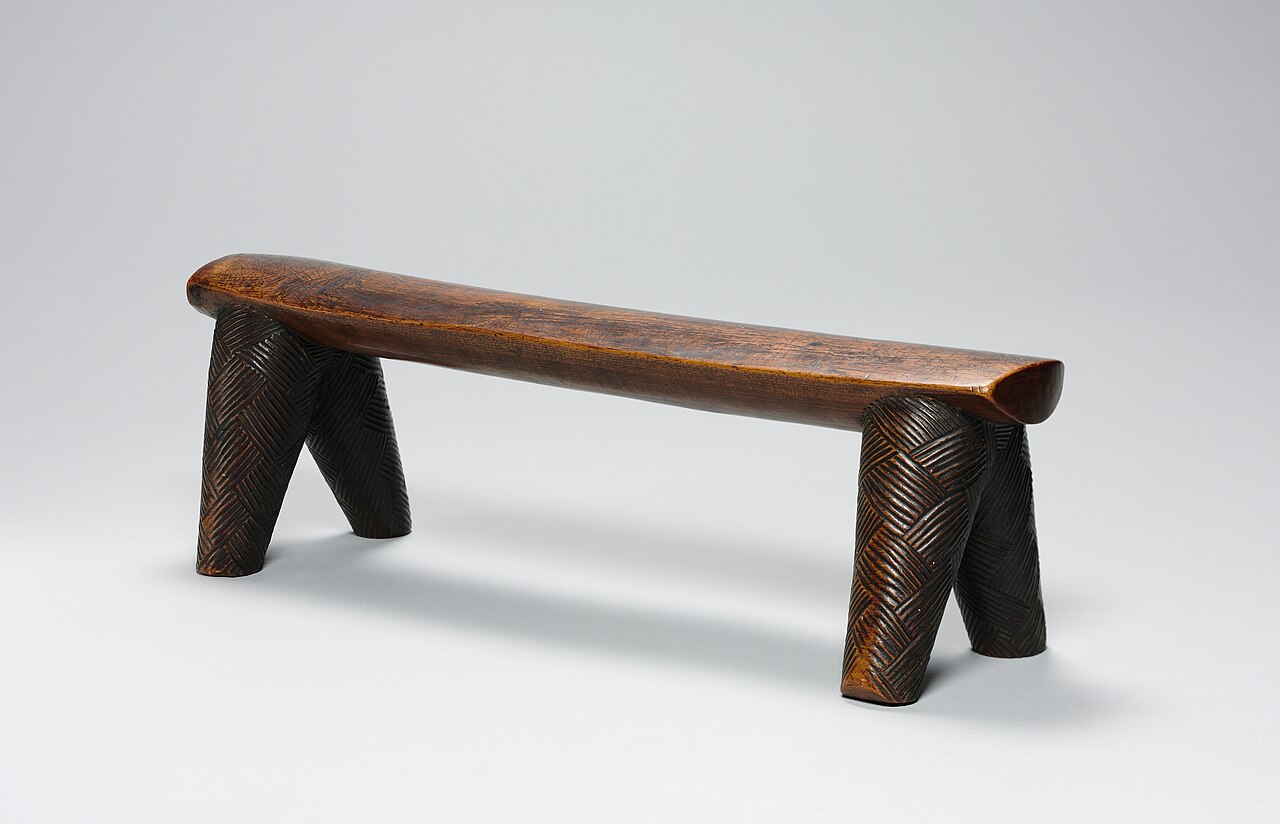
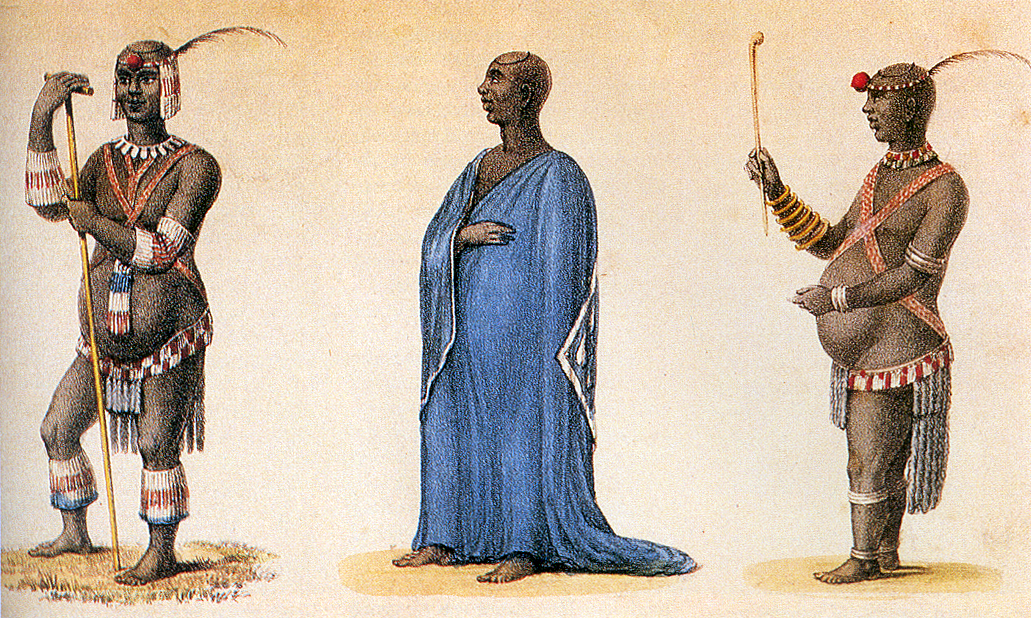
Royal women ran these towns. Allen Gardiner, a missionary who visited Dingane in 1835, wrote that the king’s female relatives “are generally placed as pensioners, one or two together, in the different military towns where they preside.”41 Jennifer Weir argues they held real ritual, administrative and judicial power. Senzangakhona’s sister Mnkabayi acted as regent in his minority, is said to have advised Shaka’s brothers to kill him, and installed Dingane; the inkatha, the coil of grass bound in python skin that stood for the unity of the people, was kept in the hut of Senzangakhona’s widow Langazana at eSiklebheni.42
Above the homesteads sat the king and the izikhulu, the great men of the kingdom, who together formed the ibandla, the council without which, Guy writes, “the king could make no decisions of national importance.”43 The izinduna were the king’s appointed officers: army commanders, messengers, tribute collectors. Older histories describe them governing the chiefdoms in a chain of command from the capital. Wright rejects that picture as the colonial administration of later Zululand read backward; under the kings, he argues, the izinduna “were primarily officials who controlled the king’s amabutho,” and the chiefdoms kept their own hereditary rulers.44 Adam Kuper sees the whole structure as the Nguni homestead writ large, with its great and lesser houses; Carolyn Hamilton argues instead that Shaka built a new ruling class by cutting branches of the royal lineage off into separate clans, which could marry back into it and fill the high offices but never claim the throne.45
The king’s authority rested on ritual as well as force. He was the intermediary between his people and the royal ancestors, and at the first-fruits ceremony, the umkhosi, nobody could eat the new crops before him. Magema Fuze, writing at the start of the 20th century, said anyone who did “would be fit for death because he would be overshadowing the king.”46
Dingane and the Voortrekkers, 1828 to 1840
Dingane had Mhlangana and Mbopha killed within weeks and ruled from a new capital, uMgungundlovu. A man, the saying went, “may not rule with a red assegai, one which has stabbed a king”; in the testimony James Stuart recorded, Dingane had only laid hold of Shaka, not stabbed him.47 He spared two half-brothers, Mpande and Gqugqu, the first reputedly because he thought him harmless.48
In October 1837 the Voortrekker leader Piet Retief rode into Natal from the interior, at the head of a migration that brought some 3,600 Boers into the territory by May 1838, and asked Dingane for land.49 Dingane set a condition: recover cattle taken from him by the Tlokwa chief Sekonyela. Retief did so by a ruse, handcuffing Sekonyela until he paid, and kept the horses and guns he had seized.50 He returned to uMgungundlovu on Feb. 3, 1838, with about 70 Boers and some 30 servants. On Feb. 6, as they prepared to leave, Dingane’s men seized them and killed them on kwaMatiwane, the hill of execution across the stream; Zulu regiments then fell on the Boer camps in the Thukela valley.51 The missionary Francis Owen, at the capital, wrote in his diary that morning that two of the Boers had breakfasted with him “only an hour or two before they were called into Eternity,” and that this was the day a “paper of transfer” was to be signed.52
That paper is still argued over. The text later printed, dated Feb. 4, 1838, has Dingane granting Retief and “his Countrymen” all the land from the Thukela to the Mzimvubu River. The Boers said they found it in a leather bag beside Retief’s bones in December 1838; the original disappeared in 1900, and what survives are printed copies that differ in their witness lists and attestations.53 The historian George Cory called it a forgery in 1923 and then withdrew the charge; Jay Naidoo, reviewing the case in 1985, concluded that if Dingane did not understand the document, it hardly mattered whether it was genuine. Laband treats it as “nothing more than a ploy” Dingane never meant to honor.54
Andries Pretorius led a Boer commando back into the kingdom. On Dec. 16, 1838, at the Ncome River, about 470 Voortrekkers with Port Natal allies and a few cannon fought off repeated attacks on their wagon laager; estimates of the Zulu force run from 8,000 to 16,000.55 The river was afterward called Blood River. Pretorius reported Zulu dead of “3,000 and some hundreds” and a victory “without the loss of a single life on our part”; Laband thinks the 3,000 “likely exaggerated” and puts the toll at probably well over 1,000, and Michał Leśniewski at no fewer than 1,500 and possibly more than 2,000.56 The Boers had three wounded.
What broke Dingane was a split in his own house. In 1839 Mpande crossed the Thukela with, by Michael Mahoney’s figure, 17,000 followers and allied with the Boers. On Jan. 30, 1840, his army of about 5,000 under Nongalaza defeated Dingane’s army of similar size under Ndlela at the Maqongqo hills, decided in part by men changing sides; the Cambridge History stresses that it was Mpande’s regiments, not Boer commandos, that brought Dingane down.57 Dingane fled across the Phongolo and was killed there in March 1840, attacked by a Swazi and Nyawo war party near Hlathikhulu hill.58 Pretorius installed Mpande as king on Feb. 10, 1840, and four days later proclaimed the annexation of the land between the Thukela and the Black Mfolozi, about two-fifths of the kingdom, along with St. Lucia Bay, while his commando drove off 31,000 cattle.59
Mpande, 1840 to 1872
Mpande ruled for 32 years, and Guy notes that he was the only Zulu king to die peacefully in old age.60 On Oct. 5, 1843, a treaty with Henry Cloete, the British commissioner for Natal, annulled the Boer annexation and set the border along the Thukela and Mzinyathi (Buffalo) rivers, but left the kingdom’s northwestern and northern borders undefined. That gap, Laband writes, “would assume explosive qualities” once a Boer republic grew up beyond it.61 Mpande gave ground there piece by piece: the wedge between the Mzinyathi and the Ncome went to Boer settlers in 1854 and was absorbed into the South African Republic (Transvaal) in 1859, and in 1861, at Waaihoek, Cetshwayo put his mark, though he later denied it, to an agreement recognizing undefined Boer claims east of the Ncome.62
Inside the kingdom the regiments kept forming. Magema Fuze, born in Zululand about 1840, listed 11 male amabutho raised under Mpande, from the iSangqu to the iNgobamakhosi; the fourth, the uThulwana, was the age group of the king’s own sons.63 Two of those sons fought for the succession. Cetshwayo’s following, the uSuthu, and that of his half-brother Mbuyazi, the iziGqoza, met at Ndondakusuka near the lower Thukela on Dec. 2, 1856. Cetshwayo had 15,000 to 20,000 men to Mbuyazi’s 7,000; only some 2,000 of the iziGqoza fighters escaped, and Mbuyazi died with two full brothers and three half-brothers.64 Mpande remained king, but from 1857 Cetshwayo shared in the government. When Mpande died at kwaNodwengu in 1872, his death was concealed until Cetshwayo had made his position secure, and Cetshwayo, by Guy’s reckoning 40 years old, inherited a kingdom of some 300,000 people.65
Cetshwayo and the British ultimatum, 1872 to 1878
On Sept. 1, 1873, Theophilus Shepstone, Natal’s Secretary for Native Affairs, presided over a ceremony that “purported to install Cetshwayo kaMpande as King,” in R. L. Cope’s words, although Britain claimed no sovereignty over the kingdom. Cetshwayo had invited him, hoping Natal’s backing would help him against rival claimants, against the Transvaal Boers on the western border and against his own great chiefs.66 Shepstone proclaimed four “laws” at the ceremony: that “the indiscriminate shedding of blood shall cease in the land,” that no Zulu be condemned without open trial and a right of appeal to the king, that no life be taken without the king’s knowledge and consent, and that fines replace death for minor crimes.67 Cope argues the laws were aimed at the chiefs’ power to kill, not the king’s, and that they failed even in that; Cetshwayo said after the war that a chief still had “the power to kill.” Five years later they were read the other way, as promises Cetshwayo had broken.68
The kingdom’s praise-singers caught the tension in their own way. Cetshwayo’s praise poem tells him to “hunt and stop on this side of the Thukela, / On the other side are the white people,” and calls him the “bandy-legged one that refuses the mediation of the whites.”69
The dispute over the land west of the kingdom came to a head once the Transvaal was under British rule. Shepstone, who in Natal had backed Mpande against the Boer settlers, reversed himself as administrator of the Transvaal. A boundary commission that sat at Rorke’s Drift nevertheless found for the Zulu king in June 1878, recommending a line up the Blood River and then straight to the sources of the Phongolo, the frontier shown on the map above. Frere blunted the award by extending British protection over the settlers’ farms inside it.70 The High Commissioner, Sir Bartle Frere, had the award read to Zulu envoys on Dec. 11, 1878, together with an ultimatum. It demanded fines and the surrender of men who had crossed into Natal, among them the sons of the chief Sihayo, who had seized and killed two of their father’s runaway wives on the Natal side of the border; and it demanded, within 30 days, that the king abolish the military system and accept a British Resident.71 “Cetshwayo could not have complied with these demands and Frere knew it,” Guy writes. Laband reads the ultimatum as “primarily a means of forcing war on the Zulu.”72 Fuze, who visited the king shortly before the invasion, recalled him asking whether Fuze knew “that the white people are coming here,” and adding: “But we Zulus will not run away from them.”73
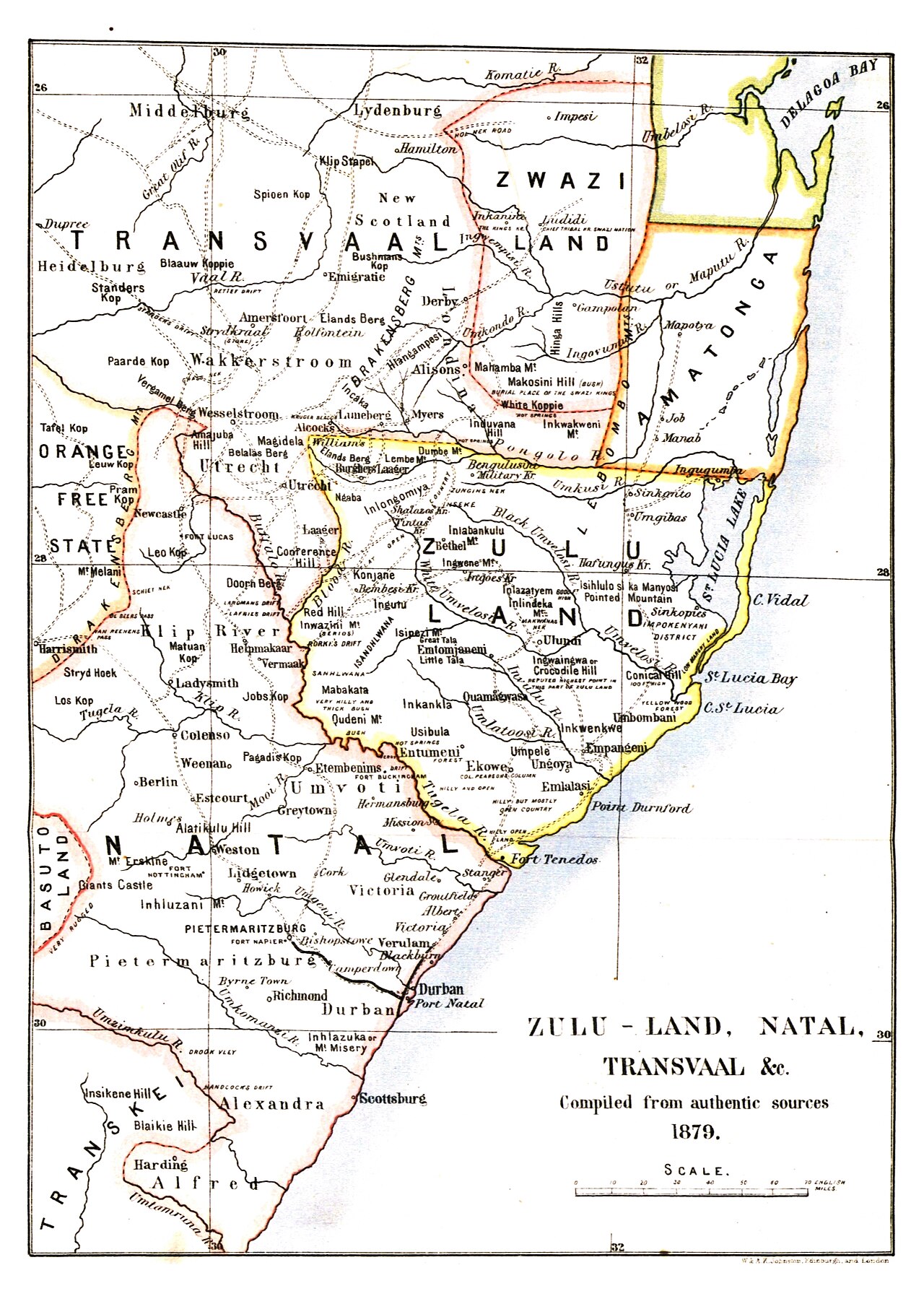
The war of 1879
British troops under Lord Chelmsford crossed into the kingdom on Jan. 11, 1879, in three columns: about 5,500 regulars, more than 1,000 colonial volunteers and some 9,000 African levies, in Guy’s figures.74 On Jan. 22 a Zulu army under Ntshingwayo kaMahole and Mavumengwana kaNdlela, Laband estimates about 20,000 men, destroyed the camp Chelmsford had left at Isandlwana. Of the 1,707 men and 67 officers there, 52 officers, 727 white soldiers and 471 African troops were killed.75 The attack was not planned for that day: British scouts stumbled on the regiments resting in a valley, and the uKhandempemvu charged at once.76 That night and into the next morning a reserve force of 3,000 to 4,000 men attacked the post at Rorke’s Drift, against the king’s orders not to cross into Natal, and lost perhaps 600 killed; the defenders lost 15.77
Isandlwana halted the invasion for weeks, and Guy points out what that meant in the homesteads: it let women bring in a harvest that was later taken or burned when the British returned in May.78 The British won at Khambula on March 29 and Gingindlovu on April 2.79 On July 4 Chelmsford formed a square of 5,170 men, a thousand of them African, on the plain before oNdini, and between 15,000 and 20,000 Zulu attacked it. They were driven off by rifle, artillery and Gatling fire and broken by a cavalry charge, and the British burned the capital. The official British estimate of Zulu dead was “not less than 1 500”; British losses were 12 killed and 69 wounded, with one more officer dying later.80 “The army is now thoroughly beaten,” said a Zulu fighter, Ndungungunga kaNgengene, that day, “and as we were beaten in the open, it will not reassemble or fight again.”81
How total the war was is disputed. Laband counts at least 6,160 Zulu men killed in the major engagements, 23 royal homesteads burned, and some 14,512 cattle taken, about 5 percent of the kingdom’s herds; British records name only 211 ordinary homesteads burned, and he rejects any suggestion of genocide. Guy argues that Chelmsford deliberately made “the Zulu nation at large” feel the strain by destroying grain and livestock, and that a war counted by battles misses what it did to women, children and the old.82 Cetshwayo hid in the Ngome forest for weeks. The people of the area refused to say where he was until his chief councillor, Mnyamana, told the British; he was captured on Aug. 28, 1879, and shipped to the Cape.83
Partition, restoration and civil war, 1879 to 1884
On Sept. 1, 1879, Sir Garnet Wolseley told about 200 Zulu at the British camp that Cetshwayo would never return and that the kingdom would be divided among 13 chiefs he had appointed, among them the trader John Dunn, who received the largest share, about a fifth of the country; Hamu, the king’s half-brother, who had defected during the war; and Zibhebhu kaMaphitha of the Mandlakazi. The chiefs were to abolish the military system and import no firearms, and a British Resident with no powers of government watched over them. Guy calls the settlement “invalid, both in conception and in implementation.”84
“There has been more bloodshed since I have been a prisoner than during the whole of my reign,” Cetshwayo said in exile.85 Held at Cape Town, he was allowed to go to London, where he met Queen Victoria at Osborne House on Aug. 14, 1882, and was told he could go home on conditions.86 He landed at Port Durnford on Jan. 10, 1883, and was installed at Mthonjaneni on Jan. 29, not as king of Zululand but as ruler of its central part. Zibhebhu kept an independent territory in the north-east, and the southern districts Wolseley had given to Dunn and Hlubi became the Reserve, under British administration.87 The king’s uSuthu party attacked Zibhebhu and was routed at Msebe on March 30, 1883. On July 20 or 21, 1883, the sources differ, Zibhebhu fell on the rebuilt oNdini at dawn. Fuze says about 40 of the leading men of the kingdom died there; Cetshwayo, wounded in the thigh, escaped to the Nkandla forest and in October placed himself under the British Resident at Eshowe.88 He died there on Feb. 8, 1884. A medical officer who examined the body gave the cause as heart failure; the Zulu then believed, Guy wrote in 1979, “and do today, that he was poisoned.”89
Dinuzulu, the New Republic and annexation, 1884 to 1887
Cetshwayo’s brothers proclaimed his son Dinuzulu, then about 16, as his heir, citing deathbed words that Guy thinks were probably composed after the king died.90 The uSuthu were starving in caves and forests, and they turned to Boers from the Transvaal for help. On May 21, 1884, a Boer gathering proclaimed Dinuzulu king of the Zulu, and on June 5 an uSuthu army with about 100 Boers routed Zibhebhu at Tshaneni.91 The price was land. On Aug. 16, 1884, at Hlobane, Dinuzulu put his mark to a proclamation granting the Boers 1,355,000 morgen, some 2.7 million acres, to found what they called the New Republic. Their later claims reached for five-sixths of the Zulu country outside the Reserve.92
Britain recognized the New Republic on Oct. 22, 1886, after the Boers agreed to limit it to the north-western third of Zululand.93 The rest, the uSuthu country, a central block known as Proviso B and the Reserve, became the British Colony of Zululand, proclaimed on May 19, 1887; Guy dates the announcement at Eshowe to June. The governor of Natal, Sir Arthur Havelock, ruled it as Supreme Chief through Melmoth Osborn as Resident Commissioner, with magistrates over six districts and a hut tax to pay for them.94 On Nov. 14, 1887, Havelock had a message read to Dinuzulu: “the rule of the House of Chaka is a thing of the past. It is dead. It is like water spilt on the ground.”95
After annexation
The kingdom ended in 1887; the royal house did not. Dinuzulu led an uSuthu rising in 1888, surrendered in November and on April 27, 1889, was sentenced with his uncles Ndabuko and Shingana for high treason, Dinuzulu to 10 years on St. Helena.96 He came back in January 1898 as a salaried “Government Induna” to a Zululand that Britain had just transferred to Natal, and a commission set up in 1902 marked out 40.2 percent of its best land for white purchase.97 When a new poll tax set off the rising led by the chief Bhambatha in 1906, Natal put Dinuzulu on trial again; the court rejected the charge that he incited the rebellion but convicted him of sheltering rebels. He died in exile on a farm in the Transvaal on Oct. 18, 1913, the year after the new South African Native National Congress had elected him its honorary life president.98
His son Solomon had no official place in the administration of the Union of South Africa, whose founding act of 1909 made the governor-general “Supreme Chief”; the government decided whom to recognize, as it did when it named Cyprian as Solomon’s heir in 1945. South Africa’s 1994 interim constitution was amended to provide for “the institution, role, authority and status” of the Zulu monarch in KwaZulu-Natal. The Ingonyama Trust, set up the same year as custodian of the land the KwaZulu homeland government had managed, holds 26.9 percent of the province. A resolution of February 1995, quoted by Laband, called the king a “constitutional Monarch who reigns but does not govern.”99 Goodwill Zwelithini died on March 12, 2021. His son Misuzulu kaZwelithini was crowned at the KwaKhangelamankengane palace at Nongoma on Aug. 20, 2022, and recognized as king of the amaZulu under the Traditional and Khoi-San Leadership Act of 2019.100 A faction of the royal family challenged the recognition. The Pretoria High Court set it aside in December 2023, the Supreme Court of Appeal restored it in October 2025, and in June 2026 the Constitutional Court dismissed the last application against it.101
How we know
The Zulu kingdom kept no written records of its own, so its history is pieced together from three kinds of evidence, each with its own distortions.
The first is what Zulu people said. Between 1897 and 1924 James Stuart, a Natal magistrate, recorded the testimony of nearly 200 informants on the Zulu past; his notes, published from 1976 as the James Stuart Archive, are, in Hamilton’s words, “the primary source for African versions” of the period.102 He also collected 258 praise poems, translated by Daniel Malcolm, of which Trevor Cope published 26 with the isiZulu text in 1968.103 Magema Fuze, a convert of Bishop Colenso, wrote a history of his people in isiZulu that was privately printed in 1922; its editor, Cope, calls it “the first major work ever written in Zulu by a native speaker of the language.”104 Wylie warns that this testimony can be “as flawed, shallow, distorted, patchy, and contradictory” as the written accounts.105
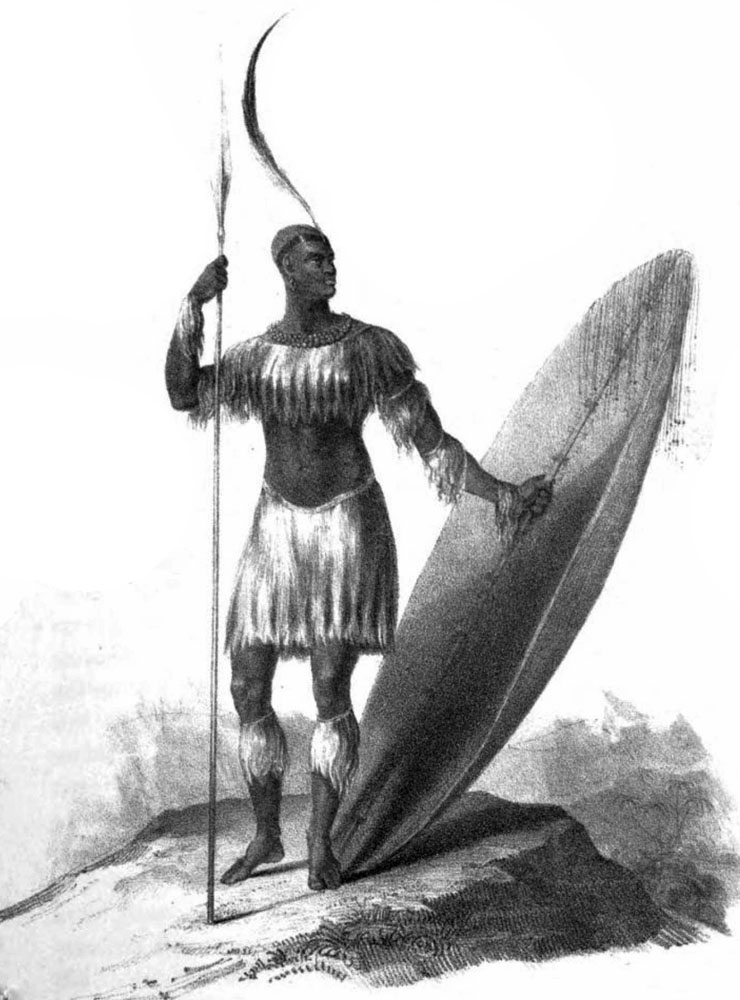
The second is what the first white visitors wrote, and here the problem is invention. Nathaniel Isaacs’s Travels and Adventures in Eastern Africa (1836), the book that gave English readers their picture of Shaka, was, Wylie argues, largely ghost-written; in 1832 Isaacs urged Fynn to make Shaka and Dingane “as bloodthirsty as you can.”106 The Diary of Henry Francis Fynn, published in 1950 and long treated as a primary source, “is not a ‘diary’ at all,” Wylie found, but writings of 1832 to 1861 reworked by Stuart and Malcolm.107 Hamilton adds a correction of her own: before Shaka’s death the traders mostly presented him as a benign patron, and the monster appeared in their writing only from 1829, drawing on hostile views of him already current among Africans.108 The drawing of Shaka with a long spear and a great shield, first printed in Isaacs’s book, is no better a witness. “We do not know what he looked like,” Wylie writes.109
The third is the British official record, above all the Parliamentary Papers that printed despatches, boundary reports and settlement terms for Parliament. They are full and precisely dated, and they make the British case in its own words. Archaeology checks all three. Excavations at uMgungundlovu and oNdini and the survey of kwaBulawayo have shown the eyewitness figures for Shaka’s capital to be inflated and filled in how the royal towns were laid out.110
Some questions stay open. The year of Shaka’s birth, the date of his decisive battle with the Ndwandwe, the number of Zulu killed at Ncome and whether Cetshwayo’s death had a natural cause all rest on sources that disagree, and the population figures, Guy’s “perhaps a quarter of a million” under Mpande and some 300,000 by 1872, are estimates. No source read for this page gives the kingdom’s area.111
Notes
-
Dooling 2023, ch. 9; Laband 2017, ch. 6; Laband 2018, chs. on Cetshwayo and Dinuzulu. ↩
-
Wright 2010, pp. 220-221; Eldredge 2014, p. 26; Dooling 2023, ch. 9. ↩
-
Eldredge 2014, pp. 38, 41; Dooling 2023, ch. 9. ↩
-
Eldredge 2014, pp. 27, 32; Dooling 2023, ch. 9. ↩
-
Eldredge 1994, p. 145, quoting Fynn; Wright 2010, p. 223. ↩
-
Eldredge 2014, p. 37. ↩
-
Gump 1988, p. 523 n. 9; Omer-Cooper 1966, p. 28. ↩
-
Dooling 2023, ch. 9; Wright 2010, p. 221. ↩
-
Chewins and Delius 2020, p. 93; Wright 2010, p. 220. ↩
-
Dooling 2023, ch. 9; Guy 1980, pp. 103, 111. ↩
-
Guy 1980, p. 102; Eldredge 1992, p. 26. ↩
-
Eldredge 1992, p. 2; Dooling 2023, ch. 9. ↩
-
Wylie 2006, pp. 101-102; Laband 2017, ch. 2; Eldredge 2014, p. 39. ↩
-
Eldredge 2014, pp. 74, 76; Laband 2017, ch. 2; Dooling 2023, ch. 9. ↩
-
Eldredge 2014, p. 119; Laband 2017, ch. 3. ↩
-
Laband 2017, ch. 3; Eldredge 2014, pp. 119-121; Dooling 2023, ch. 9; Wylie 2006, p. 210. ↩
-
Wylie 2006, p. 173; Wylie 1992, p. 425. ↩
-
Eldredge 2014, p. 158; Wright 2010, pp. 226-227; Laband 2017, ch. 3. ↩
-
Eldredge 2014, p. 158; Laband 2017, Timeline; Laband 2014, p. 37. ↩
-
Laband 2018, ch. 2; Dooling 2023, ch. 9. ↩
-
Laband 2018, ch. 2; Eldredge 2014, p. 174. ↩
-
Laband 2017, ch. 6 and Timeline; Eldredge 2014, p. 141. ↩
-
Wright 2010, p. 228. ↩
-
Cope 1968, p. 88 (English); p. 89 (isiZulu). ↩
-
Eldredge 2014, p. 270; Laband 2017, ch. 16; Wylie 2006, p. 501. ↩
-
Eldredge 2014, pp. 25, 251; Wylie 2006, pp. 499-500. ↩
-
Cobbing 1988, p. 487 and n. 2; Omer-Cooper 1966, pp. 3, 5 n. 1, 5-6. ↩
-
Cobbing 1988, pp. 487, 489, 518-519. ↩
-
Eldredge 1992, pp. 2-3, 34-35. ↩
-
Omer-Cooper 1993, pp. 273, 279. ↩
-
Hamilton 1992, pp. 39, 62-63. ↩
-
Wright 2010, p. 212. ↩
-
Chewins and Delius 2020, pp. 89, 108-109. ↩
-
Wright 2010, p. 226. ↩
-
Cope 1985, pp. 12-13; Laband 2014, pp. 210-211. ↩
-
Cope 1985, p. 13; Guy 1980, p. 117; Wright 2010, p. 229. ↩
-
van der Merwe and Pikirayi 2019, pp. 79, 86-90; Laband 2014, p. 197. ↩
-
van der Merwe 2014, p. 89. ↩
-
Whitelaw 1994, pp. 107-108. ↩
-
van der Merwe and Pikirayi 2019b, pp. 98-99. ↩
-
Gardiner 1836, quoted in van der Merwe and Pikirayi 2019, p. 81. ↩
-
Weir 2000, pp. 9-13; Eldredge 2014, p. 39; Dooling 2023, ch. 9; van der Merwe and Pikirayi 2019, p. 84. ↩
-
Guy 1981, pp. 58-59. ↩
-
Guy 1981, p. 59; Wright 2010, p. 229; Cope 1985, p. 12. ↩
-
Kuper 1993, pp. 479-487; Hamilton 1997, pp. 89-90, 106. ↩
-
Hamilton 1997, p. 106; Fuze 1979, p. 90; Dooling 2023, ch. 9. ↩
-
Eldredge 2014, p. 276; Leśniewski 2021, p. 23. ↩
-
Leśniewski 2021, p. 280. ↩
-
Leśniewski 2021, p. 32; Mahoney 2012, p. 50. ↩
-
Laband 2018, ch. 8; Okoye 1969, p. 234. ↩
-
Laband 2018, ch. 8; Leśniewski 2021, pp. 81-83; Chase 1843, pp. 8-9. ↩
-
Francis Owen’s diary, Feb. 6, 1838, quoted in Naidoo 1985, p. 189. ↩
-
Naidoo 1985, pp. 188-189, 194-195, 204; Chase 1843, pp. 71-72. ↩
-
Naidoo 1985, pp. 191, 203-205; Laband 2018, ch. 8. ↩
-
Laband 2018, ch. 9; Leśniewski 2021, pp. 212, 219-220; Mahoney 2012, p. 51. ↩
-
Pretorius’s despatch of Dec. 22, 1838, in Chase 1843, p. 71; Laband 2018, ch. 9; Leśniewski 2021, pp. 232-233. ↩
-
Mahoney 2012, p. 51; Leśniewski 2021, pp. 315-316; Laband 2018, ch. 10; Etherington, Harries and Mbenga 2010, p. 358. ↩
-
Leśniewski 2021, p. 323; Laband 2018, ch. 10. ↩
-
Leśniewski 2021, pp. 323-324; Laband 2018, ch. 11. ↩
-
Guy 1979, p. 13. ↩
-
Laband 2018, ch. 11; Leśniewski 2021, p. 352. ↩
-
Laband 2018, ch. 12. ↩
-
Fuze 1979, pp. 95, 101. ↩
-
Laband 2018, ch. 12; Cope 1968, p. 209. ↩
-
Laband 2018, ch. 12; Guy 1979, pp. 14, 21. ↩
-
Cope 1985, pp. 11-12. ↩
-
Cope 1985, p. 18, quoting Shepstone’s report. ↩
-
Cope 1985, pp. 15-19, 31; BPP C.2222 (1879), p. 94. ↩
-
Cope 1968, p. 222 (English); p. 223 (isiZulu). ↩
-
Etherington, Harries and Mbenga 2010, p. 383; BPP C.2222 (1879), p. 202. ↩
-
Laband 1992, pp. 12-13; Guy 1979, p. 49; Laband 2014, p. 200; Laband 1985, p. 37; BPP C.2222 (1879), pp. 94-95; Fuze 1979, p. 110. ↩
-
Guy 1979, p. 49; Laband 1992, p. 12. ↩
-
Fuze 1979, p. 110. ↩
-
Guy 1979, p. 50; Guy 2004, p. 55. ↩
-
Laband 1992, pp. 73-74, 87. ↩
-
Guy 1971, p. 565; Laband 2014, p. 232. ↩
-
Laband 1992, pp. 74, 109; Fuze 1979, p. 113. ↩
-
Guy 2004, p. 67. ↩
-
Guy 2004, p. 60. ↩
-
Laband 2014, p. 256; Laband 1992, pp. 218, 227, 230. ↩
-
Laband 2014, p. 258. ↩
-
Laband 2000, pp. 187, 192-195; Guy 2004, pp. 63-67. ↩
-
Fuze 1979, p. 115; Guy 1979, p. 63. ↩
-
Guy 1979, pp. 69, 73-76. ↩
-
Guy 1979, p. 149. ↩
-
Theron 2006, pp. 81-83. ↩
-
Guy 1979, pp. 161-162, 167, 172. ↩
-
Laband 1994, p. 43; Guy 1979, pp. 206, 243; Fuze 1979, pp. 117-119. ↩
-
Guy 1979, pp. 207-208. ↩
-
Guy 1979, pp. 217-218, 224; Laband 2018, ch. on Dinuzulu. ↩
-
Guy 1979, pp. 220-226; Laband 2018, ch. on Dinuzulu. ↩
-
Laband 2018, ch. on Dinuzulu; Guy 1979, p. 233. ↩
-
Laband 2018, ch. on Dinuzulu. ↩
-
Laband 1994, p. 44; Laband 2018, ch. on Dinuzulu; Guy 1979, p. 237. ↩
-
Guy 1979, p. 237. ↩
-
Laband 1994, p. 49; Laband 2018, ch. on Dinuzulu. ↩
-
Laband 1994, p. 57; Laband 2018, ch. on Dinuzulu. ↩
-
Ross, Mager and Nasson 2011, pp. 200-201; Thompson 2003, pp. 534, 537; Laband 2018, ch. on Dinuzulu. ↩
-
Laband 2018, chs. on Solomon, Cyprian and Goodwill Zwelithini. ↩
-
The Presidency, “Statement on the passing of His Majesty King Goodwill Zwelithini,” March 12, 2021; The Presidency, media advisory on the handover of the certificate of recognition, October 2022. ↩
-
Bhekuzulu and Others v President of the Republic of South Africa and Others [2023] ZAGPPHC 1982 (Dec. 11, 2023); Parliament of South Africa, COGTA committee statement, Oct. 7, 2025; IOL, June 7, 2026. ↩
-
Hamilton 1998, p. 5; Wright 2006, p. 2. ↩
-
Cope 1968, pp. vii-viii. ↩
-
Fuze 1979, p. ix. ↩
-
Wylie 2006, p. 4. ↩
-
Wylie 1992, p. 415; Wylie 1995, p. 413; Wylie 2006, p. 7. ↩
-
Wylie 1995, pp. 422-424; Wylie 2006, p. 7. ↩
-
Hamilton 1992, pp. 62-63; Hamilton 1998, p. 36. ↩
-
Wylie 2006, Preface; Golan 1994, p. 36. ↩
-
Whitelaw 1994, pp. 107-108; van der Merwe and Pikirayi 2019, p. 79. ↩
-
Guy 1979, pp. 14, 21; Laband 2000, p. 185. ↩
Where the estimates differ
| Estimate | Who holds it | Source |
|---|---|---|
| 1787 | Derived from the trader James Saunders King's guess in 1824 that Shaka was 38 | Wylie 2006, pp. 101-102 |
| About 1781 | Dan Wylie, from King's guess and two other rough estimates; John Laband finds the case persuasive | Wylie 2006, pp. 101-102; Laband 2017, ch. 2 |
| About 1780 to 1785 | Elizabeth Eldredge | Eldredge 2014, p. 39 |
| Estimate | Who holds it | Source |
|---|---|---|
| 1819 | John Laband | Laband 2017, ch. 3 |
| 1821 | Elizabeth Eldredge; Wayne Dooling | Eldredge 2014, pp. 119-121; Dooling 2023, ch. 9 |
| Probably 1819, "and maybe even 1820" | Dan Wylie | Wylie 2006, p. 210 |
| Estimate | Who holds it | Source |
|---|---|---|
| Sept. 23 | Elizabeth Eldredge; John Laband; the trader Francis Farewell | Eldredge 2014, p. 270; Laband 2017, ch. 16 |
| Sept. 24 | Henry Francis Fynn | Laband 2017, ch. 16 |
| Sept. 21 | Francis Farewell, in a later letter | Laband 2017, ch. 16 |
| The night of Sept. 22 | Dan Wylie, reading Nathaniel Isaacs | Wylie 2006, p. 501 |
| Estimate | Who holds it | Source |
|---|---|---|
| 8,000 to 10,000 | Michael Mahoney | Mahoney 2012, p. 51 |
| 10,000 to 12,000, of primary-source figures running from 8,000 to 16,000 | Michał Leśniewski | Leśniewski 2021, pp. 219-220 |
| Between 12,000 and 16,000, the largest army the Zulu could field | John Laband | Laband 2018, ch. 9 |
| Estimate | Who holds it | Source |
|---|---|---|
| "3,000 and some hundreds" | Andries Pretorius, in his despatch of Dec. 22, 1838 | Chase 1843, p. 71 |
| Probably well over 1,000 | John Laband, who thinks Pretorius's figure likely exaggerated | Laband 2018, ch. 9 |
| No fewer than 1,500, possibly more than 2,000 | Michał Leśniewski | Leśniewski 2021, pp. 232-233 |
| Estimate | Who holds it | Source |
|---|---|---|
| Perhaps a quarter of a million, under Mpande | Jeff Guy | Guy 1979, p. 14 |
| Some 300,000 in 1872 | Jeff Guy | Guy 1979, p. 21 |
| Probably around 300,000 in 1879, worked back from figures of the early 20th century | John Laband | Laband 2000, pp. 184-185 |
| Estimate | Who holds it | Source |
|---|---|---|
| July 20 | John Laband | Laband 1994, p. 43 |
| July 21 | Jeff Guy, captioning a sketch of Zibhebhu made the day after | Guy 1979, p. 243 |
Rulers of Zulu Kingdom
| Ruler | Reign | Note |
|---|---|---|
| Shaka kaSenzangakhona | c. 1816 to c. 1828 | Took the Zulu chieftaincy in about 1816 with Dingiswayo's backing; killed by his half-brothers Dingane and Mhlangana and his attendant Mbopha in September 1828. |
| Dingane kaSenzangakhona | 1828 to 1840 | Had Piet Retief's party killed in February 1838; defeated by Mpande's army at Maqongqo on Jan. 30, 1840, and killed beyond the Phongolo in March 1840. |
| Mpande kaSenzangakhona | 1840 to 1872 | Installed by the Boer leader Andries Pretorius on Feb. 10, 1840; from 1857 shared the government with his son Cetshwayo. |
| Cetshwayo kaMpande | 1872 to 1884 | Installed by Theophilus Shepstone on Sept. 1, 1873; captured by the British on Aug. 28, 1879, and exiled; restored over central Zululand in January 1883; died at Eshowe on Feb. 8, 1884. |
| Dinuzulu kaCetshwayo | 1884 to 1913 | Proclaimed king by Transvaal Boers on May 21, 1884. After the 1887 annexation he was sentenced for high treason (1889), came back from St. Helena in 1898 as a salaried government induna and died in the Transvaal in 1913. |
Timeline
- c. 1816 Zulu Kingdom emerges
- c. 1816 Shaka kaSenzangakhona begins to rule
- c. 1820 Capital at kwaBulawayo
- c. 1828 Capital at uMgungundlovu
- 1828 Dingane kaSenzangakhona begins to rule
- 1840 Mpande kaSenzangakhona begins to rule
- 1872 Cetshwayo kaMpande begins to rule
- 1884 Dinuzulu kaCetshwayo begins to rule
- 1887 Britain annexes the remaining Zulu country as the Colony of Zululand, proclaimed May 19, 1887; the Zulu monarchy continues in KwaZulu-Natal
Sources
- Elizabeth A. Eldredge. “The Creation of the Zulu Kingdom, 1815-1828: War, Shaka, and the Consolidation of Power”, Cambridge University Press, 2014.
- Elizabeth A. Eldredge. “Sources of Conflict in Southern Africa, c. 1800-30: The 'Mfecane' Reconsidered”, Journal of African History 33.1, pp. 1-35, 1992.
- Elizabeth A. Eldredge. “Delagoa Bay and the Hinterland in the Early Nineteenth Century: Politics, Trade, Slaves, and Slave Raiding”, in Elizabeth A. Eldredge and Fred Morton (eds.), Slavery in South Africa: Captive Labor on the Dutch Frontier, Westview Press, 1994.
- John Wright. “Turbulent Times: Political Transformations in the North and East, 1760s-1830s”, in Carolyn Hamilton, Bernard K. Mbenga and Robert Ross (eds.), The Cambridge History of South Africa, vol. 1, Cambridge University Press, pp. 211-252, 2010.
- Norman Etherington, Patrick Harries and Bernard K. Mbenga. “From Colonial Hegemonies to Imperial Conquest, 1840-1880”, in Carolyn Hamilton, Bernard K. Mbenga and Robert Ross (eds.), The Cambridge History of South Africa, vol. 1, Cambridge University Press, pp. 319-391, 2010.
- Robert Ross, Anne Kelk Mager and Bill Nasson (eds.). “The Cambridge History of South Africa, vol. 2, 1885-1994”, Cambridge University Press, 2011.
- John Wright. “Beyond the 'Zulu Aftermath': Migrations, Identities, Histories”, Journal of Natal and Zulu History 24, pp. 1-36, 2006.
- Wayne Dooling. “The Zulu Kingdom”, in John Parker (ed.), Great Kingdoms of Africa, Thames & Hudson / University of California Press, ch. 9, 2023.
- Jeff Guy. “The Destruction of the Zulu Kingdom: The Civil War in Zululand, 1879-1884”, Longman, 1979.
- Jeff Guy. “Ecological Factors in the Rise of Shaka and the Zulu Kingdom”, in Shula Marks and Anthony Atmore (eds.), Economy and Society in Pre-Industrial South Africa, Longman, pp. 102-119, 1980.
- J. J. Guy. “The Political Structure of the Zulu Kingdom during the Reign of Cetshwayo kaMpande”, in J. B. Peires (ed.), Before and After Shaka: Papers in Nguni History, Institute of Social and Economic Research, Rhodes University, 1981.
- J. J. Guy. “A Note on Firearms in the Zulu Kingdom with Special Reference to the Anglo-Zulu War, 1879”, Journal of African History 12.4, pp. 557-570, 1971.
- Jeff Guy. “Non-combatants and War: Unexplored Factors in the Conquest of the Zulu Kingdom”, Journal of Natal and Zulu History 22, pp. 53-71, 2004.
- John Laband. “The Eight Zulu Kings”, Jonathan Ball, 2018.
- John Laband. “The Assassination of King Shaka: Zulu History's Dramatic Moment”, Jonathan Ball, 2017.
- John Laband. “Zulu Warriors: The Battle for the South African Frontier”, Yale University Press, 2014.
- John Laband. “Kingdom in Crisis: The Zulu Response to the British Invasion of 1879”, University of Natal Press, 1992.
- J. P. C. Laband. “The Cohesion of the Zulu Polity under the Impact of the Anglo-Zulu War: A Reassessment”, Journal of Natal and Zulu History 8, pp. 33-62, 1985.
- John Laband. “British Boundary Adjustments and the uSuthu-Mandlakazi Conflict in Zululand, 1879-1904”, South African Historical Journal 30, pp. 33-60, 1994.
- John Laband. “'War Can't Be Made with Kid Gloves': The Impact of the Anglo-Zulu War of 1879 on the Fabric of Zulu Society”, South African Historical Journal 43, pp. 179-196, 2000.
- Michał Leśniewski. “The Zulu-Boer War 1837-1840”, Brill, 2021.
- Michael R. Mahoney. “The Other Zulus: The Spread of Zulu Ethnicity in Colonial South Africa”, Duke University Press, 2012.
- Dan Wylie. “Myth of Iron: Shaka in History”, University of KwaZulu-Natal Press, 2006.
- Dan Wylie. “Textual Incest: Nathaniel Isaacs and the Development of the Shaka Myth”, History in Africa 19, pp. 411-433, 1992.
- Dan Wylie. “'Proprietor of Natal': Henry Francis Fynn and the Mythography of Shaka”, History in Africa 22, pp. 409-437, 1995.
- Carolyn Hamilton. “Terrific Majesty: The Powers of Shaka Zulu and the Limits of Historical Invention”, Harvard University Press, 1998.
- Carolyn Hamilton. “'The Character and Objects of Chaka': A Reconsideration of the Making of Shaka as 'Mfecane' Motor”, Journal of African History 33.1, pp. 37-63, 1992.
- Carolyn Hamilton. “Restructuring within the Zulu Royal House”, African Studies 56.2, pp. 85-113, 1997.
- Daphna Golan. “Inventing Shaka: Using History in the Construction of Zulu Nationalism”, Lynne Rienner, 1994.
- Julian Cobbing. “The Mfecane as Alibi: Thoughts on Dithakong and Mbolompo”, Journal of African History 29.3, pp. 487-519, 1988.
- J. D. Omer-Cooper. “The Zulu Aftermath: A Nineteenth-Century Revolution in Bantu Africa”, Longmans, Ibadan History Series, 1966.
- J. D. Omer-Cooper. “Has the Mfecane a Future? A Response to the Cobbing Critique”, Journal of Southern African Studies 19.2, pp. 273-294, 1993.
- Linell Chewins and Peter Delius. “The Northeastern Factor in South African History: Reevaluating the Volume of the Slave Trade out of Delagoa Bay and Its Impact on Regional Politics in the Early Nineteenth Century”, Journal of African History 61.1, pp. 89-110, 2020.
- James Gump. “Origins of the Zulu Kingdom”, The Historian 50.4, pp. 521-534, 1988.
- R. L. Cope. “Political Power within the Zulu Kingdom and the 'Coronation Laws' of 1873”, Journal of Natal and Zulu History 8, pp. 11-31, 1985.
- Jennifer Weir. “'I Shall Need to Use Her to Rule': The Power of 'Royal' Zulu Women in Pre-Colonial Zululand”, South African Historical Journal 43, pp. 3-23, 2000.
- Adam Kuper. “The 'House' and Zulu Political Structure in the Nineteenth Century”, Journal of African History 34.3, pp. 469-487, 1993.
- Renier H. van der Merwe and Innocent Pikirayi. “The Organisation and Layout of Zulu Military Homesteads (Amakhanda)”, Azania: Archaeological Research in Africa 54.1, pp. 75-93, 2019.
- Renier H. van der Merwe and Innocent Pikirayi. “Identifying Zulu Military (Amakhanda) Settlements in the Archaeological Record”, South African Archaeological Bulletin 74 (210), pp. 91-100, 2019.
- Renier H. van der Merwe. “Ikhanda: An Ethno-Historical Archaeological Investigation of Nguni Military Homesteads between the Mfolozi and Tugela Rivers”, MA dissertation, University of Pretoria, 2014.
- Gavin Whitelaw. “Preliminary Results of a Survey of Bulawayo, Shaka kaSenzangakhona's Capital from about 1820 to 1827”, Southern African Field Archaeology 3, pp. 107-109, 1994.
- Jay Naidoo. “Was the Retief-Dingane Treaty a Fake?”, History in Africa 12, pp. 187-210, 1985.
- Felix N. Okoye. “Dingane: A Reappraisal”, Journal of African History 10.2, pp. 221-235, 1969.
- Bridget Theron. “King Cetshwayo in Victorian England: A Cameo of Imperial Interaction”, South African Historical Journal 56, pp. 60-87, 2006.
- Paul S. Thompson. “The Zulu Rebellion of 1906: The Collusion of Bambatha and Dinuzulu”, International Journal of African Historical Studies 36.3, pp. 533-557, 2003.
- Trevor Cope (ed.), collected by James Stuart, translated by Daniel Malcolm. “Izibongo: Zulu Praise-Poems”, Clarendon Press, 1968.
- Magema M. Fuze, translated by H. C. Lugg, edited by A. T. Cope. “The Black People and Whence They Came: A Zulu View”, University of Natal Press and Killie Campbell Africana Library, 1979.
- Allen F. Gardiner. “Narrative of a Journey to the Zoolu Country, in South Africa”, William Crofts, London, 1836.
- Nathaniel Isaacs. “Travels and Adventures in Eastern Africa”, Edward Churton, London, 2 vols., 1836.
- John Centlivres Chase (comp.). “The Natal Papers, Part the Second, from A.D. 1838 to A.D. 1843”, R. Godlonton, Graham's Town, 1843.
- British Parliamentary Papers. “Further Correspondence respecting the Affairs of South Africa, C.2222”, HMSO, London, 1879.
- W. C. Holden. “British Rule in South Africa: Illustrated in the Story of Kama and His Tribe, and of the War in Zululand”, Wesleyan Conference Office, London, 1879.
Further Reading
The sources above support the specific claims on this page. The works below are the scholarship behind them. Citations are given in full so readers can find them through a library or database; some are paywalled.
Peer-reviewed articles
- Fowler, Kent D.; van Schalkwyk, Leonard O. (2025). "The amakhanda settlement system of the Zulu kingdom." Azania: Archaeological Research in Africa 60(2): 285-324. DOI: 10.1080/0067270x.2025.2479337.
- Fowler, Kent D.; van Schalkwyk, Leonard O. (2022). "Reconnaissance survey of Zulu kingdom period amakhanda in the emaKhosini Basin, South Africa." Azania: Archaeological Research in Africa 57(3): 392-418. DOI: 10.1080/0067270x.2022.2115686.
- Nxumalo, Bongumenzi (2023). "Aspects of Zulu Ceramic Traditions in the Upper and Lower uThukela Basin, KwaZulu-Natal, South Africa." African Archaeological Review 40(1): 89-106. DOI: 10.1007/s10437-022-09510-9.
- Mbatha, Mthandeni P. (2026). "Territorial governance and political centralisation in the nineteenth-century Zulu Kingdom." Territory, Politics, Governance null: 1-16. DOI: 10.1080/21622671.2026.2711664.
- Pollard, Tony et al. (2005). "Survey and Excavation of the Anglo-Zulu War Fort at Eshowe, KwaZulu-Natal, South Africa." Journal of Conflict Archaeology 1(1): 133-180. DOI: 10.1163/157407705774929015.
- van der Merwe, Renier H.; Pikirayi, Innocent (2018). "The organisation and layout of Zulu military homesteads ( amakhanda )." Azania: Archaeological Research in Africa 54(1): 75-93. DOI: 10.1080/0067270x.2018.1540218.
- van der Merwe, Renier H.; Fowler, Kent D.; Sadr, Karim (2023). "A new interpretation of the military settlements of the northern Nguni." Azania: Archaeological Research in Africa 58(2): 294-319. DOI: 10.1080/0067270x.2023.2208483.
- Brottem, Bronwyn V.; Lang, Ann (1973). "Zulu Beadwork." African Arts 6(3): 8. DOI: 10.2307/3334688.
- Nxumalo, Siyabonga (2026). "British Political Hegemony and Imperialism: Crushing of the Usuthu and the Onkweni Sections of the Zulu Royal Family, 1880s–1913." The Journal of African History 67. DOI: 10.1017/s002185372510073x.
- Warhurst, Philip (1999). "The Colonial Office and Natal's Annexation of Zululand." Journal of Natal and Zulu History 19(1): 95-108. DOI: 10.1080/02590123.1999.11964110.
- Nicholls, B M (1995). "Zululand 1887–1889: The Court of the Special Commissioners for Zululand and the Rule of Law." Journal of Natal and Zulu History 15(1): 41-63. DOI: 10.1080/02590123.1995.11964087.
- Laband, J.P.C. (1981). "The Establishment of the Zululand Administration in 1887: A Study of the Criteria Behind the Selection of British Colonial Officials." Journal of Natal and Zulu History 4(1): 62-73. DOI: 10.1080/02590123.1981.11964214.
- LABAND, JOHN (2003). "Colonial Flotsam: The Zululand Squatters and the Zululand Lands Delimitation Commission 1902–1904." South African Historical Journal 49(1): 53-70. DOI: 10.1080/02582470308671447.
- LABAND, JOHN (1994). "British Boundary Adjustments and the uSuthu-Mandlakazi Conflict in Zululand, 1879–1904." South African Historical Journal 30(1): 33-60. DOI: 10.1080/02582479408671781.
- Lynd, Hilary (2021). "The Peace Deal: The Formation of the Ingonyama Trust and the IFP Decision to Join South Africa’s 1994 Elections." South African Historical Journal 73(2): 318-360. DOI: 10.1080/02582473.2021.1909116.
- Shamase, Maxwell Z. (2014). "The royal women of the Zulu monarchy through the keyhole of oral history: Queens Nandi (c. 1764 – c.1827) and Monase (c. 1797 – 1880)." Inkanyiso 6(1): 14. DOI: 10.4102/ink.v6i1.240.
- Shamase, Maxwell Z. (2014). "The royal women of the Zulu monarchy – through the keyhole of oral history: Princess Mkabayi Kajama (c.1750 – c.1843)." Inkanyiso 6(1): 8. DOI: 10.4102/ink.v6i1.241.
- Guy, Jeff (1996). "Shaka kaSenzangakhona: A Reassessment." Journal of Natal and Zulu History 16(1): 1-30. DOI: 10.1080/02590123.1996.11964090.
- Wright, John (2017). "Southern Africa before Colonial Times." Oxford Research Encyclopedia of African History null. DOI: 10.1093/acrefore/9780190277734.013.92.
- Gump, James (1988). "Origins of the Zulu Kingdom." The Historian 50(4): 521-534. DOI: 10.1111/j.1540-6563.1988.tb00757.x.
- Deflem, Mathieu (1999). "Warfare, Political Leadership, and State Formation: The Case of the Zulu Kingdom, 1808-1879." Ethnology 38(4): 371. DOI: 10.2307/3773913.
- Cobbing, Julian (1988). "The Mfecane as Alibi: Thoughts on Dithakong and Mbolompo." The Journal of African History 29(3): 487-519. DOI: 10.1017/s0021853700030590.
- Eldredge, Elizabeth A. (1992). "Sources of Conflict in Southern Africa,c.1800–30: The ‘Mfecane’ Reconsidered." The Journal of African History 33(1): 1-35. DOI: 10.1017/s0021853700031832.
- Hamilton, Carolyn Anne (1992). "‘The Character and Objects of Chaka’: A Reconsideration of the Making of Shaka as ‘Mfecane’ Motor." The Journal of African History 33(1): 37-63. DOI: 10.1017/s0021853700031844.
- Omer‐Cooper, J. D. (1993). "Has the Mfecane a future? a response to the Cobbing critique." Journal of Southern African Studies 19(2): 273-294. DOI: 10.1080/03057079308708360.
- CHEWINS, LINELL; DELIUS, PETER (2020). "THE NORTHEASTERN FACTOR IN SOUTH AFRICAN HISTORY: REEVALUATING THE VOLUME OF THE SLAVE TRADE OUT OF DELAGOA BAY AND ITS IMPACT ON ITS HINTERLAND IN THE EARLY NINETEENTH CENTURY." The Journal of African History 61(1): 89-110. DOI: 10.1017/s0021853720000055.
- Eldredge, Elizabeth A. (2019). "Delagoa Bay and the Hinterland in the Early Nineteenth Century: Politics, Trade, Slaves, and Slave Raiding." Slavery in South Africa null: 127-165. DOI: 10.4324/9780429306105-6.
- Liesegang, Gerhard (1970). "Nguni Migrations between Delagoa Bay and the Zambezi, 1821-1839." African Historical Studies 3(2): 317. DOI: 10.2307/216219.
- Wright, John (2006). "Beyond the “Zulu Aftermath”: Migrations, Identities, Histories." Journal of Natal and Zulu History 24(1): 1-36. DOI: 10.1080/02590123.2006.11964135.
- Nxumalo, Siyabonga (2024). "State Formation in Kwa-Zulu Natal and the Subsequent Rise of the Zulu Kingdom in the 1820s." South African Journal of Cultural History 38(1): 1-27. DOI: 10.54272/sach.2024.v38n1a1.
- Kuper, Adam (1993). "The ‘House’ and Zulu Political Structure in the Nineteenth Century." The Journal of African History 34(3): 469-487. DOI: 10.1017/s0021853700033764.
- Hamilton, Carolyn (1997). "Restructuring within the Zulu royal house." African Studies 56(2): 85-113. DOI: 10.1080/00020189708707870.
- WEIR, JENNIFER (2000). "‘I Shall Need to Use Her to Rule’: The Power of ‘Royal’ Zulu Women in Pre-Colonial Zululand." South African Historical Journal 43(1): 3-23. DOI: 10.1080/02582470008671905.
- Okoye, Felix N. C. (1969). "Dingane: A Reappraisal." The Journal of African History 10(2): 221-235. DOI: 10.1017/s002185370000949x.
- Naidoo, Jay (1985). "Was The Retief-Dingane Treaty a Fake?." History in Africa 12: 187-210. DOI: 10.2307/3171720.
- Kennedy, Phillip A. (1981). "Mpande and the Zulu Kingship." Journal of Natal and Zulu History 4(1): 21-38. DOI: 10.1080/02590123.1981.11964211.
- Cope, R L (1985). "Political Power Within The Zulu Kingdom and the ‘Coronation Laws’ of 1873." Journal of Natal and Zulu History 8(1): 11-31. DOI: 10.1080/02590123.1985.11964237.
- Theron, Bridget (2006). "King Cetshwayo in Victorian England: A Cameo of Imperial Interaction." South African Historical Journal 56(1): 60-87. DOI: 10.1080/02582470609464965.
- Guy, J. J. (1971). "A Note on Firearms in the Zulu Kingdom with special reference to the Anglo-Zulu War, 1879." The Journal of African History 12(4): 557-570. DOI: 10.1017/s0021853700011154.
- Laband, J P C (1985). "The Cohesion of the Zulu Polity Under the Impact of the Anglo-Zulu War: A Reassessment." Journal of Natal and Zulu History 8(1): 33-62. DOI: 10.1080/02590123.1985.11964238.
- LABAND, JOHN (2000). "‘War Can't Be Made with Kid Gloves’: The Impact of the Anglo-Zulu War of 1879 on the Fabric of Zulu Society." South African Historical Journal 43(1): 179-196. DOI: 10.1080/02582470008671912.
- Guy, Jeff (2004). "Non-combatants and war: Unexplored factors in the conquest of the Zulu kingdom." Journal of Natal and Zulu History 22(1): 53-71. DOI: 10.1080/02590123.2004.11964125.
- Thompson, Paul S. (2003). "The Zulu Rebellion of 1906: The Collusion of Bambatha and Dinuzulu." The International Journal of African Historical Studies 36(3): 533. DOI: 10.2307/3559433.
- Wylie, Dan (1995). "“Proprietor of Natal:” Henry Francis Fynn and the Mythography of Shaka." History in Africa 22: 409-437. DOI: 10.2307/3171924.
- WYLIE, DAN (1993). "A Dangerous Admiration: E.A. Ritter'sShaka Zulu." South African Historical Journal 28(1): 98-118. DOI: 10.1080/02582479308671969.
- Dooling, Wayne (2023). "The Zulu Kingdom." Great Kingdoms of Africa null: 253-281. DOI: 10.1525/9780520395688-011.
- Wright, John (2009). "Turbulent Times: Political Transformations in the North and East, 1760s–1830s." The Cambridge History of South Africa null: 211-252. DOI: 10.1017/chol9780521517942.006.
- Wright, John (2018). "Rediscovering the Ndwandwe kingdom." Five Hundred Years Rediscovered null: 217-238. DOI: 10.18772/22008084747.15.
- Bonner, Philip (2018). "Swazi oral tradition and Northern Nguni historical archaeology." Five Hundred Years Rediscovered null: 239-256. DOI: 10.18772/22008084747.16.
- Marks, Shula (1978). "Natal, the Zulu royal family and the ideology of segregation." Journal of Southern African Studies 4(2): 172-194. DOI: 10.1080/03057077808707984.
- Tallie, T.J. (2012). "Racialised Masculinity and the Limits of Settlement: John Dunn and Natal, 1879–1883." Journal of Natal and Zulu History 30(1): 1-22. DOI: 10.1080/02590123.2012.11964176.
- Laband, John (2012). "Zulu Wars." Oxford Bibliographies in Military History null. DOI: 10.1093/obo/9780199791279-0071.
- Bowman, Joye (2004). "Reconstructing the Past Using the British Parliamentary Papers: The Anglo-Zulu War of 1879." History in Africa 31: 117-132. DOI: 10.1017/s0361541300003429.
- Wylie, Dan (1992). "Textual Incest: Nathaniel Isaacs and the Development of the Shaka Myth." History in Africa 19: 411-433. DOI: 10.2307/3172010.
Books
- Parcells, Ashley (2026). A New Zulu Kingdom. Bloomsbury Publishing Plc.
- Maré, Gerhard (2024). Ethnic Continuities and a State of Exception. Routledge.
- Ndlovu, Sifiso Mxolisi (2017). African Perspectives of King Dingane kaSenzangakhona. Springer International Publishing.
- Eldredge, Elizabeth A. (2014). The Creation of the Zulu Kingdom, 1815–1828. Cambridge University Press.
- Laband, John (2014). Zulu Warriors. Yale University Press.
- Mahoney, Michael R. (2012). The Other Zulus. Duke University Press.
- Marks, Shula (2004). Cetshwayo [Cetewayo] ka Mpande (c. 1826–1884), king of the Zulu. Oxford University Press.
- Omer-Cooper, John D. (2004). Dingane ka Senzangakhona (c. 1798–1840), king of the Zulu. Oxford University Press.
- Lobban, Michael (2021). Imperial Incarceration. Cambridge University Press.
- Hamilton, Carolyn (1998). Terrific Majesty: The Powers of Shaka Zulu and the Limits of Historical Invention. Harvard University Press.
- Laband, John (1995). Rope of Sand: The Rise and Fall of the Zulu Kingdom in the Nineteenth Century. Jonathan Ball.
- Guy, Jeff (1979). The Destruction of the Zulu Kingdom: The Civil War in Zululand, 1879-1884. Longman (University of Natal Press reissue 1994).
- Duminy, Andrew; Guest, Bill (1989). Natal and Zululand from Earliest Times to 1910: A New History. University of Natal Press / Shuter & Shooter.
- Eldredge, Elizabeth A. (2015). Kingdoms and Chiefdoms of Southeastern Africa: Oral Traditions and History, 1400-1830. University of Rochester Press.
- Carton, Benedict; Laband, John; Sithole, Jabulani (2008). Zulu Identities: Being Zulu, Past and Present. University of KwaZulu-Natal Press.
- Omer-Cooper, J. D. (1966). The Zulu Aftermath: A Nineteenth-Century Revolution in Bantu Africa. Longman.
- Laband, John (2017). The Assassination of King Shaka. Jonathan Ball.
- Laband, John (2018). The Eight Zulu Kings: From Shaka to Goodwill Zwelithini. Jonathan Ball.
- Lesniewski, Michal (2021). The Zulu-Boer War 1837-1840. Brill.
- Wylie, Dan (2006). Myth of Iron: Shaka in History. University of KwaZulu-Natal Press.
- Golan, Daphna (1994). Inventing Shaka: Using History in the Construction of Zulu Nationalism. Lynne Rienner.
- Webb, C. de B.; Wright, J. B. (1976-). The James Stuart Archive of Recorded Oral Evidence Relating to the History of the Zulu and Neighbouring Peoples. University of Natal Press / UKZN Press.
- Webb, C. de B.; Wright, J. B. (1978). A Zulu King Speaks: Statements Made by Cetshwayo kaMpande on the History and Customs of His People. University of Natal Press / Killie Campbell Africana Library.
- Swanepoel, Natalie; Esterhuysen, Amanda; Bonner, Philip (2008). Five Hundred Years Rediscovered: Southern African Precedents and Prospects. Wits University Press.
- Marks, Shula; Atmore, Anthony (1980). Economy and Society in Pre-Industrial South Africa. Longman.
- Eldredge, Elizabeth A.; Morton, Fred (1994). Slavery in South Africa: Captive Labor on the Dutch Frontier. Westview Press (Routledge reissue 2019).
- Jenkinson, Thomas B. (1882). Amazulu: The Zulus, Their Past History, Manners, Customs, and Language. W. H. Allen (period document).
- Haggard, H. Rider (1882). Cetywayo and His White Neighbours: Remarks on Recent Events in Zululand, Natal, and the Transvaal. Trubner (period document).
- Dunne, W. A. (1931). Eyewitness in Zululand: The Campaign Reminiscences of Colonel W. A. Dunne, South Africa 1877-1881. Edward Arnold (period document).
- Krauss, Ferdinand (1838). Travel Journal: Cape to Zululand, Observations by a Collector and Naturalist, 1838-40. (period document).
Zulu Kingdom: c. 1816 to 1887.