Kongo, Central Africa's Christian Kingdom
By Princewill Ubani · Published · Updated
Research ID: PA-POL-kongo
The kingdom south of the Congo River whose kings turned Christian in 1491, wrote to Lisbon and Rome, and held off Portuguese Angola until civil war split it among rival royal houses.
.jpg?width=1280)
In July 1526 King Afonso of Kongo wrote to King João III of Portugal that Portuguese merchants were selling goods so freely in his country that his vassals had more of them than he did, and no longer obeyed him. Thieves, he wrote, were seizing free people, nobles and even members of his own family to sell to the traders. He threatened to end all trade with Portugal rather than see his land “completely depopulated.”1
Afonso wrote in Portuguese, and he was a Christian king. Kongo had adopted Christianity as its state religion in 1491, and its literate elite left a stream of letters and legal inquests. That record makes Kongo one of the few African kingdoms of its time whose history was documented by its own people, in historian John Thornton’s assessment.2
Three kingdoms before Kongo
Kongo grew out of older states on the lower Congo River. Before it existed, Thornton writes, the region was held by three federations: the Seven Kingdoms of Kongo dia Nlaza, with its capital on the Kwale River; Mpemba, which ran 150 kilometers north from the headwaters of the Loze River to the Congo; and a group of three small states north of the river led by Vungu.3
Tradition says the kingdom began when a ruler known only by the title Ntinu Wene, “King of the Kingdom,” crossed the Congo River from Vungu and conquered Mpemba Kasi, the northernmost part of Mpemba. Thornton places this around the end of the 13th century, perhaps 1280, though he notes that a founder with a title instead of a name is more likely a statement about rights of rule than a record of events.4 Kongo’s royal family still regarded the Vungu federation as its ancestral home in the 17th century.5
The kingdom’s core lay in the valley of Nsi a Kwilu, a corridor that carried raffia cloth from the north and copper, in Central Africa as precious as gold elsewhere, to buyers in the south. The valley was also a center of iron and steel working.6
The founder on the mountain
In the 1350s, by Thornton’s reconstruction, a ruler named Nimi a Nzima allied with Nsaku Elau of Mbata, who gave him his daughter in marriage. Mbata’s ruler would help elect the kings, and later kings called him “grandfather.”7 Their son Lukeni lua Nimi is remembered as the founder. He fortified himself in a rocky stronghold, taxed passing trade, and, in one story, killed his pregnant aunt when she refused to pay his toll. Thornton reads the tale as a political metaphor for a sovereign’s power over life and death.8
Lukeni lua Nimi followed the trade routes south to a market town at the foot of the Mountain of Kongo and made its broad summit his capital, Mbanza Kongo. Archaeologists have found no settlement there older than about 1350.9 From there Kongo allied with Vunda, absorbed Mpemba, took over the lands of Kabunga, a regional religious leader, and conquered Nsundi, which became the province of the heir to the throne.10
Provinces held at the king’s pleasure
By the late 15th century Kongo covered close to 100,000 square kilometers, more than the area of Portugal, and probably had as many as half a million subjects.11 Thornton has since raised his estimate for the kingdom’s peak: from about 509,000 people in 1650, his figure of 1977, to about 790,000 in 1623, using newly found records of baptisms.12 It was, in Thornton’s word, a centralized and bureaucratic state. The king appointed governors of most provinces for short terms and could dismiss them at will, collected taxes across the realm, and paid officials in nzimbu, small shells gathered on Luanda Island, which served as Kongo’s money.13 Only a few territories, Mbata above all, were held by inheritance because of their part in the kingdom’s founding.14
The king also judged. A report from the 1490s said he punished adultery, theft and treason and could order death and confiscation of goods.15 His army was built around professional heavy infantry, nobles who fought with swords and large shields, surrounded by thousands of archers raised from the villages.16
Kongo grew by moving people. Its armies brought captives from conquered lands to settle around the capital, which witnesses in 1491 compared in size to Évora, then Portugal’s second-largest city: perhaps 15,000 people.17
Ships from Portugal
The Portuguese captain Diogo Cão made official contact with Kongo in 1483, the start of a long exchange of envoys. Kongo’s first embassy, led by a nobleman named Kala ka Mfusu, reached Lisbon at the end of 1487 or early in 1488, and a priest there learned Kikongo from its members.18
The embassy came home late in 1490 with priests, masons, carpenters and Portuguese peasant families sent to teach farming. The Mwene Soyo, ruler of the coastal province, was baptized as Manuel, and King Nzinga a Nkuwu as João, with their courts.19 Christianity remained the state religion for the rest of the kingdom’s existence.20
Afonso and the Kongo church
João’s son Afonso Mvemba a Nzinga became king in 1506 after a disputed succession. His own account says he defeated his half-brother Mpanzu a Nzinga with the help of the Virgin Mary and St. James, who appeared on the battlefield. Thornton treats the miracle as good international politics laid over a real factional struggle.21
Afonso made the story official. In letters to the Kongo elite around 1512 he set out his accession as the second founding of the kingdom, and the king of Portugal had a herald design a coat of arms for Kongo from Afonso’s written account of the battle. It shows a silver cross for the apparition in the sky, a red field for the bloodshed, shells for St. James, five armored arms holding swords and two broken “idols.” Afonso wanted the arms kept “so that the kings that will follow Us in our kingdom and lordship of the Kongo would not be able at any time to forget such great grace and favor.” Kongo kings were still crowned with the arms in the 17th and 18th centuries, and a painted copy survives in a 16th-century Portuguese armorial in the national archive in Lisbon.22
Afonso sent young nobles to Portugal to study and set up schools when they returned. By 1530 there was a network of schools across the country, staffed by Kongolese teachers, which Thornton calls the surest guarantee of Christianity’s survival in Kongo into the 20th century.23 A Portuguese priest who knew him called Afonso “the apostle of Congo.”24
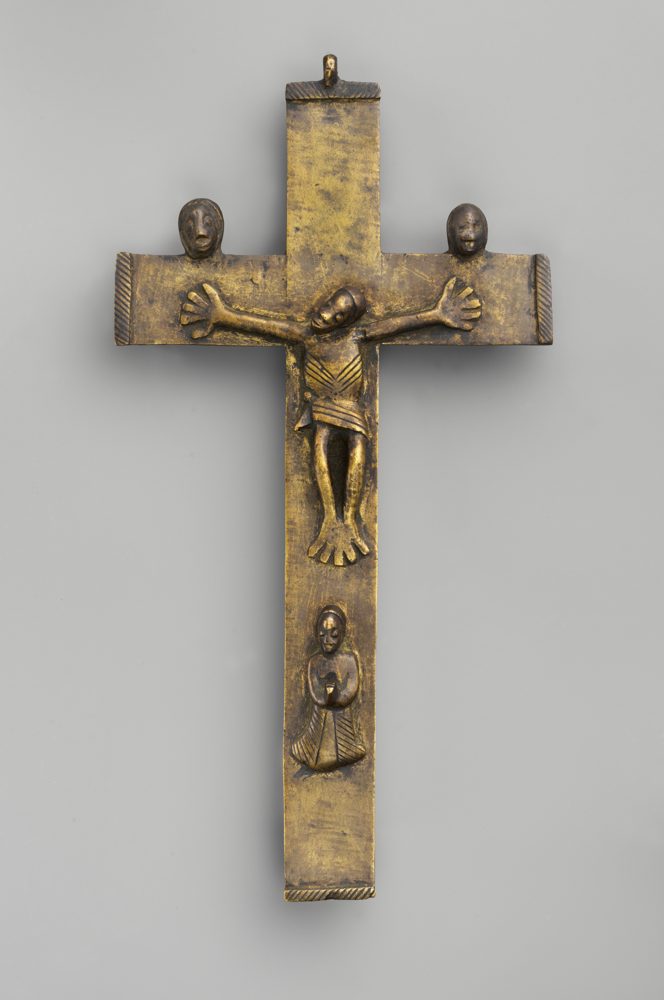
The church he built was Kongolese. Afonso and his teachers fitted Christian teaching to Kongo’s own religion, in which a distant creator god, Nzambi a Mpungu, stood above ancestors and territorial spirits. The Kikongo word for “holy” became nkisi, the term for the spiritual force that linked the other world to this one.25 The art historian Cécile Fromont sees the cross as the point where the two religions met. It was already a Kongo sign of the passage between life and death, and the hundreds of Kongo-made crucifixes that survive carry an iconography that grew “at the crux between Christian and Kongo religious and visual syntax.”26
Afonso wanted his own clergy. His son Henrique became a bishop, in 1518 by Thornton’s 1984 account and in 1521 by his 2020 one, and served until his death in 1531, but Portugal persuaded Rome to place Kongo under the new diocese of São Tomé in 1534.27
The letters of 1526
Afonso’s complaint of 1526 is the best-known document of his reign. In three letters that year he protested the illegal slave trade run through São Tomé, blaming sailors from Cape Verde and Guinea, people from Benin, “white men” and his own countrymen.28 His remedy was a board of three judges, two Kongolese and one Portuguese, to decide whether each captive had been lawfully enslaved.29
The letters have been read as Kongo resisting the slave trade, or as proof that Afonso had lost control of his country. Thornton reads them differently. Kongo itself sold captives and had done so since at least 1502, when the trade is first recorded. What Afonso was defending was his monopoly, which Portuguese traders were breaking by dealing directly with Ndongo, a kingdom to the south that he claimed as a vassal.30 Thornton also doubts the country was being emptied: exports in this period were at most a few thousand people a year, from a population of well over half a million.31 The historian Igor Matonda Sakala disagrees. Reworking the Capuchin baptism counts, he found that Thornton had put the density of some districts far too low, including Nsevo, which he reckoned at about 14 people per square kilometer in 1650 rather than 3.5. He argued in 2016 that baptisms alone cannot measure Kongo’s population, that the kingdom did lose people, and that slaves were taken from inside it, not only beyond its borders.32
Ndongo was Kongo’s great rival in the south. Its royal traditions traced the dynasty to a blacksmith who came from Kongo, and its king sent envoys to Afonso around 1518 asking to become Christian, probably because he was still nominally Kongo’s subordinate. Within a few years Ndongo had its own embassy in Portugal.33
The Jagas and São Salvador
Kongo’s successions were contested from the start. Afonso’s son Pedro was overthrown in 1545 by Afonso’s grandson Diogo, who ruled until 1561.34 In 1567 King Bernardo died fighting a people the Portuguese called Jagas on the eastern frontier, and his successor died in battle against Makoko, a rival kingdom to the northeast.35
The Jagas then invaded. They ravaged Mbata and took the capital, and the new king, Álvaro I, fled to islands in the Congo River while thousands of his subjects were displaced and many sold as slaves. Portugal sent 600 soldiers, and after a year and a half of fighting Álvaro was restored. He paid with papers of vassalage and a share of the shell revenue from Luanda Island.36
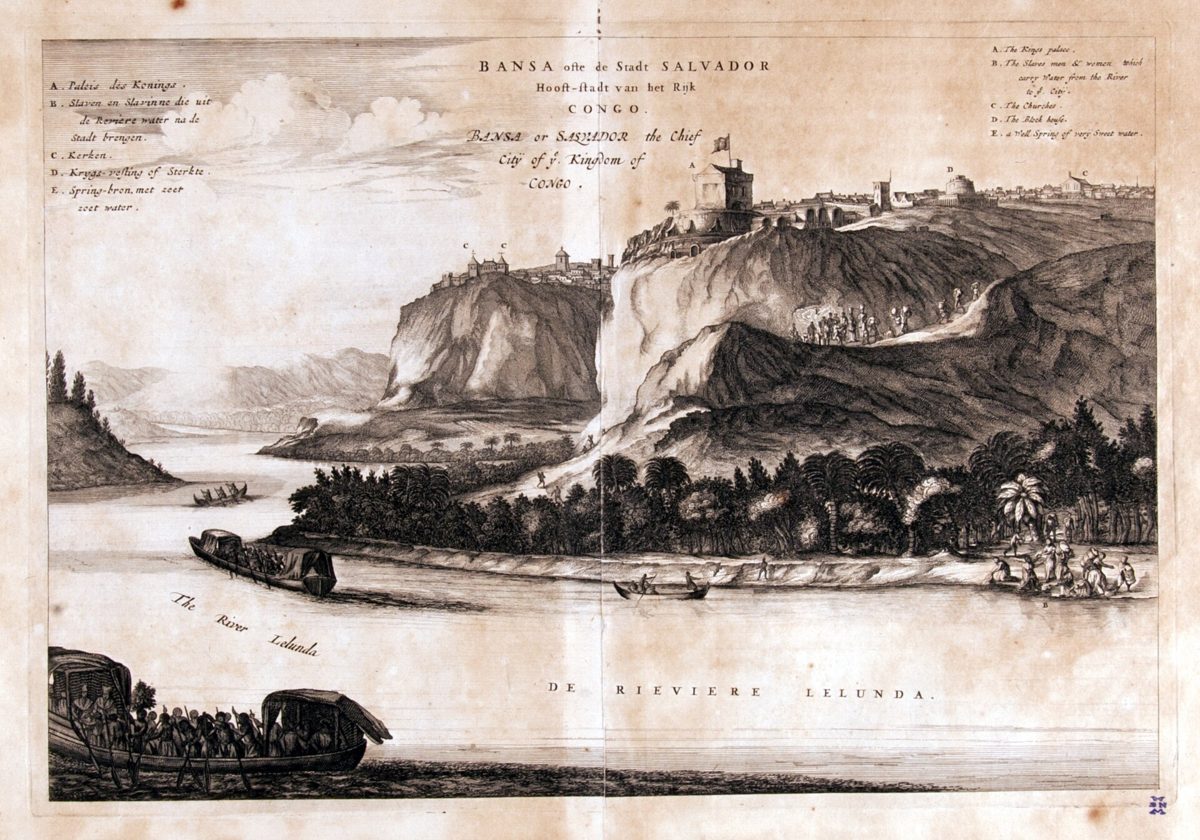
Álvaro soon shook off the Portuguese hold. He began calling his capital São Salvador and sent an ambassador to Rome, and in 1596, after a second embassy under his son, the pope made São Salvador the seat of a bishop.37 His son Álvaro II secured the throne in 1587 by defeating his half-brother in single combat, despite wounds from an earlier battle, and later built a church on the spot.38 Álvaro II gave the provincial rulers European titles, so that Nsundi, Mbamba and Mbata became duchies and Soyo a county, titles still in use centuries later.39
War with Angola
Portugal planted its colony of Angola south of Kongo in 1575, and by the 1590s it was pushing across Kongo’s borders.40 In 1622 the Angolan governor invaded with an army of about 30,000, including Imbangala mercenaries. The Portuguese won the first battle, at Mbumbi, but at Mbanda Kasi the royal army of Kongo, perhaps 20,000 strong, crushed them.41 Merchants in Luanda, whose trade ran through Kongo, protested that “to make war on Congo was to make war on Luanda,” and the governor fled the colony.42
Kongo then looked for allies against Portugal. King Pedro II proposed a joint attack on Angola to the Dutch, and in 1641 Garcia II’s embassy helped bring a Dutch fleet that took Luanda. Dutch and Kongolese forces defeated the Portuguese together in September 1642, but in January 1643 the Dutch made a truce with Portugal without consulting Garcia.43
Italian Capuchin missionaries, whom Kongo’s kings had asked Rome to send since 1619, reached Soyo in 1645. They baptized tens of thousands of people but also set out to purge practices they called diabolical. Their campaign against kimpasi, a public cult meant to heal communities and protect them from witchcraft, met stiff resistance; in 1652 a Flemish friar, Joris van Geel, died after being beaten when he broke up a kimpasi meeting.44
At home, the kings fought their own electors and rivals. For a time in the 1620s a group of royal women on the council, known as the matrons, held the factions together; Thornton credits them with saving the kingdom from civil war, at least for a while.45 Garcia II, who had taken the throne without an election, later broke with them. His house, founded when his brother seized the crown in 1636 and later called the Kinlaza, became one of the rival lines that would divide the kingdom.46
Mbwila and the civil wars
In 1665 a Portuguese army met the army of King António I at Mbwila. Portuguese estimates put the Kongo force at 100,000; Thornton thinks it had perhaps 20,000 archers at most, around a core of 800 shield-bearing nobles and 190 musketeers. António was shot and then killed, and his severed head was carried back to Luanda.47
Kongo was not conquered. When an Angolan army pushed into Soyo in 1670, Soyo’s forces all but destroyed it at Kitombo.48 Soyo was now a power in its own right. Its capital had grown to some 30,000 people, swollen by war captives, and its princes traded with the Dutch and sent their own ambassador to the Low Countries in 1671.49 But António’s death opened a civil war between the Kinlaza and their rivals, the Kimpanzu, with Soyo making and unmaking kings.50 In 1678 King Pedro III and his Yaka allies sacked São Salvador. The capital, which had held a fifth of the kingdom’s people under Garcia II and about 3,000 by 1670, was abandoned, and three rival kings each ruled from his own stronghold.51
Kimpa Vita
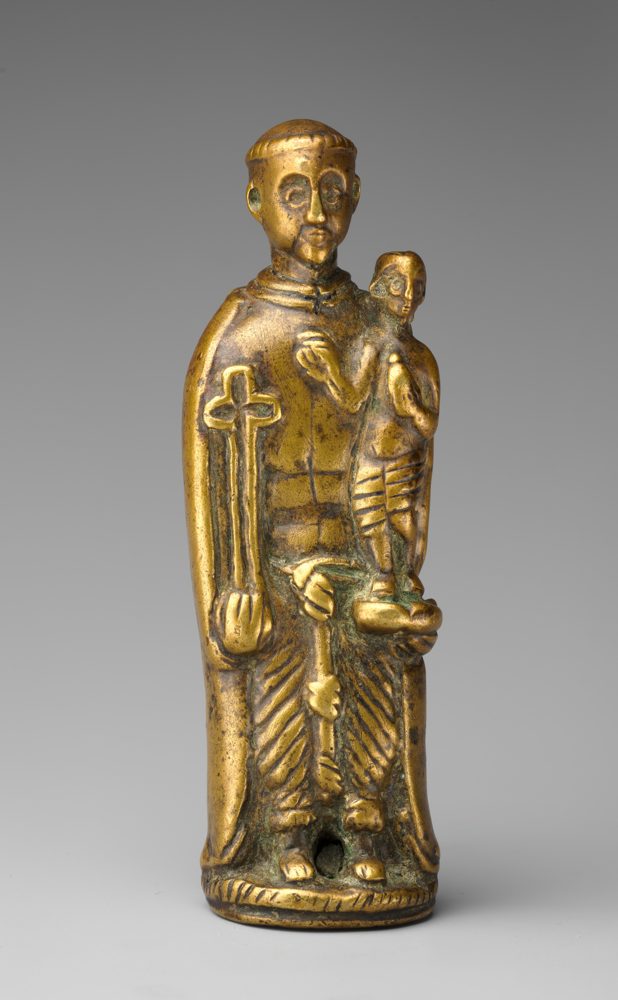
The war produced a prophet. Beatriz Kimpa Vita, born in 1684 to a minor noble family near Kibangu, began in 1704 to claim that St. Anthony had taken possession of her. She demanded that the kings reoccupy São Salvador, and when they did not, she moved into the ruined cathedral herself and drew thousands of people to the city.52 Her teaching held that Jesus was Kongolese and that God judged people by their intentions rather than their use of the sacraments.53
King Pedro IV had her tried for witchcraft and heresy, and on July 2, 1706, she was burned at his camp at Evululu. In 1709 his army took São Salvador and restored at least the form of the kingdom.54
A kingdom of factions
Pedro IV’s settlement was a rotation: kings would come in turn from the rival houses. For some decades it held.55 Women led several of the rival houses. Suzanna de Nóbrega headed the Kimpanzu exiles, and Garcia II’s sister Ana Afonso de Leão led a branch of the Kinlaza and tried to broker a settlement she called the “Concert of Congo.” In the 1760s one of the kingdoms within Kongo, Mukondo, was said to be always ruled by a woman.56 But by the 1710s, Thornton writes, Kongo was no longer a centralized kingdom. Soyo, Nsundi and Mbata went their own ways, and a missionary of the 1760s thought Kongo “better called an Empire,” a loose union of about 22 provinces.57 At the end of the 18th century one king had only 20 or 25 soldiers, and the marquis of Vunda, still called the “grandfather of the king,” blessed him at his coronation and was the last court of appeal.58
Kings under Portugal
The kingship regained some standing in the 19th century as Portugal and Britain competed for influence and courted the king.59 King Henrique II held the throne in the 1840s and 1850s with an army of some 12,000 raised from villages he had founded himself. When a Portuguese envoy urged him in 1845 to end the slave trade, he answered that the kings of Europe had many ways to make a living, but “black kings have no other means than the slaves that they take in war, or tribute they gain from selling them.”60
The Portuguese closed in. They took the port of Ambriz in 1855, and around 1860 a long succession dispute ended in favor of Pedro Elelo, a protégé of the Portuguese in Luanda, who became Pedro V with Portuguese troops behind him. Five years later the last transatlantic slave ship left the Congo River, bound for Cuba.61 British Baptist missionaries arrived in São Salvador in 1878, and Portuguese priests followed two years later. Portugal secured its claim to the region at the Berlin Conference of 1885 and formally occupied São Salvador in 1888.62
Kings were still elected by council, and they became the channel through which colonial taxes and labor demands reached the villages.63 That arrangement broke down in 1913. Portugal had begun conscripting Kongo workers for plantations in Cabinda in 1912, and in October 1913 it tried to recruit 1,500 for the cocoa islands of São Tomé and Príncipe. On Dec. 10, 1913, chiefs led by Tulante Álvaro Buta stormed São Salvador looking for King Manuel Martins Kiditu. They demanded his removal, a lower hut tax and an end to forced labor overseas.64 Historian Jelmer Vos finds that the rebels blamed the abuses mainly on the king’s own agents rather than on distant Portugal.65 The rising became a war that lasted until July 1915, when Buta and the remaining rebels surrendered; he died in prison soon after.66 In Angola it is remembered as the end of Kongo’s independence.67
Kongo kept its kings under Portuguese rule until Pedro VIII in 1962.68 By then the kingdom lived on mainly as an idea. In the 1950s Angolan independence movements, among them a forerunner of the FNLA founded in 1957, spoke of restoring it.69
How we know
Kongo’s history rests on an unusual body of documents written by its own people. Afonso I’s letters are the single most important source for his reign, though Thornton warns that they are political statements, presenting events as Afonso wished them seen.70 Later kings, nobles and royal inquests added to this record, alongside reports by Portuguese officials, Jesuits and the Italian Capuchin missionaries who arrived in 1645 and traveled widely in the countryside.71
Kikongo itself was written early. Three works from the 17th century survive: a catechism of 1624, a word list copied in 1652 and a grammar of 1659. Linguists Koen Bostoen and Gilles-Maurice de Schryver call them the earliest surviving book-length texts in any Bantu language.72
The kingdom’s origins are harder to reach. Its founding stories reach the written record only in hints in royal letters from 1514 onward, and they served the politics of their time; one version recorded in 1712 made the founder a wise blacksmith.73 Archaeology has only recently begun to help. No systematic excavation aimed at Kongo’s origins took place before 2012, and Kongo’s buildings were made of perishable materials, so its capitals leave little on the surface.74 Excavations at Mbanza Kongo supported the city’s nomination as a UNESCO World Heritage Site, which succeeded in 2017.75
Notes
-
Thornton 2023, pp. 87-88; Thornton 2020, p. 55. ↩
-
Thornton 2020, pp. 21, 39. ↩
-
Thornton 2020, pp. 24-25. ↩
-
Thornton 2020, pp. 24-26. ↩
-
Thornton 2020, p. 25. ↩
-
Thornton 2020, p. 26. ↩
-
Thornton 2020, p. 27. ↩
-
Thornton 2020, pp. 27-28; Thornton 2001, p. 119. ↩
-
Thornton 2020, p. 28. ↩
-
Thornton 2020, pp. 28-30; Thornton 2001, p. 119. ↩
-
Thornton 2020, pp. 21, 37; Thornton 2006, p. 438. ↩
-
Thornton 2021, pp. 201, 208, 212; Thornton 1977, p. 526. ↩
-
Thornton 2020, pp. 21, 31, 33-34. ↩
-
Thornton 2020, pp. 30, 73-74. ↩
-
Thornton 2020, p. 35. ↩
-
Thornton 2020, pp. 35, 84-85. ↩
-
Thornton 2020, p. 36. ↩
-
Thornton 2020, pp. 37-38. ↩
-
Thornton 2020, p. 39. ↩
-
Thornton 2020, p. 39; Thornton 1984, p. 148. ↩
-
Thornton 2020, pp. 33 n. 54, 40-41. ↩
-
Fromont 2014, pp. 26-28. ↩
-
Thornton 2020, pp. 43-44; Thornton 1984, pp. 164-165; Thornton 2013, pp. 61-62. ↩
-
Thornton 2020, p. 44. ↩
-
Thornton 2020, pp. 44-47; Thornton 1984, p. 152; Thornton 2013, pp. 58, 71. ↩
-
Fromont 2011, pp. 109, 114. ↩
-
Thornton 2020, pp. 48-49; Thornton 1984, pp. 155, 163. ↩
-
Thornton 2023, pp. 87-88; Heywood 2009, pp. 4-5. ↩
-
Thornton 2023, p. 89; Thornton 2020, p. 55. ↩
-
Thornton 2020, pp. 53-55; Thornton 2023, pp. 89-90; Heywood 2009, pp. 3-5. ↩
-
Thornton 2023, pp. 90-91. ↩
-
Matonda Sakala 2016, pp. 851, 854, 864-865. ↩
-
Thornton 2020, pp. 23, 57-58. ↩
-
Thornton 2020, pp. 58, 68. ↩
-
Thornton 2020, p. 74. ↩
-
Thornton 2020, pp. 75-77. ↩
-
Thornton 2020, pp. 81-82, 108; Gray 1999, pp. 143-145; Thornton 1984, p. 163. ↩
-
Thornton 2020, p. 90. ↩
-
Thornton 2020, p. 109. ↩
-
Thornton 2020, pp. 78, 107. ↩
-
Thornton 2020, pp. 130-131. ↩
-
Thornton 2020, pp. 131-132. ↩
-
Thornton 2020, pp. 135, 164-166. ↩
-
Thornton 2020, pp. 127-128, 166-169. ↩
-
Thornton 2020, pp. 148-149; Thornton 2006, p. 450. ↩
-
Thornton 2020, pp. 160-161, 164, 174. ↩
-
Thornton 2020, p. 182. ↩
-
Thornton 2020, p. 185. ↩
-
Thornton 2020, pp. 197-198. ↩
-
Thornton 2020, pp. 183-184. ↩
-
Thornton 2020, pp. 200-202. ↩
-
Thornton 2020, p. 242; Thornton 1998, p. i. ↩
-
Thornton 1998, p. i; Thornton 2020, p. 243. ↩
-
Thornton 2020, p. 243. ↩
-
Thornton 2020, pp. 244-246. ↩
-
Thornton 2020, pp. 201, 206, 208, 277; Thornton 2006, pp. 456, 459; Hastings 1998, p. 151. ↩
-
Thornton 2020, pp. 246, 275-276. ↩
-
Thornton 2020, p. 284. ↩
-
Hilton 1985, p. 222. ↩
-
Thornton 2020, pp. 343-344; Broadhead 1979, p. 636. ↩
-
Hilton 1985, p. 223; Vos 2015, pp. xiii, 3, 11. ↩
-
Vos 2015, pp. 11, 13-14. ↩
-
Vos 2015, pp. 12, 14. ↩
-
Vos 2015, pp. 5-6. ↩
-
Vos 2015, p. 7; Vos 2017, p. 157. ↩
-
Vos 2015, p. 151. ↩
-
Vos 2015, p. 8. ↩
-
Vos 2015, p. xiii. ↩
-
Vos 2015, p. 152; Hilton 1985, p. 224. ↩
-
Thornton 2020, p. 39. ↩
-
Thornton 2020, p. 167; Bostoen and de Schryver 2018, p. 60; Thornton 1984, pp. 164-165. ↩
-
Bostoen and de Schryver 2018, p. 60. ↩
-
Thornton 2020, pp. 24, 244; Thornton 2001, p. 98. ↩
-
Bostoen and Brinkman 2018, p. 4; Thornton 2020, p. 21; Clist et al. 2015, pp. 371, 403-404. ↩
-
Bostoen and Brinkman 2018, p. 4. ↩
Where the estimates differ
| Estimate | Who holds it | Source |
|---|---|---|
| Formation began about 1280 | John K. Thornton (2020) | Thornton 2020, pp. 24-25 |
| About 1390 | John K. Thornton (1982, 2001), in earlier studies | Thornton 1982, p. 325; Thornton 2001, p. 119 |
| Origin stories are symbolic and cannot be fitted to a chronology | Marshall Sahlins, as summarized by Thornton | Thornton 2020, p. 26 n. 30 |
| Estimate | Who holds it | Source |
|---|---|---|
| 1506 | Jean Cuvelier (1946); Thornton since a 1508 document came to light | Thornton 2020, p. 33 n. 54 |
| 1509 | François Bontinck (1979), once accepted by Thornton | Thornton 2020, p. 33 n. 54 |
| Estimate | Who holds it | Source |
|---|---|---|
| 100,000 men | Portuguese estimates | Thornton 2020, p. 182 |
| Perhaps 20,000 archers at most, with about 800 shield-bearing nobles and 190 musketeers | John K. Thornton | Thornton 2020, p. 182 |
| Estimate | Who holds it | Source |
|---|---|---|
| More than 400,000 (early 1500s) | John K. Thornton (2006) | Thornton 2006, p. 438 |
| About 509,000 (c. 1650) and 532,000 (c. 1700) | John K. Thornton (1977), an estimate he later revised | Thornton 1977, p. 526; Thornton 2021, pp. 201, 208 |
| About 790,000 (1623) | John K. Thornton (2021), from newly found records of baptisms | Thornton 2021, pp. 208, 212 |
| Not measurable from baptism records alone; Thornton's densities too low in places | Igor Matonda Sakala (2016) | Matonda Sakala 2016, pp. 851, 854, 865 |
| Estimate | Who holds it | Source |
|---|---|---|
| About the size of Évora, perhaps 15,000 (1491) | Portuguese witnesses of 1491, as estimated by Thornton | Thornton 2020, p. 36 |
| About 60,000 with its environs (1665); Cavazzi put it at 70,000 | John K. Thornton (1977) | Thornton 1977, p. 523 |
| About 5,000 after Soyo's troops sacked the city in 1666 | Cavazzi's informants, as reported by Thornton | Thornton 1977, p. 524 |
| About 3,000 (by 1670) | John K. Thornton | Thornton 2020, p. 200 |
| Little more than 100 (early 1790s) | Contemporary estimate cited by Anne Hilton | Hilton 1985, p. 219 |
Rulers of Kongo
| Ruler | Reign | Note |
|---|---|---|
| Lukeni lua Nimi | 14th century (tradition) | Remembered as the founder who took the Mountain of Kongo. |
| Nzinga a Nkuwu (João I) | Ruling in 1483; died 1506 | Baptized in 1491. |
| Afonso I Mvemba a Nzinga | 1506 to 1542 | Built the Kongo church and schools; his letters are the main source for his reign. |
| Pedro I | 1542 to 1545 | Overthrown by his nephew Diogo. |
| Diogo I | 1545 to 1561 | |
| Bernardo I | 1561 to 1567 | Killed fighting the Jagas in the east. |
| Álvaro I | c. 1568 to c. 1587 | Restored with Portuguese troops after the Jaga invasion. |
| Álvaro II | 1587 to 1614 | Created dukes and counts; São Salvador became a bishopric in 1596. |
| Pedro II | 1622 to 1624 | Elected in the war with Angola; sought a Dutch alliance. |
| Garcia II | 1641 to 1661 | Allied with the Dutch; took the throne without an election. |
| António I | 1661 to 1665 | Killed at Mbwila. |
| Pedro IV Agua Rosada | 1694 at Kibangu; São Salvador from 1709 to 1718 | Reoccupied the capital and set up a rotation between rival houses. |
| Henrique II | 1840s to 1856 | |
| Pedro V (Pedro Elelo) | 1860 to 1891 | Protégé of the Portuguese in Luanda. |
| Manuel III (Manuel Martins Kiditu) | 1911 to 1913 | Deposed in the revolt of Tulante Álvaro Buta. |
| Pedro VIII | 1962 | Last king in Vos's list of kings under Portuguese rule. |
Timeline
- c. 1280 Kongo emerges
- 1506 Afonso I Mvemba a Nzinga begins to rule
- 1542 Pedro I begins to rule
- 1545 Diogo I begins to rule
- 1561 Bernardo I begins to rule
- c. 1568 Álvaro I begins to rule
- 1587 Álvaro II begins to rule
- 1622 Pedro II begins to rule
- 1641 Garcia II begins to rule
- 1661 António I begins to rule
- 1860 Pedro V (Pedro Elelo) begins to rule
- 1888 Portugal formally occupies São Salvador; kings reign under Portuguese rule until 1962
- 1911 Manuel III (Manuel Martins Kiditu) begins to rule
Correction
Our Kingdom of Kongo overview has moved into the new Kongo page, and it had the ending wrong.The overview at /history/articles/kingdom-of-kongo-peak-portugal/ now redirects to the new state page. It said the Portuguese victory at Mbwila in 1665 ended the kingdom. Kongo went on for more than two centuries: its province of Soyo destroyed the next Portuguese army at Kitombo in 1670, and Portugal formally occupied São Salvador only in 1888 (Thornton 2020, p. 185; Vos 2015, p. 11). It also placed Luanda in Ndongo, but Luanda was Kongo territory when the Portuguese colony was founded there (Thornton 2020, p. 79). Its figures of about 129,400 square kilometers and 790,000 people in 1623 could not be confirmed and are not carried over.Corrected in September 2026. See the log entry.
Sources
- John K. Thornton. “A History of West Central Africa to 1850”, Cambridge University Press, 2020.
- Anne Hilton. “The Kingdom of Kongo”, Clarendon Press, Oxford, 1985.
- John K. Thornton. “Afonso I Mvemba a Nzinga, King of Kongo”, 2023.
- John K. Thornton. “The Kongolese Saint Anthony: Dona Beatriz Kimpa Vita and the Antonian Movement, 1684-1706”, Cambridge University Press, 1998.
- Jelmer Vos. “Kongo in the Age of Empire, 1860-1913: The Breakdown of a Moral Order”, University of Wisconsin Press, 2015.
- Cécile Fromont. “The Art of Conversion: Christian Visual Culture in the Kingdom of Kongo”, University of North Carolina Press, 2014.
- Koen Bostoen and Inge Brinkman (eds.). “The Kongo Kingdom: The Origins, Dynamics and Cosmopolitan Culture of an African Polity”, Cambridge University Press, 2018.
- John K. Thornton. “The Development of an African Catholic Church in the Kingdom of Kongo, 1491-1750”, Journal of African History 25, no. 2, pp. 147-167, 1984.
- John K. Thornton. “The Kingdom of Kongo, ca. 1390-1678: The Development of an African Social Formation”, Cahiers d'études africaines 22, pp. 325-342, 1982.
- John K. Thornton. “The Origins and Early History of the Kingdom of Kongo, c. 1350-1550”, International Journal of African Historical Studies 34, no. 1, pp. 89-120, 2001.
- John K. Thornton. “Elite Women in the Kingdom of Kongo: Historical Perspectives on Women's Political Power”, Journal of African History 47, no. 3, pp. 437-460, 2006.
- John K. Thornton. “Afro-Christian Syncretism in the Kingdom of Kongo”, Journal of African History 54, no. 1, pp. 53-77, 2013.
- John K. Thornton. “Revising the Population History of the Kingdom of Kongo”, Journal of African History 62, no. 2, pp. 201-212, 2021.
- Linda M. Heywood. “Slavery and Its Transformation in the Kingdom of Kongo: 1491-1800”, Journal of African History 50, no. 1, pp. 1-22, 2009.
- Bernard Clist et al.. “The Elusive Archaeology of Kongo Urbanism: The Case of Kindoki, Mbanza Nsundi (Lower Congo, DRC)”, African Archaeological Review 32, no. 3, pp. 369-412, 2015.
- Adrian Hastings. “The Christianity of Pedro IV of the Kongo, 'The Pacific' (1695-1718)”, Journal of Religion in Africa 28, no. 2, pp. 145-159, 1998.
- Richard Gray. “A Kongo Princess, the Kongo Ambassadors and the Papacy”, Journal of Religion in Africa 29, no. 2, pp. 140-154, 1999.
- Susan Herlin Broadhead. “Beyond Decline: The Kingdom of the Kongo in the Eighteenth and Nineteenth Centuries”, International Journal of African Historical Studies 12, no. 4, pp. 615-650, 1979.
- Jelmer Vos. “Império, Patronato e uma Revolta no Reino do Kongo”, Cadernos de Estudos Africanos 33, pp. 157-182, 2017.
- Igor Matonda Sakala. “Nouveaux regards sur la démographie du bassin de l'Inkisi à l'époque du royaume Kongo (XVIe-XVIIIe siècles)”, Cahiers d'études africaines 56, no. 224, pp. 845-874, 2016.
- John K. Thornton. “Demography and History in the Kingdom of Kongo, 1550-1750”, Journal of African History 18, no. 4, pp. 507-530, 1977.
- Cécile Fromont. “Under the Sign of the Cross in the Kingdom of Kongo: Religious Conversion and Visual Correlation in Early Modern Central Africa”, RES: Anthropology and Aesthetics 59-60, pp. 109-123, 2011.
Further Reading
The sources above support the specific claims on this page. The works below are the scholarship behind them. Citations are given in full so readers can find them through a library or database; some are paywalled.
Peer-reviewed articles
- Thornton, John K. (2001). "The Origins and Early History of the Kingdom of Kongo, c. 1350-1550." International Journal of African Historical Studies 34(1): 89-120. DOI: 10.2307/3097288.abstract free
- Thornton, John K. (2006). "Elite Women in the Kingdom of Kongo: Historical Perspectives on Women's Political Power." Journal of African History 47(3): 437-460. DOI: 10.1017/S0021853706001812.abstract free
- Heywood, Linda M. (2009). "Slavery and Its Transformation in the Kingdom of Kongo: 1491-1800." Journal of African History 50(1): 1-22. DOI: 10.1017/S0021853709004228.abstract free
- Thornton, John K.; Mosterman, Andrea (2010). "A Re-Interpretation of the Kongo-Portuguese War of 1622 According to New Documentary Evidence." Journal of African History 51(2): 235-248. DOI: 10.1017/S0021853710000277.abstract free
- Thornton, John K. (2013). "Afro-Christian Syncretism in the Kingdom of Kongo." Journal of African History 54(1): 53-77. DOI: 10.1017/S0021853713000224.abstract free
- Thornton, John K. (2021). "Revising the Population History of the Kingdom of Kongo." Journal of African History 62(2): 201-212. DOI: 10.1017/S0021853721000451.abstract free
- Thornton, John K. (1984). "The Development of an African Catholic Church in the Kingdom of Kongo, 1491-1750." Journal of African History 25(2): 147-167. DOI: 10.1017/s0021853700022830.
- Thornton, John K. (1982). "The Kingdom of Kongo, ca. 1390-1678: The Development of an African Social Formation." Cahiers d'études africaines 22: 325-342. DOI: 10.3406/cea.1982.3380.
- Clist, Bernard (2015). "The Elusive Archaeology of Kongo Urbanism: The Case of Kindoki, Mbanza Nsundi (Lower Congo, DRC)." African Archaeological Review 32(3): 369-412. DOI: 10.1007/s10437-015-9199-2.
- Hastings, Adrian (1998). "The Christianity of Pedro IV of the Kongo, 'The Pacific' (1695-1718)." Journal of Religion in Africa 28(2): 145-159. DOI: 10.2307/1581710.
- Gray, Richard (1999). "A Kongo Princess, the Kongo Ambassadors and the Papacy." Journal of Religion in Africa 29(2): 140-154. DOI: 10.2307/1581869.
- Broadhead, Susan Herlin (1979). "Beyond Decline: The Kingdom of the Kongo in the Eighteenth and Nineteenth Centuries." International Journal of African Historical Studies 12(4): 615-650. DOI: 10.2307/218070.
- Vos, Jelmer (2017). "Império, Patronato e uma Revolta no Reino do Kongo." Cadernos de Estudos Africanos 33: 157-182. DOI: 10.4000/cea.2225.
- Matonda Sakala, Igor (2016). "Nouveaux regards sur la démographie du bassin de l'Inkisi à l'époque du royaume Kongo (XVIe-XVIIIe siècles)." Cahiers d'études africaines 56(224): 845-874. DOI: 10.4000/etudesafricaines.18367.
- Thornton, John K. (1977). "Demography and History in the Kingdom of Kongo, 1550-1750." Journal of African History 18(4): 507-530. DOI: 10.1017/S0021853700015693.
- Fromont, Cécile (2011). "Under the Sign of the Cross in the Kingdom of Kongo: Religious Conversion and Visual Correlation in Early Modern Central Africa." RES: Anthropology and Aesthetics 59-60: 109-123. DOI: 10.1086/RESvn1ms23647785.
Books
- Thornton, John K. (1983). The Kingdom of Kongo: Civil War and Transition, 1641-1718. University of Wisconsin Press.
Kongo: c. 1280 to 1888.