
By Princewill Ubani · Published · Updated
Research ID: PA-ART-zimbabwe-hyperinflation-crisis-2008
Zimbabwe's Hyperinflation: The First of the 21st Century, and the Economists Who Had to Reconstruct Its Real Numbers
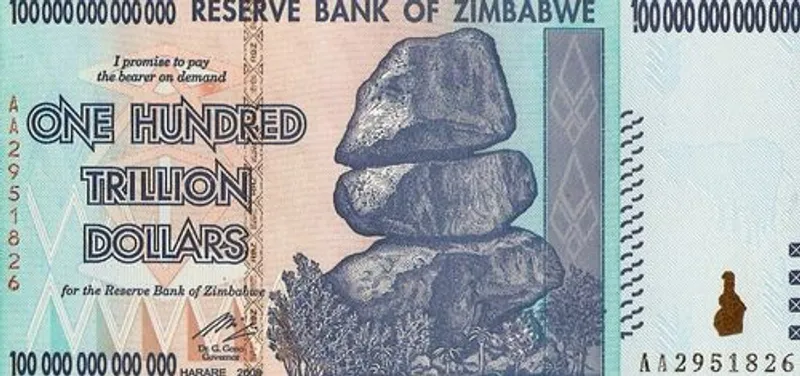
Zimbabwe holds a distinction no economist wants attached to their country: its collapse of 2007 and 2008 was the first hyperinflation of the 21st century, and by the count Hanke and Kwok use, the 30th recorded anywhere since the French Revolution. Venezuela would follow roughly a decade later. The crisis built over years of economic strain tied to Zimbabwe’s land reform program, declining agricultural output, and a government increasingly reliant on printing money to cover its obligations, but it reached genuinely historic extremes only in 2008.
Pinning down exactly how extreme required real detective work, because Zimbabwe’s government stopped publishing official inflation statistics before the crisis reached its worst final months. The Reserve Bank’s last published inflation figure covered July 2008, leaving no official record of the four months that followed. Economists Steve Hanke and Alex Kwok, publishing in the Cato Journal in 2009, reconstructed the missing data using purchasing power parity, deriving an exchange rate from the share price of Old Mutual, an insurance company listed on both the Harare and London exchanges, whose price gap between the two markets tracked what the Zimbabwean dollar was actually worth. They cross-checked that figure against the black-market rate Zimbabwean importers were using. Their reconstruction found Zimbabwe’s monthly inflation rate peaked at 79.6 billion percent on November 14, 2008, the second-highest monthly rate ever recorded in world history, behind only Hungary’s in July 1946.
Converted to an annualized figure, the same date produced a number that strains ordinary comprehension: a year-on-year rate of 89.7 sextillion percent. At that pace prices doubled roughly every 24.7 hours, so a purchase that cost a given number of Zimbabwean dollars in the morning cost meaningfully more by the next day, and denominations issued by the central bank climbed into the trillions before the government abandoned the Zimbabwean dollar entirely in 2009, adopting foreign currencies, primarily the U.S. dollar, for ordinary transactions instead.
Hanke and Kwok’s reconstructed figures became the standard reference for measuring the episode precisely because Zimbabwe’s own government had stopped keeping, or at least stopped releasing, the numbers itself, an unusual case where the definitive account of a country’s economic collapse had to be built from outside data rather than the state’s own statistics.
Correction
Zimbabwe's hyperinflation: first of the century, not the only one.Body and fact card both described it as the only hyperinflation of the 21st century. Venezuela's ran from late 2016 to early 2021. Zimbabwe's was the first. We also had the reconstruction method backwards: Hanke and Kwok derived their exchange rate from Old Mutual shares dual-listed in Harare and London and used the black-market rate as a cross-check, not the other way round. Prices doubled every 24.7 hours at the peak, which is more precise than the "every day or so" we had.Corrected in September 2026. See the log entry.
Sources
- “Steve H. Hanke and Alex K.F. Kwok, "On the Measurement of Zimbabwe's Hyperinflation," Cato Journal, Vol. 29, No. 2 (Spring/Summer 2009), pp. 353-364”.
- Tara McIndoe-Calder. “Hyperinflation in Zimbabwe: money demand, seigniorage and aid shocks (Vol. 50, No. 15, pp. 1659-1675)”, Applied Economics, 2017.
Books & Further Reading
Steve H. Hanke and Alex K.F. Kwok, "On the Measurement of Zimbabwe's Hyperinflation," Cato Journal, Vol. 29, No. 2 (Spring/Summer 2009), pp. 353-364