By Princewill Ubani · Published
Research ID: PA-ART-417686716573843457
Before Africa Was Free: The Pan-African Congresses of 1919 to 1945
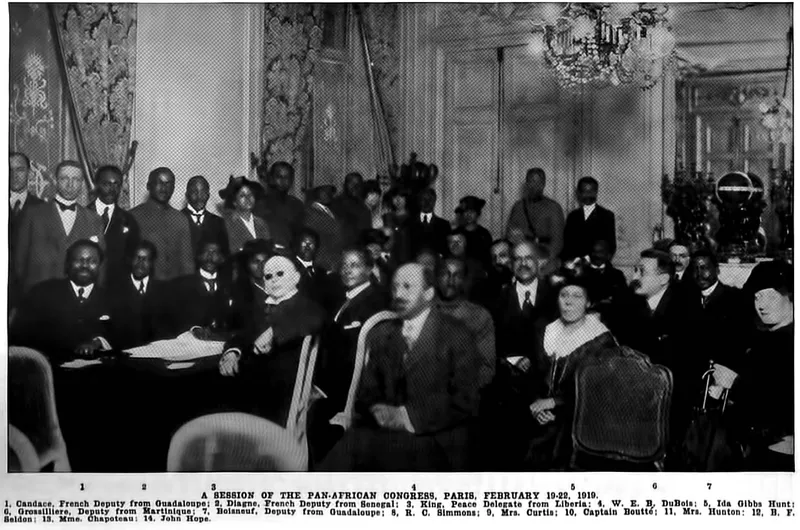
Long before most of Africa held its own flag, a small, shifting group of activists tried to organize the continent’s political future from conference halls in Europe and the United States. Between 1919 and 1945, five Pan-African Congresses met in Paris, London, Brussels, Lisbon, New York and finally Manchester, drawing together African, Caribbean and African-American delegates to press colonial powers on self-government, labor rights and racial equality decades before independence became a realistic prospect for most of the continent.
The first Congress convened in Paris from February 19 to 22, 1919, deliberately timed to coincide with the Versailles Peace Conference, where the victorious Allied powers were carving up the defeated Ottoman and German empires and deciding the fate of Germany’s former African colonies. Organized chiefly by the American sociologist and activist W.E.B. Du Bois, with Ida Gibbs Hunt serving as principal translator, it drew 57 delegates representing 15 countries and produced a memorandum and resolutions calling for Allied oversight of African territories and greater African participation in their own governance. A second Congress followed in 1921, meeting in sessions across London, Brussels and Paris and drawing delegates identified as representing 26 different groups of people of African descent from Africa, the Caribbean and the wider diaspora, alongside international observers including the Indian revolutionary Shapurji Saklatvala; a third, more loosely organized, met across London and Lisbon in 1923, and a fourth convened in New York in 1927, both continuing to press demands for African self-rule and to condemn lynching in the United States and white-minority rule in Kenya, Rhodesia and South Africa.
The fifth and most consequential Congress met in Manchester, England, from October 15 to 21, 1945, in the immediate aftermath of the Second World War. Organized primarily by George Padmore, physician Peter Milliard and the Guyanese-born activist T. Ras Makonnen, it was chaired by a 77-year-old Du Bois, who by then had attended every Congress since the first, and brought together a younger generation of future independence leaders, including Kwame Nkrumah of the Gold Coast and Jomo Kenyatta of Kenya, alongside Amy Ashwood Garvey, who chaired its opening session. Where the earlier Congresses had largely appealed to colonial powers to reform their rule, Manchester’s resolutions moved further, explicitly demanding an end to colonialism itself across Africa and the Caribbean.
None of the five Congresses had the power to compel a single colonial government to act, and their resolutions were, in the short term, mostly ignored by the states they addressed. Their lasting significance lay instead in the network they built: many of the young delegates who sat in Chorlton Town Hall in Manchester in 1945 returned home to lead the independence movements that would, within a generation, dismantle the colonial system the Congresses had spent a quarter-century petitioning.
Sources
- “The Pan-African Congresses, a story”, African American Registry.
- “Pan-African Congresses”, Encyclopedia.com.
Books & Further Reading
Hakim Adi and Marika Sherwood, The 1945 Manchester Pan-African Congress Revisited (New Beacon Books, 1995, ISBN 9781873201121)