
By Princewill Ubani · Published · Updated
Research ID: PA-ART-mutapa-empire-great-zimbabwe-successor
The Mutapa Empire: Great Zimbabwe's Successor, and a Size Claim Historians Still Dispute
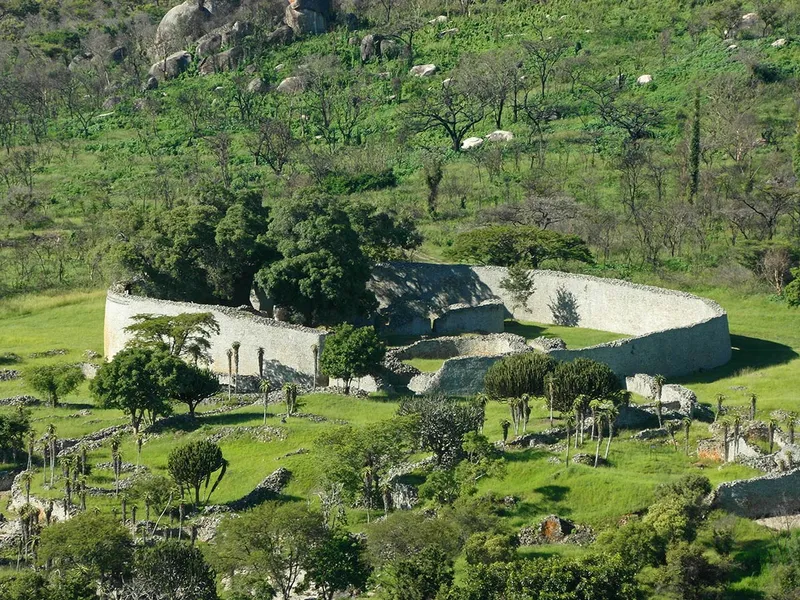
The Mutapa Empire inherited one of precolonial Africa’s most famous legacies: it rose as the political and trading successor to Great Zimbabwe, the stone-walled city whose builders’ dry-stone architecture still stands today, as that earlier state’s dominance faded in the 15th century. Records describe what Mutapa did with that inheritance in real detail. Exactly how big it got is a different matter, and that distinction has to be stated plainly rather than smoothed over.
Tradition credits the empire’s founding to Nyatsimba Mutota, around 1430 to 1450, though historians studying the period note real uncertainty about whether “Mutota” represents a single individual or a composite figure standing in for several early reigns. His successor, Matope, is credited with the empire’s greatest territorial expansion, pushing trade influence toward the Indian Ocean coast and extending control along the Zambezi River, with the empire’s peak reach generally placed around 1480.
A commonly repeated figure puts Mutapa’s peak territory at roughly 700,000 square kilometers, covering the plateau between the Zambezi and Limpopo rivers. That number should not be treated as settled. The same body of scholarship that produces it also notes there’s little evidence Mutapa’s rulers exercised uniform administrative control over an area that size, and states plainly that there is no scholarly consensus on the empire’s actual extent. Mutapa is better understood as a core territory surrounded by a much larger zone of looser tributary and trading influence, a hegemonic system rather than a uniformly governed bloc, closer in structure to a network of vassal relationships than to a centrally administered state.
Portuguese traders and missionaries reached the empire in the 16th century, and the relationship turned openly extractive after the 1561 killing of Jesuit missionary Gonçalo da Silveira triggered Portuguese military intervention. By 1629, the ruler Mavhura had signed vassalage terms formally submitting Mutapa to Portuguese suzerainty, and the empire’s independence steadily eroded from there. A Mutapa vassal named Changamire Dombo rebelled in the 1670s and 1680s, built his own army, drove Portuguese traders from their plateau trading posts by the 1690s, and founded a rival state, the Rozvi Empire, which itself collapsed in the 1860s, decades before the residual Mutapa state’s own final absorption in the early 20th century. The original Mutapa state survived in reduced, increasingly Portuguese-dependent form for generations afterward, with its final political absorption dated by different sources to either 1884 or as late as 1902, itself a reflection of how gradual and poorly documented the empire’s last chapter was, in keeping with the uncertainty that runs through much of its history.
Sources
- “Mwene Matapa empire”, Britannica.
- S. I. G. Mudenge. “A Political History of Munhumutapa, c.1400-1902, the standard scholarly treatment of the state's territorial extent and the limits of the evidence for it (ISBN 9780949932303)”, Zimbabwe Publishing House, 1988.
Books & Further Reading
S. I. G. Mudenge, A Political History of Munhumutapa, c.1400-1902 (Zimbabwe Publishing House / James Currey, 1988, ISBN 9780949932303)