
By Princewill Ubani · Published
Research ID: PA-ART-galton-fenzi-east-africa-automobile-pioneer
The 1926 Drive That Opened East Africa's Roads to the Motorcar
In January 1926, Lionel Douglas Galton-Fenzi and his co-driver, Captain Gethin, set out to do something no one had yet managed: drive a car the roughly 1,000 kilometers between Mombasa, on Kenya’s coast, and Nairobi, the colony’s inland administrative center. There was no road in the modern sense to follow, only bush track and open country, no petrol stations along the way, and enough wildlife in the path that the two men had to watch for lions as carefully as they watched for washouts. The drive, in a Riley 12/50 supplied by the British manufacturer Riley Motor Car Ltd., took roughly 15 days, much of it spent clearing brush by hand to get the vehicle through.
Galton-Fenzi’s achievement mattered for reasons beyond the personal feat. Kenya in the mid-1920s remained almost entirely dependent on the Uganda Railway, completed in 1901, for inland transport, with road infrastructure limited to tracks passable mainly on foot, by bicycle or on horseback. His Mombasa-to-Nairobi run demonstrated that motor vehicles could traverse the colony’s interior at all, a proof of concept that helped build the case for the road-building programs British colonial administrators pursued through the following decades as Kenya’s settler economy expanded and automobile ownership grew beyond a small circle of enthusiasts.
Galton-Fenzi had already been laying groundwork for that shift before his famous drive. In 1919 he helped found the Kenya branch of the Royal East Africa Automobile Association, an organization dedicated to promoting motoring and advocating for better roads across the colony, and he went on to help chart and popularize a number of additional automobile routes across Kenya and the wider East African region over the following decade, work that made him arguably the central figure in establishing motoring as a viable mode of transport in colonial East Africa. He remained the association’s honorary secretary until his death on May 15, 1937.
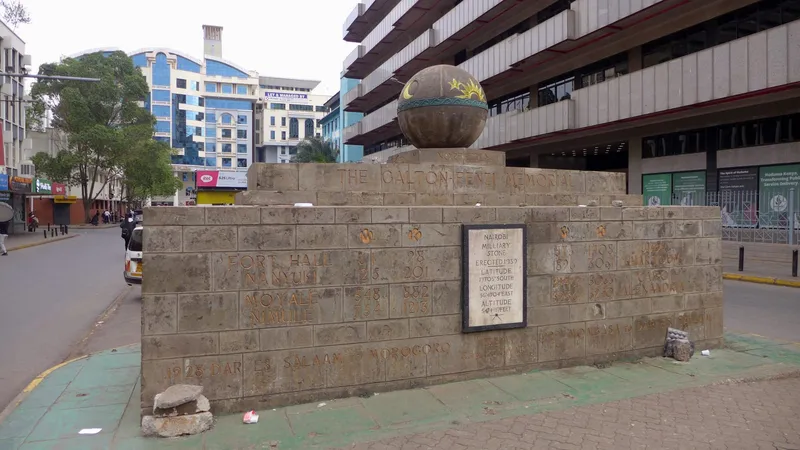
Two years after he died, admirers erected the Galton-Fenzi Memorial in his honor, a stone monument that still stands today at what is considered the geographic center of Nairobi, on Kenyatta Avenue. The memorial marks not just one man’s achievement behind the wheel but the moment East Africa’s road network began its transition from footpaths and rail lines to the motorcar, a shift that reshaped how people and goods moved across the region for the century that followed.
Sources
- “Enthusiast who brought the first vehicle to Kenya”, Business Daily Africa.
- “Demystifying the Galton-Fenzi Memorial”, Kenya Geographic.
Books & Further Reading
Gordon H. Pirie, "Non-Urban Motoring in Colonial Africa in the 1920s and 1930s," South African Historical Journal, Vol. 63, No. 1 (2011), pp. 38-60