
By Princewill Ubani · Published
Research ID: PA-ART-gabon-forest-elephants-population
Why Gabon Holds the Bulk of Africa's Forest Elephants
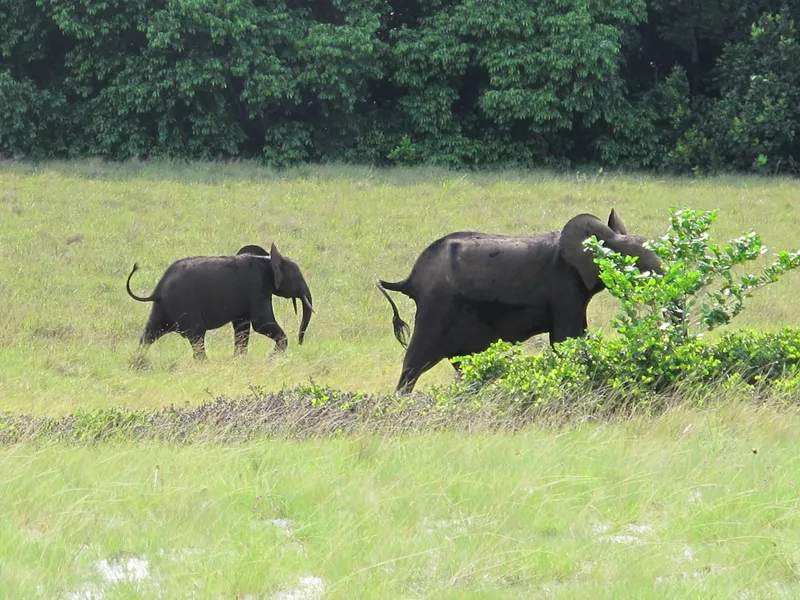
Gabon holds more than 95,000 forest elephants, a figure that DNA-based population assessments have confirmed represents roughly 60 to 70 percent of the entire world’s remaining forest elephant population, making the small Central African nation the species’ last genuine stronghold. The scale of that concentration is easy to understate in casual framing: Gabon accounts for only about 13 percent of Central Africa’s total forest cover, yet holds the clear majority of the region’s forest elephants, a mismatch that reflects both the country’s comparatively low deforestation rate and decades of conservation policy that kept large tracts of habitat intact while forest elsewhere in the region gave way faster to logging and agriculture.
The forest elephant is not simply a smaller version of the more familiar savanna elephant found across East and Southern Africa; genetic research has established it as a distinct species in its own right, adapted specifically to dense Central African rainforest rather than open grassland, with a different body size, tusk shape and social structure from its savanna relative. That distinction matters for how Gabon’s numbers should be read: the country’s elephant population represents the bulk of one particular African elephant species, not 70 percent of the continent’s elephants overall, since savanna elephants, concentrated in countries like Botswana, Zimbabwe and Kenya, remain considerably more numerous continent-wide across the two species combined.
Gabon’s status as a stronghold has come under serious pressure. Minkébé National Park, once one of the country’s most important elephant reserves, lost an estimated 78 to 81 percent of its forest elephant population to ivory poaching between 2004 and 2014, a decline that outside researchers only fully documented years after it happened, since Minkébé’s remote, densely forested terrain made real-time monitoring difficult. Separate reporting on poaching across Gabon’s broader park system put losses at well over 11,000 elephants in specific incidents documented by conservation groups, a scale of loss that alarmed both international conservationists and Gabonese authorities given how disproportionately important the country’s population had become to the species’ global survival.
Gabon’s government has responded by expanding its national park network and increasing anti-poaching enforcement, framing forest elephant conservation as tied directly to the country’s broader environmental and tourism strategy. Whether that response can outpace continued poaching pressure remains an open question, but the underlying math is not in dispute: with forest elephants extinct or vanishingly rare across most of their former Central African range, what happens to Gabon’s population functions, in practical terms, as close to a referendum on the species’ survival as a whole.
Sources
- “DNA assessment confirms Gabon as last stronghold of forest elephants”, Mongabay.
- “More forest elephants in Gabon than previously thought – new research”, Africa Geographic.
Books & Further Reading
A. Laguardia et al., "Nationwide abundance and distribution of African forest elephants across Gabon using non-invasive SNP genotyping," Global Ecology and Conservation, e01894 (2021); J.R. Poulsen et al., "Poaching empties critical Central African wilderness of forest elephants," Current Biology 27 (2017): R134-R135.