
By Princewill Ubani · Published
Research ID: PA-ART-1279495412035006464
The Dingane-Retief Treaty and the Killing of the Voortrekker Delegation
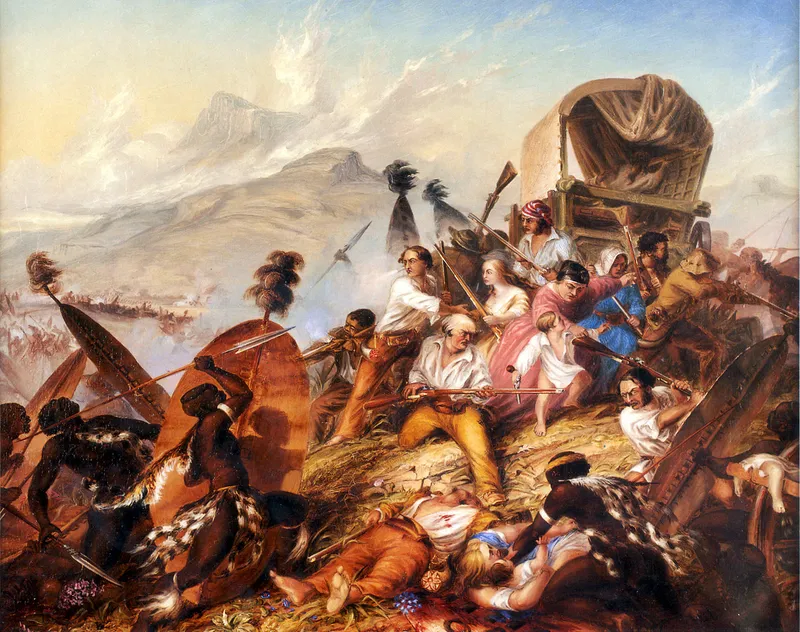
On February 6, 1838, Zulu King Dingane signed a treaty ceding a large stretch of land between the Tugela River and Port St. Johns to Voortrekker leader Piet Retief, who had led Boer settlers into Natal the previous year in search of territory beyond the reach of British colonial authority at the Cape. Retief had earned the concession by meeting a condition Dingane set during an earlier meeting: recovering roughly 700 head of cattle that a rival chief, Sekonyela of the Tlokwa, had stolen from the Zulu king. The deed itself, dated February 4 but signed two days later, was drafted by Retief’s secretary, Jan Gerritze Bantjes, and witnessed by three men on each side.
Dingane did not let the agreement stand. On the day of the signing, he invited Retief and his party, roughly 100 people including Voortrekkers along with Khoikhoi and Basuto servants and allies, into his stronghold at uMgungundlovu for a farewell marked by beer-drinking and a display by Zulu regiments. Partway through the performance, Dingane gave the order to seize them. Retief’s men, who had left their firearms outside as a condition of entering the royal enclosure, were overpowered and dragged to a nearby hill, kwaMatiwane, where Zulu warriors clubbed them to death. Accounts of the killing describe Retief being forced to watch his companions die before he himself was killed last.
Dingane’s motives are still debated by historians, but the massacre touched off a wider war between the Zulu kingdom and the Voortrekkers that ran through the rest of 1838, including a Boer defeat at the Battle of Italeni in April and a decisive Voortrekker victory at the Battle of Blood River that December. After that battle, a commando led by Andries Pretorius recovered the remains of Retief’s delegation and buried them at the massacre site on December 21, 1838. Among the recovered remains was Retief’s leather pouch, which still held the undamaged treaty document, Bantjes’s original deed of cession, giving the Voortrekkers documentary claim to the land Dingane had ceded and then tried to take back by force. That document’s authenticity has itself been debated by historians in the decades since, with some questioning how a parchment could have survived ten months of exposure to the elements still legible, though most researchers who have examined the chain of custody evidence have accepted it as genuine.
Sources
- “Copy of the treaty allegedly signed by Dingaan and Retief ceding large tracts of the Zulu Kingdom”, South African History Online.
- “Zulu King Dingane orders the execution of Piet Retief's men”, South African History Online.
- “Today in history: Dingane orders the killing of Piet Retief's men”, News24 (Drum).
Books & Further Reading
Sifiso Mxolisi Ndlovu, African Perspectives of King Dingane kaSenzangakhona: The Second Monarch of the Zulu Kingdom (Palgrave Macmillan, 2017, ISBN 9783319567860)