
By Princewill Ubani · Published · Updated
Research ID: PA-ART-british-transatlantic-slave-trade-statistics
Britain's Transatlantic Slave Trade, by the Numbers
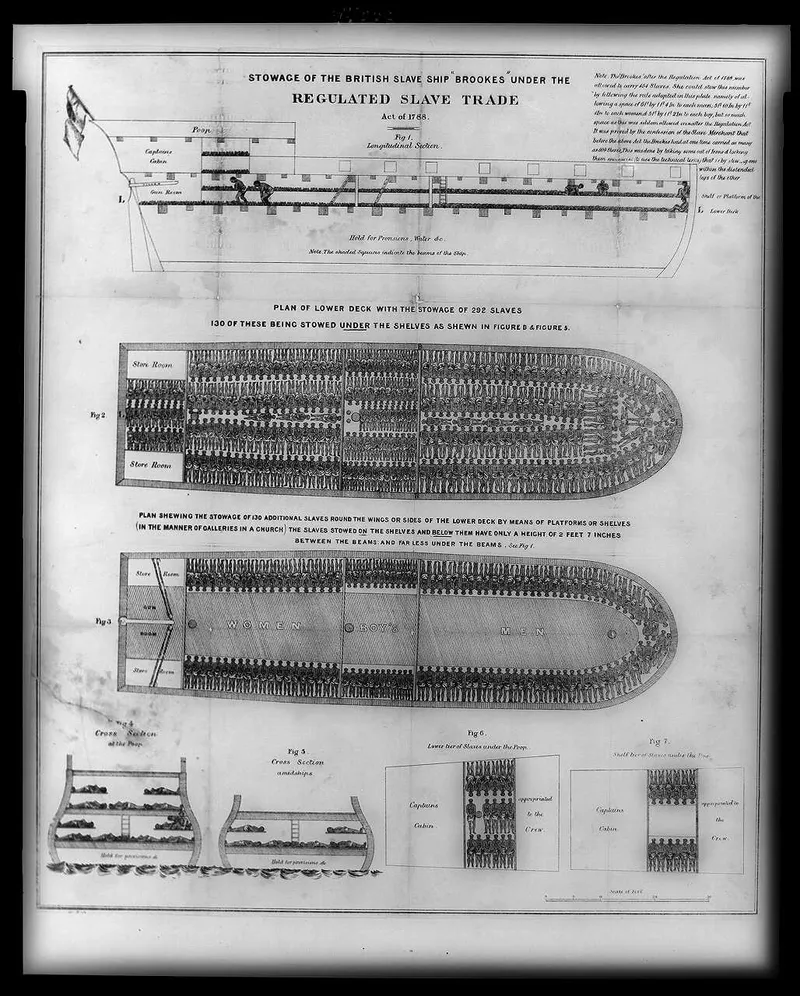
Between roughly 1640, when England’s involvement in transporting enslaved Africans began accelerating, and 1807, when Parliament finally passed the Act abolishing the British slave trade, British ships carried an estimated 3.1 to 3.4 million enslaved Africans across the Atlantic. The range reflects real disagreement between rigorous sources rather than sloppiness: the National Archives cites roughly 3.1 million transported, of whom 2.7 million survived the crossing to arrive in the Americas, while figures drawn from the Trans-Atlantic Slave Trade Database, the product of decades of research led by historian David Richardson and collaborators cataloguing nearly 35,000 individual slaving voyages, put the total closer to 3.4 million. That makes Britain the second-largest national carrier over the trade’s full span, behind Portugal and Brazil, whose ships carried more than 5.8 million people between them. An estimated 450,000 of those transported on British ships did not survive the Middle Passage, dying from disease, malnutrition, and the brutal conditions of the crossing before ever reaching land.
Britain’s dominance built gradually. The Company of Royal Adventurers of England Trading with Africa, later reorganized as the Royal African Company, gave England its first sustained, chartered foothold in the trade starting in the 1660s. Volume grew sharply from there: by the first third of the 18th century Britain’s involvement in the trade “grew enormously,” and over the course of the 1700s as a whole, British ships are estimated to have carried close to half of all Africans transported into slavery that century, more than any other European power. Britain and Portugal together, the trade’s two largest national participants, accounted for roughly 70 percent of everyone carried across the Atlantic into slavery over the trade’s full history.
Abolition in 1807 did not end the trade or slavery itself in the British Empire, only British ships’ legal participation in transporting new captives; a quarter of all Africans ever forced across the Atlantic were transported after that date by other nations’ vessels, and slavery persisted in British colonies for another generation, ending only with the Slavery Abolition Act of 1833, which took effect on August 1, 1834 and freed roughly 800,000 enslaved people across the British Caribbean, though most were held in a further four years of compulsory “apprenticeship” that did not end until 1838.
Correction
Britain's transatlantic slave trade: Britain was not the largest carrier.The article called Britain "the single largest national carrier in the trade's history". Portuguese and Brazilian ships carried more than 5.8 million people against Britain's 3.1 to 3.4 million. Britain led the eighteenth century, which the article says separately and correctly. The same piece dated the Slavery Abolition Act as taking effect in 1838; it took effect on August 1, 1834, with the apprenticeship period running to 1838.Corrected in September 2026. See the log entry.
Sources
- “Stephen D. Behrendt, "The Annual Volume and Regional Distribution of the British Slave Trade, 1780-1807," The Journal of African History, Vol. 38, No. 2 (JSTOR)”.
- “The history of the transatlantic slave trade”, Royal Museums Greenwich.
- “Slavery and the British transatlantic slave trade”, The National Archives (UK).
Books & Further Reading
David Richardson, Principles and Agents: The British Slave Trade and Its Abolition (Yale University Press, 2022, ISBN 9780300250435)