Published
Rhodesia's 1965 UDI and Pan-African Protest Against White-Minority Rule
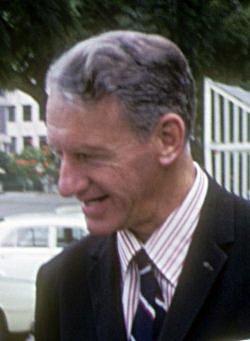
On November 11, 1965, Rhodesian prime minister Ian Smith unilaterally declared his self-governing British colony independent, rather than accept London’s condition that independence would come only with progress toward majority rule. Smith chose the date deliberately: Armistice Day, meant to invoke Rhodesia’s wartime sacrifices for Britain. His government, representing a white settler minority that made up roughly five percent of the colony’s population, framed the Unilateral Declaration of Independence (UDI) as a defense of “justice, civilisation and Christianity” against what it cast as the threat of African majority rule and communism, language that made explicit what the declaration was actually protecting: a racial hierarchy that denied Rhodesia’s Black African majority political power.
Britain refused to recognize the declaration, calling it an act of rebellion, and moved to isolate Rhodesia economically: the government in London cut aid, banned Rhodesian tobacco imports, and recalled its High Commissioner. The United Nations Security Council followed with mandatory economic sanctions in 1966, the first time it had ever imposed such sanctions on a state. Across Africa, the reaction was swift and largely unified in condemnation. The Organisation of African Unity, founded just two years earlier with the express purpose of supporting the continent’s remaining liberation struggles, denounced the declaration, and several African governments, including Ghana under Kwame Nkrumah, then one of the continent’s most vocal proponents of Pan-Africanism, broke diplomatic relations with Britain over what they saw as London’s failure to act forcefully enough against Smith’s regime.
That anger was not confined to diplomatic statements. Archival newsreel footage from mid-November 1965 shows a demonstration in Accra by Ghanaian women, organized under Kwame Nkrumah’s National Council of Ghana Women, marching to protest the British government’s handling of the Rhodesian crisis, a vivid example of how the UDI registered as a grievance for ordinary Pan-African activists, not just heads of state, well beyond Rhodesia’s borders.
It would, however, be a stretch to credit any single protest, in Accra or elsewhere, with forcing the outcome that eventually ended white-minority rule. Rhodesia’s illegal government survived sanctions and international isolation for nearly fifteen more years, propped up in part by covert trade routes through apartheid South Africa and Portuguese-ruled Mozambique. What actually broke Smith’s government was a combination of forces that built over that entire period: the costly Rhodesian Bush War waged by Black nationalist guerrilla movements from the early 1970s onward, the collapse of Portuguese colonial rule in neighboring Mozambique in 1975 which deprived Rhodesia of a friendly border, and the mounting economic toll of sustained sanctions. Those pressures finally pushed Smith’s government and the nationalist movements to the negotiating table in London, producing the Lancaster House Agreement in December 1979 and the multiracial elections of February 1980, which Robert Mugabe’s ZANU–PF party won decisively, leading to Zimbabwe’s internationally recognized independence that April. The 1965 protests were part of a much longer current of Pan-African pressure and solidarity: real, but one contributing factor among many, not the direct cause of an outcome fifteen years later.
Sources
- South African History Online — Rhodesian PM Ian Smith issues a Unilateral Declaration of Independence
- YouTube (archival footage) — Accra Women Protest Against British Govt. Handling of Rhodesian Crisis, Nov. 1965
- Britannica — Ian Smith, biography and the UDI
- UN Digital Library — Security Council Resolution 232 (1966), mandatory sanctions on Southern Rhodesia
Books & Further Reading
Carl Peter Watts, Rhodesia's Unilateral Declaration of Independence: An International History (Palgrave Macmillan, 2012, ISBN 9781403979070)