Published
Kilimanjaro: Africa's Roof and the World's Tallest Free-Standing Mountain
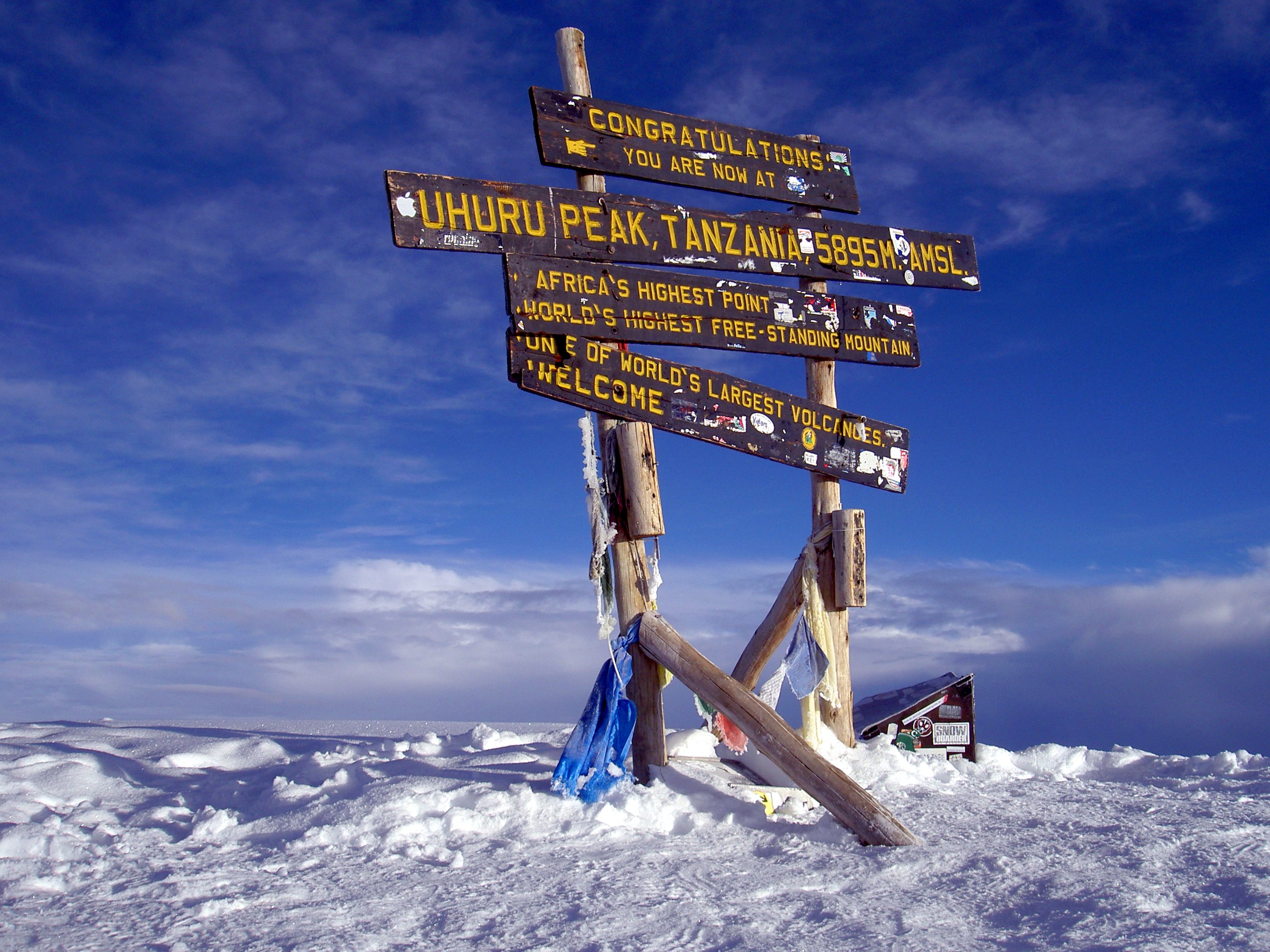
Mount Kilimanjaro rises out of the Tanzanian savanna to 5,895 meters, or 19,341 feet, at Uhuru Peak, making it both the highest point on the African continent and, by the usual geological definition, the tallest free-standing mountain in the world. Unlike Everest or the peaks of the Andes, Kilimanjaro is not part of a mountain range pushed up by colliding tectonic plates. It is a solitary stratovolcano that grew skyward on its own, formed by three distinct volcanic cones, Kibo, Mawenzi and Shira, that erupted along the same rift roughly 750,000 to 1 million years ago. Kibo, the youngest and tallest of the three, holds Uhuru Peak at its rim. Mawenzi and Shira are extinct, but Kibo is still classified as dormant rather than extinct, with fumaroles venting gas near its summit crater.
The summit’s name reflects Tanzania’s own history rather than the mountain’s geology. When the trust territory of Tanganyika gained independence from Britain in December 1961, the peak was renamed Uhuru, Swahili for “freedom,” in honor of the occasion. That renaming came 72 years after the first recorded ascent, made in October 1889 by the German geographer Hans Meyer and the Austrian mountaineer Ludwig Purtscheller, guided by a local porter, Yohani Kinyala Lauwo, whose contribution went largely uncredited for decades. Kilimanjaro’s summit was surveyed at its now-standard height by a British team in 1952, a figure that UNESCO and the Tanzania National Parks Authority still use today.
What has made Kilimanjaro a magnet for hikers, rather than a mountain reserved for technical climbers, is that its standard routes require no ropes or specialized climbing gear. Trekkers can walk to the summit along established paths such as the Marangu route, nicknamed the “Coca-Cola route” for its hut-based comfort, or the more scenic Machame, Lemosho and Rongai routes, typically over five to nine days. That accessibility is also the mountain’s biggest hazard: because climbers ascend nearly 4,000 meters in a matter of days, altitude sickness is common, and summit success rates on the shorter routes can run as low as 50 to 65 percent, improving significantly on longer itineraries that allow more time to acclimatize. Kilimanjaro National Park, which surrounds the peak, was declared a UNESCO World Heritage Site in 1987 in recognition of both the mountain’s scale and the unusual band of ecosystems climbers pass through en route to the top, from cultivated farmland and rainforest at the base, through moorland and alpine desert, to the glaciated summit zone.
Those summit glaciers, once a defining image of Kilimanjaro, have shrunk dramatically over the past century, with studies estimating the ice fields have lost more than 80 percent of their area since the late 1800s and could disappear entirely within decades, a trend scientists attribute to a combination of reduced snowfall, rising temperatures and sublimation. For now, Kilimanjaro remains what it has been for well over a century: the highest, most climbable of the world’s great solitary summits, and a defining symbol of Tanzania itself.
Sources
Books & Further Reading
Michel Moushabeck and Hiltrud Schulz, Kilimanjaro: A Photographic Journey to the Roof of Africa (Interlink Books, 2022, ISBN 9781623718282)