Published
Jaafar Nimeiry: Sudan's Coup-Prone Ruler, 1969-1985
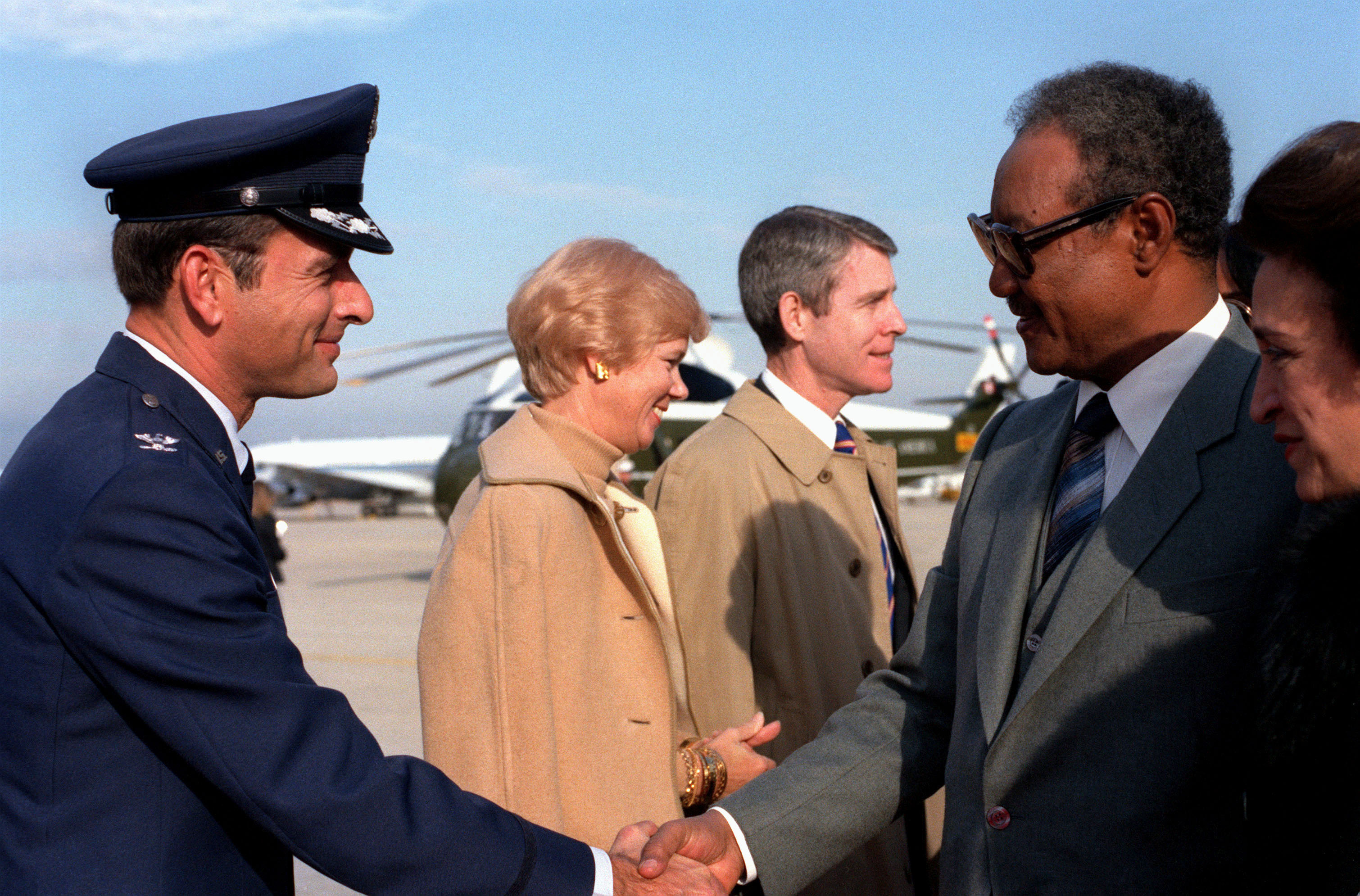
Colonel Gaafar Muhammad Nimeiry came to power on May 25, 1969, when he and a group of fellow “Free Officers” overthrew the elected civilian government of Prime Minister Ismail al-Azhari in what became known as the May Revolution. The coup was timed while Sudan’s most senior military officers were out of the country, and Nimeiry, commanding the Khartoum garrison, moved quickly to install himself as chairman of a new Revolutionary Command Council before later becoming president outright.
His sixteen years in power were exceptionally turbulent, even by the standards of the region’s frequent postcolonial upheavals. Nimeiry began his rule aligned with the political left, working closely with Sudanese communists, but broke violently with them after a 1971 coup attempt backed by Communist Party members briefly removed him from power before he was restored within days, after which he executed much of the party’s civilian leadership. He then pivoted toward a more Western-aligned, Arab nationalist posture through most of the 1970s, reaching a 1972 peace agreement that temporarily ended Sudan’s first civil war with the south.
Nimeiry’s government faced repeated attempts to remove him by force throughout the 1970s and into the 1980s, from disaffected officers, exiled opposition figures, and rival factions; accounts of the period commonly put the total number of coup attempts against him at twenty-two, a widely repeated figure in popular retellings of his rule, though it is not a number derived from a single official tally and should be read as an approximate, oft-cited count rather than a precisely documented one. Among the more serious were a 1975 attempt by Communist-aligned officers, crushed within hours, and a bloodier 1976 Libyan-backed attempt in which Nimeiry narrowly avoided capture when his returning flight landed ahead of schedule.
In September 1983, seeking to shore up support among Islamist constituencies, Nimeiry imposed a strict version of Sharia law nationwide through what became known as the September Laws, introducing punishments such as amputation for theft and public flogging for alcohol consumption. The move, combined with worsening economic conditions, a renewed civil war in the south, and the execution of a prominent liberal theologian who opposed the new legal code, triggered a wave of civil disobedience and mass protests by early 1985.
On April 6, 1985, while Nimeiry was in Washington, D.C., seeking further American financial aid, his own defense minister, General Abdel Rahman Swar al-Dahab, led a bloodless military coup that ended his rule for good. Nimeiry went into exile in Egypt, where he remained until returning to Sudan in 1999; he ran unsuccessfully in Sudan’s 2000 presidential election and died in Khartoum in 2009.
Sources
- Peter Woodward, 'Is the Sudan Governable? Some Thoughts on the Experience of Liberal Democracy and Military Rule,' Bulletin (British Society for Middle Eastern Studies), 1986 (JSTOR)
- The New York Times — Sudan's President Is Ousted in Coup by Military Chief
- Face2Face Africa — The little-known Sudanese leader who survived 22 coup plots in the 1970s
Books & Further Reading
Peter Woodward, Sudan, 1898-1989: The Unstable State (Lynne Rienner Publishers, 1990)