Published
Herodotus on the Ethiopians and the 'Black' Indians
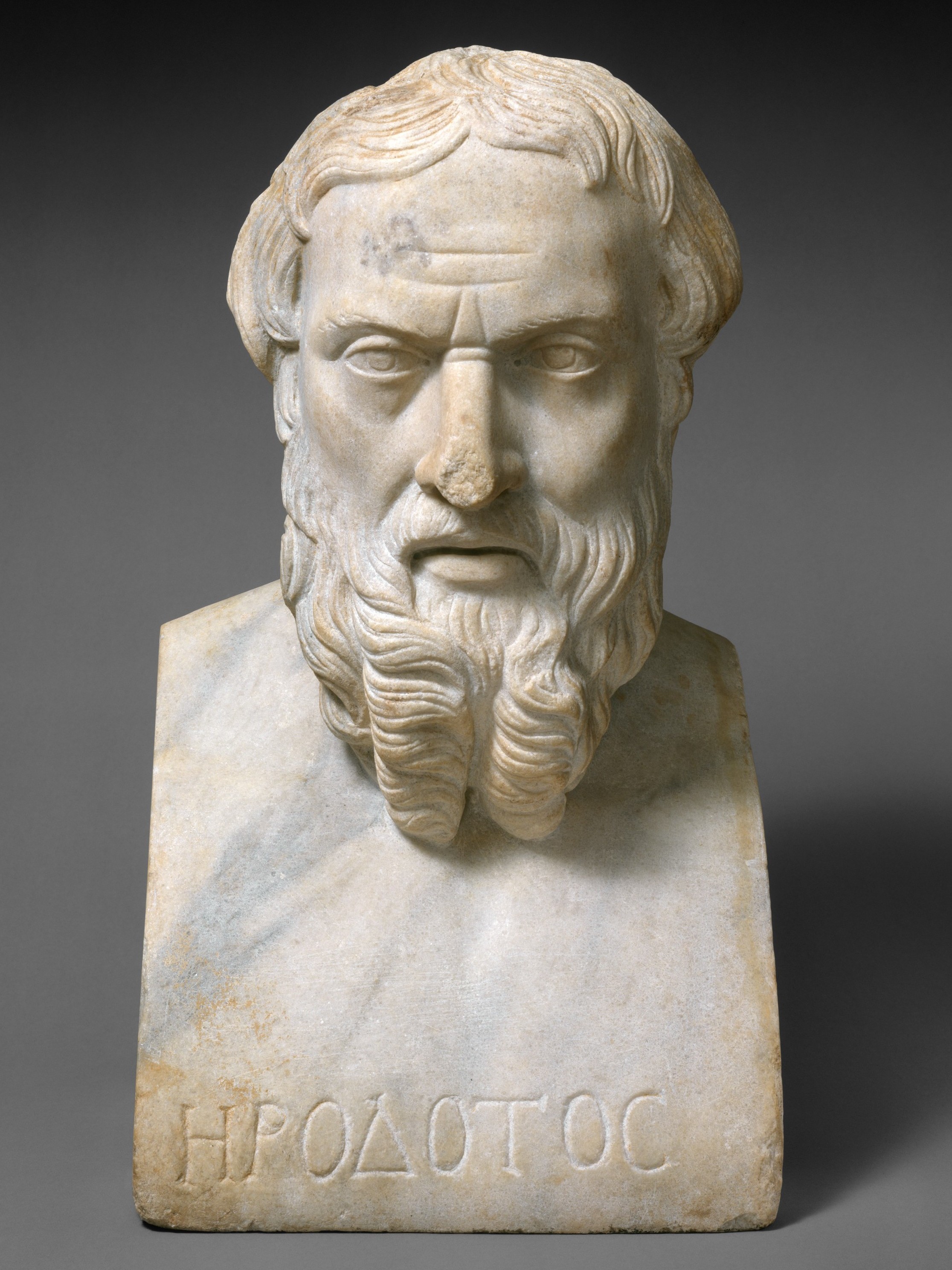
Herodotus of Halicarnassus, writing around the middle of the fifth century BC, is remembered as the “Father of History” for producing the first extended prose narrative in the Western tradition to treat the past as a subject worth investigating systematically rather than mythologizing. His Histories range across the known world of his day, from Egypt and Persia to Scythia and the Greek city-states, and in the process he offers some of the earliest surviving descriptions by any Greek writer of the physical characteristics of the peoples living south and east of the Mediterranean world.
In Book 7 of the Histories, cataloguing the vast array of peoples Xerxes I mustered for his invasion of Greece, Herodotus describes contingents of “Eastern Ethiopians” serving alongside Indian troops in the Persian army. He writes that these Eastern Ethiopians, from the region of India, looked just like the Ethiopians of Africa in their dark complexion, but differed in one specific respect: their hair was straight, not woolly. The African Ethiopians, by contrast, he describes elsewhere as having the woolliest hair of any people known to him. It is one of the earliest known instances of a classical author explicitly grouping distant populations together by skin color while distinguishing them by a separate physical trait, hair texture, which he attributes to climate and environment rather than lineage.
This needs a word of context. The Greek term “Ethiopian,” from aithiops, meaning roughly “burnt-faced,” was not a precise national or ethnic label the way it might read today. Ancient Greek writers used it broadly for dark-skinned peoples across a wide swath of Africa and, per Herodotus’s own account, parts of Asia as well. It did not map cleanly onto the modern country of Ethiopia, nor onto any single ethnic group. When Herodotus and later classical writers describe “Ethiopians,” they are typically referring to this broad and somewhat fluid Greek category rather than a specific, bounded population, which is part of why his descriptions of Egyptians, Nubians, and other sub-Saharan Africans sometimes use similar or overlapping language.
Herodotus’s other writings on Egypt, particularly in Book 2 of the Histories, known by the traditional title Euterpe, add further detail that later writers and modern commentators have pointed to when discussing how classical Greeks perceived the peoples of the Nile Valley. He notes there that the Colchians, a Caucasus people he believed were descended from Egyptian soldiers left behind by a legendary pharaoh’s campaign, were recognizably similar to Egyptians in having dark skin and woolly hair, which he offers as evidence, however anecdotal by modern standards, for a shared ancestry. Whatever the merits of that particular claim about the Colchians, the passage reflects the same descriptive vocabulary he used elsewhere: skin color and hair texture as the two main physical markers he reached for when distinguishing one ancient population from another.
None of this amounts to a scientific racial classification in any modern sense. Herodotus was a traveler and compiler of secondhand reports as much as an eyewitness, and his ethnographic passages mix careful observation with legend, rumor, and the occasional traveler’s tale that later scholarship has treated with skepticism. What his account does offer, reliably, is a window into how a well-traveled fifth-century BC Greek observer categorized human physical variation across three continents, using descriptive criteria, skin tone paired with hair type, that would recur in Western writing about race and physical anthropology for centuries afterward, for better and for worse.
Books & Further Reading
Herodotus, The Histories, trans. Tom Holland (Penguin Classics Deluxe Edition, 2013, ISBN 9780143107545)