Published
Freetown and the Founding of the Sierra Leone Creole People
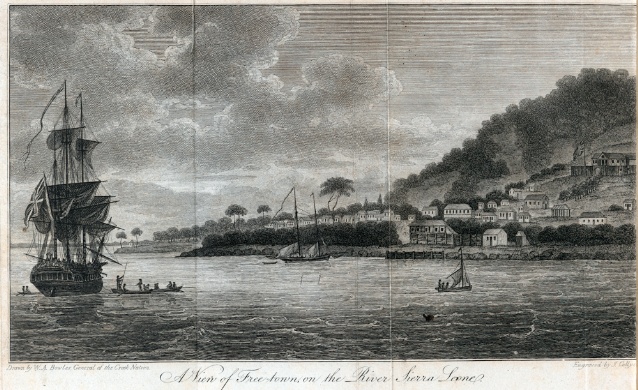
Freetown, the capital of Sierra Leone, was not founded as a colonial outpost in the ordinary sense. It was founded as a resettlement project for people the transatlantic slave system had already displaced once: free Black Britons, formerly enslaved Americans who had fought for the British Crown, Jamaican Maroons who had never submitted to British rule at all, and, later, tens of thousands of Africans pulled directly off intercepted slave ships. Their descendants became the Sierra Leone Creole people, known as the Krio, whose language today functions as the common tongue of a nation with more than a dozen distinct ethnic groups.
The first settlement dates to May 1787, when 411 so-called “Black Poor,” a mix of formerly enslaved African Americans, West Indians, and other Black Britons living in poverty in London, organized with backing from abolitionists including Granville Sharp, sailed to the Sierra Leone peninsula to found what they called the “Province of Freedom,” at a site they named Granville Town. The settlement struggled badly: disease, poor planning, and conflict with the local Koya Temne political authority who had granted the land devastated the population, and in 1789 the town was burned down entirely following a dispute with a local ruler. Only a small remnant of settlers survived to rebuild.
A far larger and more durable wave arrived in 1792, organized by the newly formed Sierra Leone Company under abolitionists including Thomas Clarkson and Henry Thornton, and led on the ground by naval officer John Clarkson. Roughly 1,200 Black Loyalists sailed from Halifax, Nova Scotia, where they had been resettled after the American Revolutionary War in exchange for their service to the British against the rebelling colonies, a promise of freedom that, in practice, had left many in Nova Scotia facing discrimination and unproductive land. These Nova Scotian settlers founded Freetown proper on March 11, 1792, giving the city its name. A third distinct group arrived in 1800: roughly 550 Jamaican Maroons, descendants of Africans who had escaped slavery in Jamaica and fought the British to a standoff for generations before being deported following a renewed conflict in the 1790s. They settled an area that became known as Maroon Town and brought their own military traditions and cultural practices into the growing colony.
The largest and most transformative wave came after 1807, when Britain outlawed the transatlantic slave trade and stationed a naval squadron off the West African coast to intercept ships still carrying captives illegally. The Royal Navy brought the people it rescued from these intercepted vessels to Freetown, where colonial authorities registered and resettled them as “liberated Africans”: over the following decades, this population numbered in the tens of thousands, drawn from a wide range of West and Central African ethnic groups including Yoruba, Igbo, Akan, and Kongo peoples. Unlike the earlier settler waves, most liberated Africans arrived directly from African societies rather than from the diaspora, and their integration into Freetown’s existing settler communities, through intermarriage, shared Christian institutions, and a common colonial administration, did as much as anything to shape the emerging Creole culture.
Out of these four distinct migrations, Black Poor, Nova Scotian Loyalists, Jamaican Maroons, and liberated Africans, emerged the Sierra Leone Creole people and their language, Krio, an English-based creole layered with vocabulary and grammatical influence from Yoruba, other West African languages, and the Caribbean creoles the Maroon settlers brought with them. Though Krios today make up only a small share of Sierra Leone’s population, a legacy of their historical position as the colony’s educated, Western-oriented elite, Krio itself became the country’s most widely spoken language, understood by the great majority of Sierra Leoneans regardless of ethnic background, a linguistic monument to a settlement built, uniquely, from the diaspora’s return to the very coast the slave trade had emptied.
Sources
Books & Further Reading
Arthur T. Porter, Creoledom: A Study of the Development of Freetown Society (Oxford University Press, 1963; reprint ISBN 9781015070936)